Digital Principles and Computer Organization: Chapter 8: Instruction Set Architecture and Control Unit Design
RISC Vs CISC Architecture
Questions: 1. Define the acronyms CISC and RISC. 2. What is the primary concept or goal each architecture is based on? 3. Compare and contrast CISC and RISC architectures.
RISC Vs CISC
•
Instruction Set Architectures can be broadly categorized into two types :
Complex Instruction Set Architecture (CISC) and Reduced Instruction Set
Architecture CHTE (RISC).
1. Complex Instruction
Set Architecture (CISC)
2. Reduced Instruction
Set Architecture CHTE (RISC)
1. CISC Architecture
•
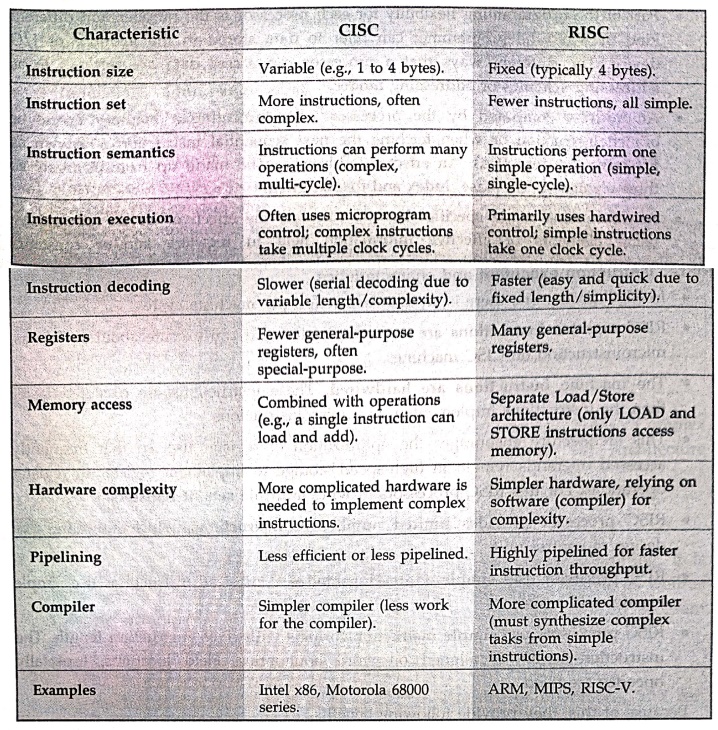
CISC is an acronym for Complex Instruction Set computers or computing. It is
based on the concept of using very large instruction set having simple as well
as complex instructions and making instruction set more flexible to keep
program length as small as possible.
•
In CISC complex instructions may take multiple cycles for execution.
•
CISC instructions vary in size, often specify a sequence of operations, and can
require serial (slow) decoding algorithms.
•
They tend to have few registers, and the registers may be special purpose,
which restrict the way in which they can be used.
•
In CISC, there are many instructions that support memory reference. For
example, we can add memory contents to the registers.
•
CISC instruction sets are designed to take advantage of microcode.
•
To add the flexibility in the instruction set, they support more and complex
addressing modes.
•
Example of CISCs are : Intel X86, Motorola 68000 series, DEC VAX, etc.
2. RISC Architecture
•
RISC refers to Reduced Instruction Set Computers or Computing. RISC
microprocessors are very different from CISC microprocessors. RISC use concept
of keeping the instruction set as simple as possible to allow the
microprocessor's program to be written using only simple instructions.
•
The designer designed RISC architecture considering following points :
1.
A limited and simple instruction set.
2.
A large number of general purpose registers, or the use of compiler technology
to optimize register usage.
3.
An emphasis on optimizing the instruction pipeline.
RISC : Instruction execution and characteristics
•
In RISC processors, there is an one
instruction per machine cycle.
•
RISC machine instructions are not
complicated and can execute about as fast as, microinstruction on CISC
machines.
•
The machine instructions are hardwired.
These instructions are executed faster than the instructions implemented with
microinstructions.
•
This architecture encourages the optimization of register use, so that
frequently accessed operands remain in high–speed storage to implement register
to register operations. For this RISC processors provide multiple sets of registers.
•
RISC processor provides limited number
of instructions, which simplifies the design of control unit.
•
RISC processor uses simple addressing
modes. Almost all instructions use simple register addressing.
•
RISC processors use simple instruction
formats with fixed instruction length. The instruction length is aligned on
word boundaries. Field locations, especially opcodes are fixed.
Because
of this, they provide following benefits :
•
With fixed fields, opcode decoding and register operands addressing can occur
simultaneously.
•
It simplifies the design of control unit.
•
Instruction fetching is optimized since word–length units are fetched.
To
speed–up instruction execution, RISC uses instruction pipelining.
•
Examples of RISCs are : ARM, ATMEL, 8051 family, AVR, MIPS, PIC etc.
3. CISC VS RISC Processor Architectures
Review Questions
1. Define the acronyms
CISC and RISC.
2. What is the primary
concept or goal each architecture is based on?
3. Compare and
contrast CISC and RISC architectures.
Digital Principles and Computer Organization: Chapter 8: Instruction Set Architecture and Control Unit Design : Tag: : - RISC Vs CISC Architecture
Digital Principles and Computer Organization: Chapter 8: Instruction Set Architecture and Control Unit Design
Under Subject
Digital Principles and Computer Organization
CS25C06 2nd Semester AIDS, CSE, IT, CSE(CY) Dept | 2025 Regulation | 2nd Semester 2025 Regulation
Related Subjects
English Essentials II
EN25C02 2nd Semester | 2025 Regulation | 2nd Semester 2025 Regulation
Tamils and Technology தமிழர்களும் தொழில்நுட்பமும்
UC25H02 2nd Semester | 2025 Regulation | 2nd Semester 2025 Regulation
Linear Algebra
MA25C02 2nd Semester | 2025 Regulation
Applied Physics (CSIE) II
PH25C03 2nd Semester AIDS, CSE, IT, CSE(CY) Dept | 2025 Regulation | 2nd Semester 2025 Regulation
Digital Principles and Computer Organization
CS25C06 2nd Semester AIDS, CSE, IT, CSE(CY) Dept | 2025 Regulation | 2nd Semester 2025 Regulation

Basic Electrical and Electronics Engineering
EE25C01 2nd Semester | 2025 Regulation | 2nd Semester 2025 Regulation
Python for Data Science
AD25201 2nd Semester AIDS Dept | 2025 Regulation | 2nd Semester 2025 Regulation

Re-Engineering for Innovation
ME25C05 2nd Semester | 2025 Regulation | 2nd Semester 2025 Regulation
Python for Data Science - Laboratory
AD25201 2nd Semester AIDS Dept | 2025 Regulation | 2nd Semester 2025 Regulation