Data Structures using C PlusPlus: Chapter 4: Stacks and Queues
Stacks: Arithmetic Expressions
Data Structures using C++ Program
Questions: 1. With examples explain how a stack can be used to convert an infix expression to a postfix expression. 2. Explain the applications of stack in detail. 3. Explain the process of conversion from infix expression to postfix using stack.
Arithmetic
Expressionsang
•
There are three types of expressions :
1. Infix Expression
2. Postfix Expression
3. Prefix Expression
One
of the application of stack is conversion of expression. First of all, let us
see these expressions with the help of examples.
1. Infix Expression :
In
this type of expressions the arrangement of operands and operator is as
follows.
Postfix
expression = Operand1 operand operator
For
example
1.
(a+b)
2.
(a+b) * (c ‒ d)
3.
(a+b/e) * (d+f)
Parenthesis
can be used in these expressions infix expression are the most natural way of
representing the expressions.
2. Postfix Expression :
In
this type of expressions the arrangement of operands and operator is as follows
Infix
Expression = operand1 operator operand2
For
example
1.
ab+
2.
ab + cd ‒ *
3.
ab + e/df + *
In
postfix expression there is no parenthesis used. All the corresponding operands
come first and then operator can be placed.
3. Prefix Expression :
In
prefix expression the arrangement of operands and operators is as follows.
Prefix
expression = Operator operand1 operand2
For
example
1.
+ ab
2.
*+ ab ‒ cd
3.
*/ +abe+df
In
prefix expression, there is no parenthesis used. All the corresponding
operators come first and then operands are arranged.
Conversion from Infix to Postfix Expression
•
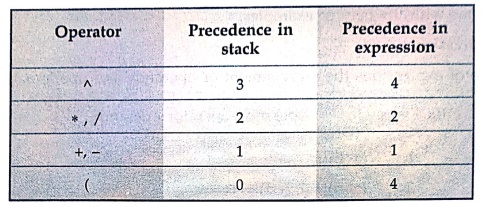
The most important thing in the conversion procedure is to know the priorities
of the operators being used in it. This helps in determining the order of
evaluation of operands.
•
There are certain rules which has to be followed while coverting infix
expression to postfix form :
1.
The expression is to be read from left to right.
2.
Read one character at a time from infix expression.
3.
Make use of stack to store the operators.
4.
There should not be any parenthesis in the postfix form.
Let
us see an algorithm for it.
Algorithm for conversion of infix to postfix form:
1.
Read the expression from left to right.
2.
If the input symbol read is '(' then push it onto the stack.
3.
If the input symbol read is an operand then place it in postfix expression.
4.
If the input symbol read is an operator then
a)
Check if the precedence of the operator which is in the stack has greater
precedence than the precedence of the operator read, if so then remove that
symbol from stack and place it in the postfix expression. Repeat step 4
(a)
till you get the operator in the stack has greater precedence than the operator
being read.
b)
Otherwise push the operator being read onto the stack.
5.
If the input symbol read is a closing parenthesis ')' then pop all the
operators from the stack, place them in postfix expression till the opening
parenthesis is not popped. The '(' should not be place in the postfix
expression.
6.
Finally print the postfix expression.
Let
us see the procedure with some examples.
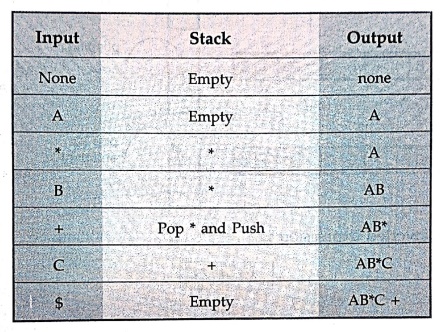
Example :
A*B + C $
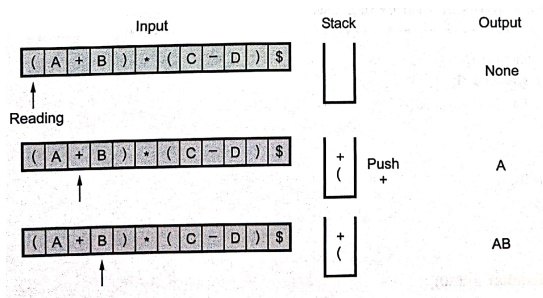
Example :
When
closing parenthesis comes pop everything and print except '('.
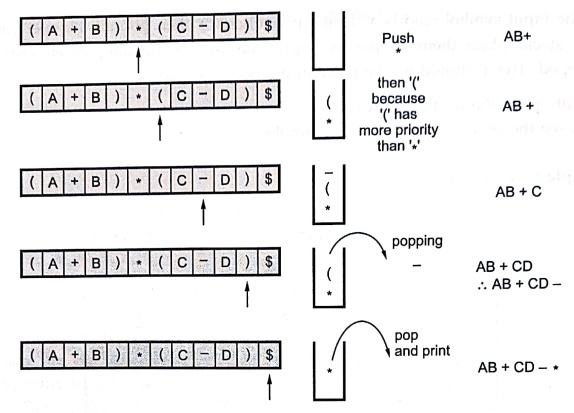
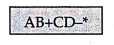
So
finally the converted expression is
AB+CD ‒ *
C++
Program
/**************************************************************************
Program for conversion of Infix expression to Postfix form.
***************************************************************************/
#include<iostream>
using namespace std;
class EXP
{
private:
char post[40];
int top,st[20];
public:
EXP();
void postfix(char inf[40]);
void push(int);
char pop();
};
EXP::EXP()
{
top = 0;
}
/*
‒‒‒‒‒‒‒‒‒‒‒‒‒‒‒‒‒‒‒‒‒‒‒‒‒‒‒‒‒‒‒‒‒‒‒‒‒‒‒‒‒‒‒‒‒‒‒‒‒‒‒‒‒‒‒‒‒‒‒‒‒‒‒‒‒‒‒‒‒‒‒‒‒‒‒‒‒‒‒‒‒‒‒‒‒‒‒‒
Postfix function
‒‒‒‒‒‒‒‒‒‒‒‒‒‒‒‒‒‒‒‒‒‒‒‒‒‒‒‒‒‒‒‒‒‒‒‒‒‒‒‒‒‒‒‒‒‒‒‒‒‒‒‒‒‒‒‒‒‒‒‒‒‒‒‒‒‒‒‒‒‒‒‒‒‒‒‒‒‒‒‒‒‒‒‒‒‒‒
*/
void EXP: postfix(char inf[40])
{
int i,j=0;
for(i=0;inf[i]!='\0';i++)
{
switch(inf[i])
{
case '+': while
(st[top] >= 1)
post[j++] = pop();
push(1);
break;
case '‒' : while(st[top]
>= 1)
post[j++]
= pop();
push(2);
break;
case '*': while(st[top]
>= 3)
postlj++] = pop();
push(3);
break;
case '/' : while(st[top]
>= 3)
post[j++]= pop();
push(4);
break;
case '˄' :
while(st[top] >= 4)
postlj++] = pop();
push(5);
break;
case '(' : push(0);
break;
case ')': while(st[top]
= 0)
post[j++] = pop();
top‒‒;
break;
default: post [j++]
= inf[i];
}
}
while(top>0)
post[i++] = pop();
cout<<"\n\tPostfix expression is =>\n\n\t\t
"<<post;
}
/*
‒‒‒‒‒‒‒‒‒‒‒‒‒‒‒‒‒‒‒‒‒‒‒‒‒‒‒‒‒‒‒‒‒‒‒‒‒‒‒‒‒‒‒‒‒‒‒‒‒‒‒‒‒
Push function
‒‒‒‒‒‒‒‒‒‒‒‒‒‒‒‒‒‒‒‒‒‒‒‒‒‒‒‒‒‒‒‒‒‒‒‒‒‒‒‒‒‒‒‒‒‒‒‒‒‒‒‒
*/
void EXP::push(int ele)
{
top++;
st[top] = ele;
}
/*
‒‒‒‒‒‒‒‒‒‒‒‒‒‒‒‒‒‒‒‒‒‒‒‒‒‒‒‒‒‒‒‒‒‒‒‒‒‒‒‒‒‒‒‒‒‒‒‒‒‒‒‒‒‒‒‒
pop Function
‒‒‒‒‒‒‒‒‒‒‒‒‒‒‒‒‒‒‒‒‒‒‒‒‒‒‒‒‒‒‒‒‒‒‒‒‒‒‒‒‒‒‒‒‒‒‒‒‒‒‒‒‒‒‒‒‒
*/
char EXP::pop()
{
int el;
char e;
el = st[top];
top‒‒;
switch(el)
{
case 1: e = '+';
break;
case 2: e = '‒';
break;
case 3: e = '*',
break;
case 4: e = '/ ';
break;
case 5: e='˄';
break;
}
return(e);
}
void main(void)
{
EXP obj;
char inf[40];
clrscr();
cout<<"\n\tEnter
the infix expression :: \n";
cin>>inf;
cout<<"The
infox expression entered by you is..."<<inf;
obj.postfix(inf);
getch();
}
Output
Enter the infix
expression ::
(a+b)*(c‒d)
The infox expression
entered by you is...(a+b)*(c‒d)
Postfix expression is
=>
ab+cd‒*
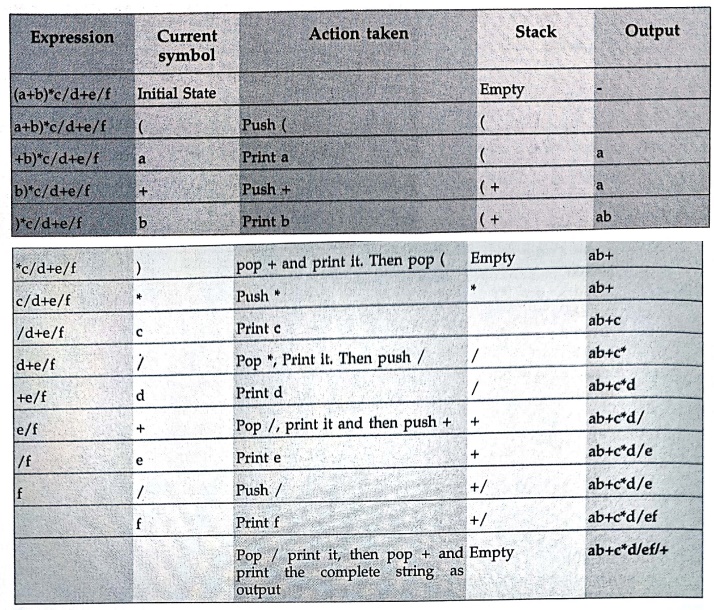
Example: 1
Write an algorithm to
convert an infix to postfix expression Trace the algorithm to convert the infix
expression "(a+b)*c/d+e/f" to a postifx expression. Explain the need
for infix and postfix expressions.
Solution :
Need for infix and postfix expressions :
The
infix expressions are used in mathematical expressions and postfix expressions
are used in compilers for checking the syntax of an expression. The postfix
expressions are also used in evaluating the expressions.
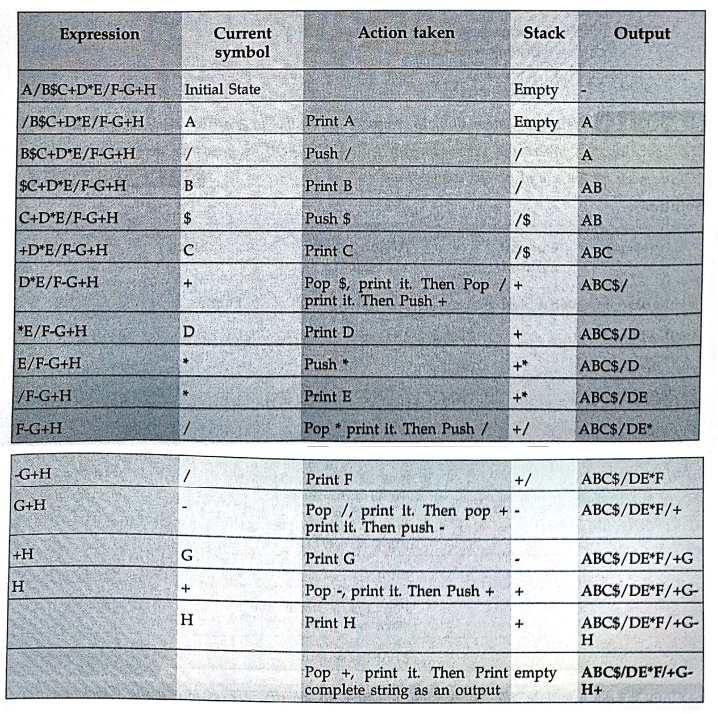
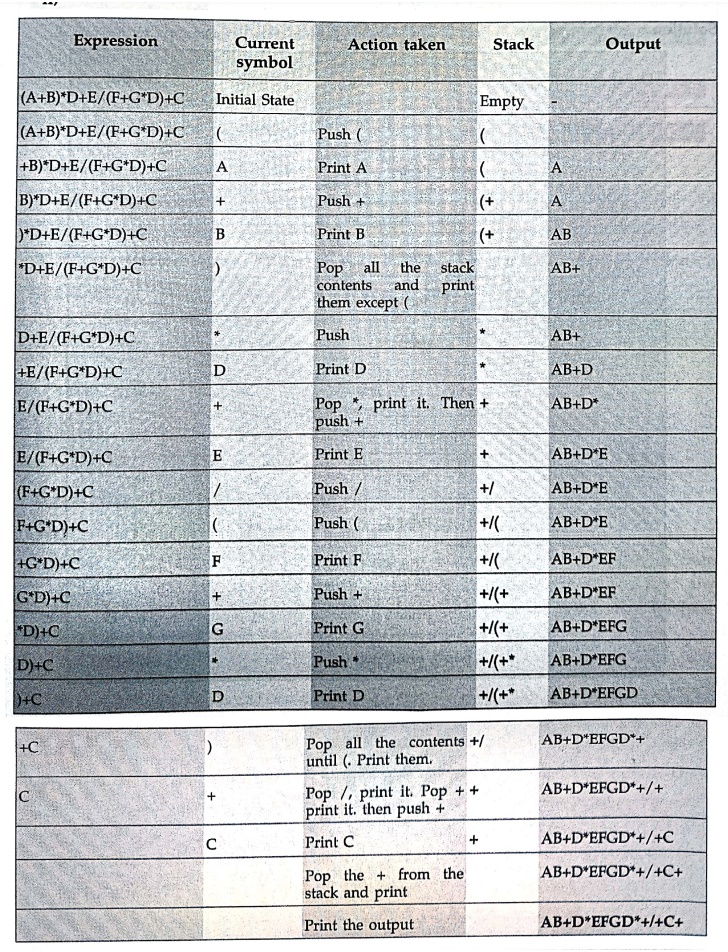
Example: 2
Convert the following
infix expression to the postfix expression. Show stack traces.
i) A/B$C+D*E/F‒G+H
ii)
(A+B)*D+E/(F+G*D)+C.
Solution: i)
ii)
Example: 3
Simulate the conversion
of infix to postfix expression using stack for the following expression : 3 ‒ (4/2)
+ (1*5) + 6.
Solution:
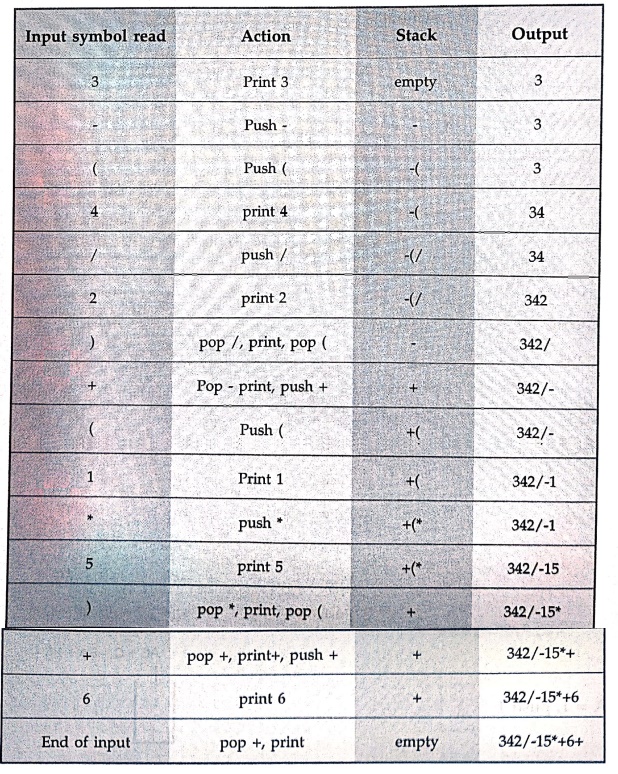
The
equivalent postfix expression is 342/‒15*+6+
Review Questions
1. With examples
explain how a stack can be used to convert an infix expression to a postfix
expression.
2. Explain the
applications of stack in detail.
3. Explain the process
of conversion from infix expression to postfix using stack.
Data Structures using C PlusPlus: Chapter 4: Stacks and Queues : Tag: Data Structure, C++ Programing : Data Structures using C++ Program - Stacks: Arithmetic Expressions
Data Structures using C PlusPlus: Chapter 4: Stacks and Queues
Under Subject
Data Structures using CPlusPlus
CS25C05 2nd Semester ECE Dept | 2025 Regulation | 2nd Semester 2025 Regulation
Related Subjects

English Essentials II
EN25C02 2nd Semester | 2025 Regulation | 2nd Semester 2025 Regulation

Tamils and Technology தமிழர்களும் தொழில்நுட்பமும்
UC25H02 2nd Semester | 2025 Regulation | 2nd Semester 2025 Regulation
Linear Algebra
MA25C02 2nd Semester | 2025 Regulation

Electron Devices
EC25C01 2nd Semester ECE Dept | 2025 Regulation | 2nd Semester 2025 Regulation
Data Structures using CPlusPlus
CS25C05 2nd Semester ECE Dept | 2025 Regulation | 2nd Semester 2025 Regulation

Circuits and Network Analysis
EC25C02 2nd Semester ECE Dept | 2025 Regulation | 2nd Semester 2025 Regulation

Re-Engineering for Innovation
ME25C05 2nd Semester | 2025 Regulation | 2nd Semester 2025 Regulation
Engineering Drawing - Laboratory
ME25C01 2nd Semester | 2025 Regulation | 2nd Semester 2025 Regulation
Data Structures using CPlusPlus - Laboratory
CS25C05 2nd Semester ECE Dept | 2025 Regulation | 2nd Semester 2025 Regulation
Devices and Circuits Laboratory
EC25C03 2nd Semester ECE Dept | 2025 Regulation | 2nd Semester 2025 Regulation