Data Structures using C PlusPlus: Chapter 4: Stacks and Queues
Representation of Stack using Arrays
Data Structures using C++ Program
Questions: 1. Explain the ADT operations for array implementation of stack. 2. Write C++ program to implement stack and its operations PUSH and POP. 3. Explain the operations preformed by stack in detail. Write a C++ program to implement these operations. 4. Write the ADT operation for insertion and deletion routine in stack.
Representation
of Stack using Arrays
Declaration 1:
#define
size 100
int
stack[size], top = ‒1;
•
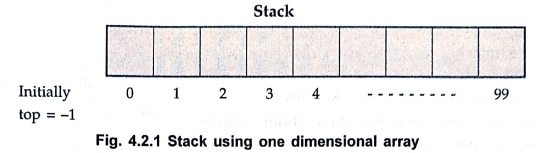
In the above declaration stack is nothing but an array of integers. And most
recent index of that array will act as a top.
•
The stack is of the size 100. As we insert the numbers, the top will get
incremented. The elements will be placed from 0th position in the
stack. At the most we can store 100 elements in the stack, so at the most last
element can be at (size ‒1) position, i.e., at index 99.
Declaration 2 :
#define size 10
struct stack
{
int s[size];
int top;
}st;
•
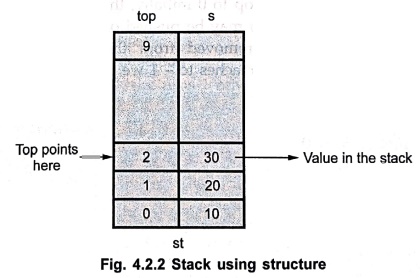
In the above declaration stack is declared as a structure.
•
Now compare declaration 1 and 2. Both are for stack declaration only. But the
second declaration will always preferred. Why ? Because in the second
declaration we have used a structure for stack elements and top. By this we are
binding or co‒relating top variable with stack elements. Thus top and stack are
associated with each other by putting them together in a structure. The stack
can be passed to the function by simply passing the structure variable.
•
We will make use of the second method of representing the stack in our program.
•
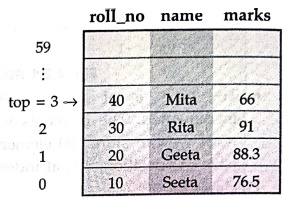
The stack can also be used in the databases. For example if we want to store
marks of all the students of fourth semester we can declare a structure of
stack as follows.
#define size 60
typedef struct student
{
int roll no;
char name[30];
float marks;
}stud;
stud s1[size];
int top = ‒1;
•
The above stack will look like this.
•
Thus we can store the data about whole class in our stack. The above
declaration means creation of stack. Hence we will write only push and pop
function to implement the stack. And before pushing or popping we should check
whether stack is empty or full.
Key Point
If top =
MAXSIZE means stack full.
1. Stack Empty Operation
•
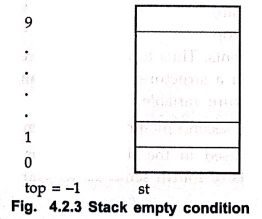
Initially stack is empty. At that time the top should be initialized to 1 or 0.
If we set top to ‒ 1 initially then the stack will contain the elements from 0th
position and if we set top to 0 initially, the elements will be stored from 1st
position, in the stack. Elements may be pushed onto the stack and there may be
a case that all the elements are removed from the stack. Then the stack becomes
empty. Thus whenever top reaches to ‒1 we can say the stack is empty.
int stempty ()
{
if(st.top = = ‒1)
return 1;
else
return 0:
}
Key Point
If top = ‒
1 means stack empty.
2. Stack Full Operation
•
In the representation of stack using arrays, size of array means size of stack.
As we go on inserting the elements the stack gets filled with the elements. So
it is necessary before inserting the elements to check whether the stack is
full or not. Stack full condition is achieved when stack reaches to maximum
size of array.
int stfull()
{
if(st.top > = size ‒1)
return 1;
else
return 0;
}
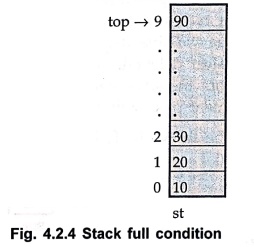
Thus
stfull is a Boolean function if stack is full it returns 1 otherwise it returns
0.
3. The 'Push' and 'Pop' Functions
•
We will now discuss the two important functions which are carried out on a
stack. Push is a function which inserts new element at the top of the stack.
The function is as follows.
void push(int item)
{
st.top++;
st.s[st.top] =item;
}
•
Note that the push function takes the parameter item which is actually the element
which we want to insert into the stack ‒ means we are pushing the element onto
the stack. In the function we have checked whether the stack is full or not, if
the stack is not full then only the insertion of the element can be achieved by
means of push operation.
•
Now let us discuss the operation pop, which deletes the element at the top of
the stack. The function pop is as given below.
•
Note that always top element can be deleted.
int pop ()
}
int item;
item = st.s[st.top];
st.top ‒ ‒;
return (item);
}
•
In the choice of pop‒ it invokes the function 'stempty' to determine whether
the stack is empty or not. If it is empty, then the function generates an error
as stack underflow! If not, then pop function returns the element which is at
the top of the stack. The value at the top is stored in some variable as item
and it then decrements the value of the top, which now points to the element
which is just under the element being retrieved from the stack. Finally it
returns the value of the element stored in the variable item. Note that this is
what called as logical deletion and not a physical deletion, i.e. even when we
decrement the top, the element just retrieved from the stack remains there
itself, but it no longer belongs to the stack. Any subsequent push will
overwrite this element.
•
The push operation can be shown by following Fig. 4.2.5.
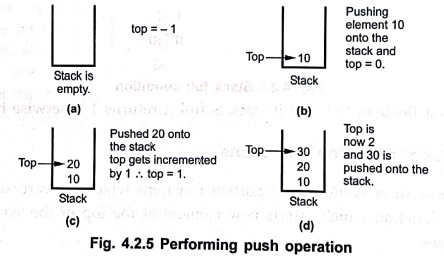
The
pop operation can be shown by following Fig. 4.2.6.
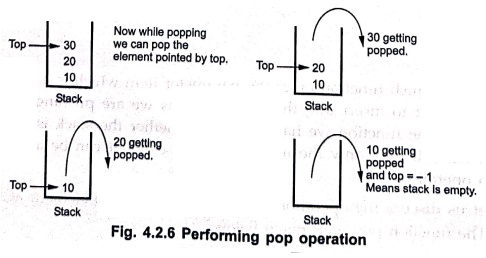
Key Point
If stack
is empty, then we cannot pop and if stack is full we cannot push.
4. Stack ADT
•
The stack is a data structure which posses the LIFO property. When we declare
the structure for stack at that time it gets created. There is no need to write
separate function for creation of stack. We can perform push and pop operations
on the stack. Before pushing the elements it is necessary to check whether
stack is full or not. We cannot push the elements onto the stack if it is full.
Similarly before popping the elements we should check whether the stack is
empty or not.
AbstractDataType Stack
{
Instances :
Stack is a collection of elements in which insertion and deletion of elements
is done by one end called top.
Operations
1. Push :
By this operation one can push elements onto the stack. Before performing push
we should check whether stack is full or not.
2. Pop :
By this operation one can remove the elements from stack. Before popping the
elements from stack we should check whether stack is empty or not.
}
C++ Program
/**************************************************************************
Program for implementing a stack using arrays.It involves various
operations such as push,pop,stack empty,stack full and display.
**************************************************************************/
#include<iostream>
#include<cstdlib>
using namespace std;
#define size 5
/* stack structure*/
class STACK_CLASS
{
private:
struct stack
{
int s[size];
int top;
}st;
public:
STACK _CLASS();
int stfull();
void push(int item);
int stempty();
int pop();
void display();
};
//constructor is used to initialise stack
STACK_CLASS::STACK_CLASS()
{
st.top= ‒1;
for(int
i=0;i<size;i++)
st.s[i]=0;
}
int STACK_CLASS::stfull()
{
if(st.top> = size‒1)
return 1;
else
return 0;
}
void STACK _CLASS::push(int item)
{
st.top++;
st.s[st.top] = item;
}
/*
The stempty Function
Input:none
Output:returns 1 or 0 for stack empty or not
Called By:main
Calls:none
*/
int STACK_CLASS::stempty()
{
if(st.top= = ‒1)
return 1;
else
return 0;
}
int STACK_CLASS::pop()
{
int item;
item=st.s[st.top];
st.top ‒ ‒ ;
return(item);
}
void STACK_CLASS::display()
{
int i;
if(stempty())
cout<<"\n
Stack Is Empty!";
else
{
for(i=st.top;i>=0;i
‒ ‒)
cout<<"\n"<<<st.s[i];
}
}
/*
The main Function
Input:none
Output:none
Called By:O.S.
Calls:push,pop,stempty,stfull,display
*/
void main(void)
{
int item,choice;
char ans;
STACK CLASS obj;
clrscr();
cout<<"\n\t\t Implementation Of Stack";
do
{
cout<<"\n
Main Menu";
cout<<"\n1.Push\n2.Pop\n3.Display\n4.exit";
cout<<"\n
Enter Your Choice: ";
cin>>choice;
switch(choice)
{
case
1:cout<<"\n Enter The item to be pushed":
cin>>item;
if(obj.stfull())
cout<<"\n Stack is
Full!";
else
obj.push(item);
break;
case
2:if(obj.stempty())
cout<<"\n Empty
stack/Underflow II";
else
{
item=obj.pop();
cout<<"\n The popped element
is "<<item;
}
break;
case
3:obj.display();
break;
case 4:exit(0);
}
cout<<"\n Do You want To Continue?";
ans=getche();
} while(ans = =Y ||ans = =y);
getch();
}
/**************** End Of Program *********************/
Output
Implementation Of
Stack
Main Menu
1.Push
2.Pop
3.Display
4.exit
Enter Your Choice: 1
Enter The item to be
pushed 10
Do You want To
Continue?y
Main Menu
1.Push
2.Pop
3.Display
4.exit
Enter Your Choice: 1
Enter The item to be
pushed 20
Do You want To
Continue?y
Main Menu
1.Push
2.Pop
3.Display
4.exit
Enter Your Choice: 1
Enter The item to be
pushed 30
Do You want To
Continue?y
Main Menu
1.Push
2.Pop
3.Display
4.exit
Enter Your Choice: 2
The popped element is
30
Do You want To
Continue?y
Main Menu
1.Push
2.Pop
3.Display
4.exit
Enter Your Choice: 3
20
10
Example: 1
Define an efficient
representation of two STACKS in a given area of memory with n words and
explain.
OR
Write a set of routines
for implementing two stacks within a single array.
Solution :
The
two stacks can be adjusted in a single array with n words as shown below ‒
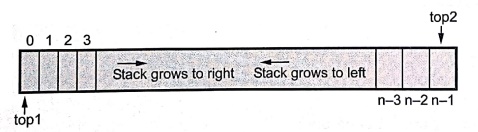
One
stack starts at the leftmost end of array and the other at the rightmost end of
array. The insertion in stack1 moves top1 to right while insertion in stack2
moves top2 to left. When the stack is full both the top1 and top2 positions are
adjacent to each other. The advantage of this location is that every location
of the array can be utilized. The implementation routines are ‒
#define MAX 80
class STACK
{
private:
int stack[MAX];
int top1, top2,n,stackno;
public:
void push(int,int);
int pop(int);
STACK();
};
STACK::STACK()//constructor defined for initialization
{
top1=‒1;
top2=n;
stackno=1;
}
void STACK::push(int item, int stackno)
{
if(stackno= =1)
{
//pushing in stack1/
if(top1+1==top2)
cout<<"stack1
is full";
top++;
stack[top1] = item; /
pushing element /
}
else
{
if(top2‒1= = top1)
cout<<"stack2
is full":
top1‒ ‒; / pushing
element in stack2/
stack[top2]=item;
}
int STACK::pop(int stackno)
{
int item;
if(stackno= =1)
{
if (top1= = ‒1)
cout<<"stack1
is empty";
item=stack[top1];
top1++;
return(item);
}
else
{
if(top2= =MAX)
cout<<"stack2
is empty";
item=stack/top2];
top2‒‒;
return(item);
}
}
Example: 2
Split a stack into two.
The first contains bottom half elements and the second contains the remaining
elements.
Solution :
#include<iostream>
#include<cstdlib>
using namespace std;
#define size 5
/* stack structure*/
class STACK _CLASS
{
public:
struct stack
{
int s[size];
int top;
}st;
STACK CLASS();
int stfull();
void push(int item);
int stempty();
void display();
void split();
};
//constructor is used to initialise stack
STACK_ CLASS::STACK_CLASS()
{
st.top= ‒1;
for(int
i=0;i<size;i++)
{
st.s[i]=0;
}
}
int STACK_ CLASS::stfull()
{
if(st.top>=size‒1)
return 1;
else
return 0;
}
void STACK_CLASS::push(int item)
{
st.top++;
st.s[st.top] = item;
}
int STACK CLASS::stempty()
{
if(st.top = = ‒1)
return 1;
else
return 0;
}
void STACK_CLASS::display()
{
int i;
if(stempty())
cout<<"\n
Stack Is Empty!";
else
{
for(i=st.top;i>=0;i‒‒)
cout<<"\n"<<st.s[i];
}
}
void STACK_CLASS::split()
{
int i,j,top1,top2;
int s1[size],s2[size];
top1=0;
top2‒st.top/2;
for(i=0;i<=top2;i++)
s1[i]=st.s[i];
int k=0;
for(j=top2+1;j<=st.top;j++)
{
s2[k]=st.s[j];
k++;
}
cout<<"\n\t
Content of stack1 are...\n";
for(i=top1;i<=top2;i++)
cout<<"
"<<s1[i];
cout<<"\n\t
Content of stack2 are...\n";
for(i=0;i<=k‒1;i++)
cout<<" "<<s2[i];
}
void main(void)
{
STACK CLASS obj;
int item,choice;
char ans;
cout<<"\n\t\t Implementation Of Stack";
do
{
cout<<"\n Main
Menu";
cout<<"\n1.Push\n2.Display\n3.Split\n4.exit";
cout<<"\n
Enter Your Choice: ";
cin>>choice;
switch(choice)
{
case
1:cout<<"\n Enter The item to be pushed ";
cin>>item;
if(obj.stfull())
cout<<"\n
Stack is Fulll";
else
obj.push(item);
break;
case 2:obj.display();
break;
case 3:obj.split();
break;
case 4:exit(0);
}
cout<<"\n Do You want To Continue?";
cin>>ans;
}while(ans = ='Y' || ans = ='y');
getch();
}
Output
Implementation Of
Stack
Main Menu
1.Push
2.Display
3.Split
4.exit
Enter Your Choice: 1
Enter The item to be
pushed 11
Do You want To
Continue?y
Main Menu
1.Push
2.Display
3.Split
4.exit
Enter Your Choice: 1
Enter The item to be
pushed 22
Do You want To
Continue?y
Main Menu
1.Push
2.Display
3.Split
4.exit
Enter Your Choice: 1
Enter The item to be
pushed 33
Do You want To
Continue?y
Main Menu
1.Push
2.Display
3.Split
4.exit
Enter Your Choice: 3
Content of stack1
are...
11 22
Content of stack2
are...
33
Do You want To
Continue?
Review Questions
1. Explain the ADT
operations for array implementation of stack.
2. Write C++ program
to implement stack and its operations PUSH and POP.
3. Explain the
operations preformed by stack in detail. Write a C++ program to implement these
operations.
4. Write the ADT
operation for insertion and deletion routine in stack.
Data Structures using C PlusPlus: Chapter 4: Stacks and Queues : Tag: Data Structure, C++ Programing : Data Structures using C++ Program - Representation of Stack using Arrays
Data Structures using C PlusPlus: Chapter 4: Stacks and Queues
Under Subject
Data Structures using CPlusPlus
CS25C05 2nd Semester ECE Dept | 2025 Regulation | 2nd Semester 2025 Regulation
Related Subjects

English Essentials II
EN25C02 2nd Semester | 2025 Regulation | 2nd Semester 2025 Regulation

Tamils and Technology தமிழர்களும் தொழில்நுட்பமும்
UC25H02 2nd Semester | 2025 Regulation | 2nd Semester 2025 Regulation
Linear Algebra
MA25C02 2nd Semester | 2025 Regulation

Electron Devices
EC25C01 2nd Semester ECE Dept | 2025 Regulation | 2nd Semester 2025 Regulation
Data Structures using CPlusPlus
CS25C05 2nd Semester ECE Dept | 2025 Regulation | 2nd Semester 2025 Regulation

Circuits and Network Analysis
EC25C02 2nd Semester ECE Dept | 2025 Regulation | 2nd Semester 2025 Regulation

Re-Engineering for Innovation
ME25C05 2nd Semester | 2025 Regulation | 2nd Semester 2025 Regulation
Engineering Drawing - Laboratory
ME25C01 2nd Semester | 2025 Regulation | 2nd Semester 2025 Regulation
Data Structures using CPlusPlus - Laboratory
CS25C05 2nd Semester ECE Dept | 2025 Regulation | 2nd Semester 2025 Regulation
Devices and Circuits Laboratory
EC25C03 2nd Semester ECE Dept | 2025 Regulation | 2nd Semester 2025 Regulation