Data Structures using C PlusPlus: Chapter 4: Stacks and Queues
Circular Queue
Data Structures using C++ Program
Question: What is circular queue ? Implement insert and delete operations.
Circular
Queue
• Definition :
A circular queue is a linear data structure in which the last position is
connected back to the first position, forming a circle.
•
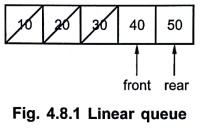
As we have seen, in case of linear queue the elements get deleted logically.
This can be shown by following Fig. 4.8.1.
•
We have deleted the elements 10, 20 and 30 means simply the front pointer is
shifted ahead. We will consider a queue from front to rear always. And now if
we try to insert any more element then it won't be possible as it is going to
give "queue full !" message. Although there is a space of elements
10, 20 and 30 (these are deleted elements), we can not utilize them because
queue is nothing but a linear array !
•
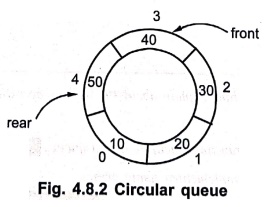
Hence there is a concept called circular queue. The main advantage of circular
queue is we can utilize the space of the queue fully. The circular queue is
shown by following Fig. 4.8.2.
•
Considering that the elements deleted are 10, 20 and 30.
•
There is a formula which has to be applied for setting the front and rear
pointers, for a circular queue.
rear = (rear + 1) %
size
front = (front + 1) %
size.
rear
= (rear + 1)% size
= (4 + 1) % 5
rear
= 0
So
we can store the element 60 at 0th location similarly while deleting
the element.
front
= (front + 1)% size
= (3 + 1) % 5
front
= 4
So
delete the element at 4th location i.e. element 50
Let
us see the 'C++' program now,
C++ Program
#include<iostream>
using namespace std;
#define MAX 10
class Queue
int Que[MAX];
int front,rear;
public:
Queue()//constructor defined
{
front=‒1;
rear=0;
}
void init();
void insert(int ch);
int delet();
void display();
};
void Queue::init()
{
int i;
for(i=0;i<MAX;i++)
Que[i]=0;
}
/*
‒‒‒‒‒‒‒‒‒‒‒‒‒‒‒‒‒‒‒‒‒‒‒‒‒‒‒‒‒‒‒‒‒‒‒‒‒‒‒‒‒‒‒‒‒‒‒‒‒‒‒‒‒‒‒‒‒‒‒‒
insert function
‒‒‒‒‒‒‒‒‒‒‒‒‒‒‒‒‒‒‒‒‒‒‒‒‒‒‒‒‒‒‒‒‒‒‒‒‒‒‒‒‒‒‒‒‒‒‒‒‒‒‒‒‒‒‒‒‒‒‒‒‒
*/
void Queue::insert(int item)
{
if
(front==(rear+1)%MAX)
{
cout<<"Queue
is full\n";
}
else
{
//setting front
pointer for a single element in Queue,
if(front= =‒1)
front= rear=0;
else
rear=(rear+1)%MAX;
Que[rear]=item;
}
}
/*
‒‒‒‒‒‒‒‒‒‒‒‒‒‒‒‒‒‒‒‒‒‒‒‒‒‒‒‒‒‒‒‒‒‒‒‒‒‒‒‒‒‒‒‒‒‒‒‒‒
delet function
‒‒‒‒‒‒‒‒‒‒‒‒‒‒‒‒‒‒‒‒‒‒‒‒‒‒‒‒‒‒‒‒‒‒‒‒‒‒‒‒‒‒‒‒‒‒‒‒‒
*/
int Queue::delet()
{
int val;
if(front= =‒1)
{
cout <<
"Queue is empty\n";
return 0; // return
null on empty Queue
}
val= Que[front]://item to be deleted
if(front= =rear)//when single element is present
{
front= rear=‒1;
}
else
front (front+1)%MAX;
return val;
}
/*
‒‒‒‒‒‒‒‒‒‒‒‒‒‒‒‒‒‒‒‒‒‒‒‒‒‒‒‒‒‒‒‒‒‒‒‒‒‒‒‒‒‒‒‒‒‒‒‒‒‒‒‒‒‒‒‒‒
Display function
‒‒‒‒‒‒‒‒‒‒‒‒‒‒‒‒‒‒‒‒‒‒‒‒‒‒‒‒‒‒‒‒‒‒‒‒‒‒‒‒‒‒‒‒‒‒‒‒‒‒‒‒‒‒‒‒‒‒
*/
void Queue::display()
{
int i;
i=front;
while(il = rear)
{
cout<<Que[i]<<"
";
i=(i+1)%MAX;
}
cout<<Que[i] <<endl;
}
/*
‒‒‒‒‒‒‒‒‒‒‒‒‒‒‒‒‒‒‒‒‒‒‒‒‒‒‒‒‒‒‒‒‒‒‒‒‒‒‒‒‒‒‒‒‒‒‒‒‒‒‒‒
The main function
‒‒‒‒‒‒‒‒‒‒‒‒‒‒‒‒‒‒‒‒‒‒‒‒‒‒‒‒‒‒‒‒‒‒‒‒‒‒‒‒‒‒‒‒‒‒‒‒‒‒‒
*/
void main()
{
int i,choice,item;
char ans='y';
clrscr();
Queue obj;
obj.init();
do
{
cout<<"
Menu" <endl;
cout<<"1.Insert
\n 2.Delete \n 3.Display"<<endl;
cout<<"Enter
Your choice"<<endl;
cin>>choice;
switch(choice)
{
case
1:cout<<"Enter the element"<<endl;
cin>item;
obj.insert(item);
break;
case
2:cout<<"The element to be deleted is"<<endl;
cout<<obj.delet();
break;
case
3:obj.display();
break;
}
cout<<"Do
You Want to Continue?"<<endl;
ans=getche();
} while(ans= ='Y' || ans= ='y');
getch();
}
Output
Menu
1.Insert
2.Delete
3.Display
Enter Your choice: 1
Enter the element
10
Do You Want to
Continue? y
Menu
1.Insert
2.Delete
3.Display
Enter Your choice: 1
Enter the element
20
Do You Want to
Continue? y
Menu
1.Insert
2.Delete
3.Display
Enter Your choice: 1
Enter the element
30
Do You Want to
Continue? y
Menu
1.Insert
2.Delete
3.Display
Enter Your choice: 3
10 20 30
Do You Want to
Continue? y
Menu
1.Insert
2.Delete
3.Display
Enter Your choice: 2
The element to be
deleted is
10
Do You Want to
Continue? y
Menu
1.Insert
2.Delete
3.Display
Enter Your choice: 3
20 30
Do You Want to
Continue? n
Example: 1
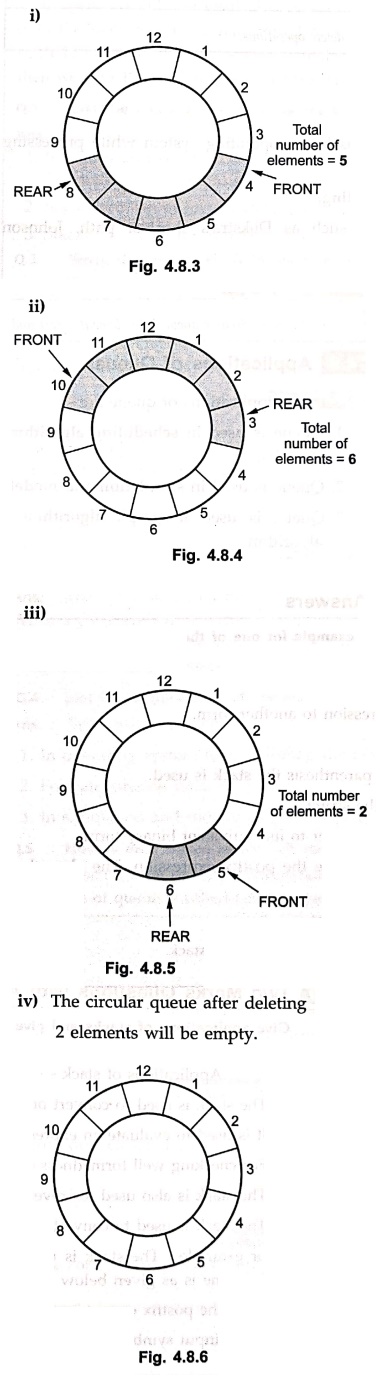
Suppose a queue is
maintained by circular array QUEUE with N = 12 memory cells. Find the number of
elements in the queue when :
i) FRONT = 4, REAR = 8,
ii) FRONT = 10, REAR =
3
iii) FRONT = 5, REAR = 6,
iv) Delete two elements
after step (iii)
Solution :
The
circular queue with 12 Cell is.
Advantages of Circular Queue Over Linear Queue
1. Better
memory utilization :
Circular
queue reuses the empty spaces created after deletions. So no wastage of space
as in linear queue.
2. No
"Queue Full" problem when space exists :
Even
if some space exists at the beginning, a linear queue cannot insert new
elements once rear reaches the end.
3.
Efficient use of array :
The
array acts like a continuous loop, allowing insertion and deletion without
shifting elements.
4. Faster
operations :
Both
insertion and deletion take O(1) time without requiring shifting.
Review Question
1. What is circular
queue ? Implement insert and delete operations.
Data Structures using C PlusPlus: Chapter 4: Stacks and Queues : Tag: Data Structure, C++ Programing : Data Structures using C++ Program - Circular Queue
Data Structures using C PlusPlus: Chapter 4: Stacks and Queues
Under Subject
Data Structures using CPlusPlus
CS25C05 2nd Semester ECE Dept | 2025 Regulation | 2nd Semester 2025 Regulation
Related Subjects
English Essentials II
EN25C02 2nd Semester | 2025 Regulation | 2nd Semester 2025 Regulation

Tamils and Technology தமிழர்களும் தொழில்நுட்பமும்
UC25H02 2nd Semester | 2025 Regulation | 2nd Semester 2025 Regulation
Linear Algebra
MA25C02 2nd Semester | 2025 Regulation

Electron Devices
EC25C01 2nd Semester ECE Dept | 2025 Regulation | 2nd Semester 2025 Regulation
Data Structures using CPlusPlus
CS25C05 2nd Semester ECE Dept | 2025 Regulation | 2nd Semester 2025 Regulation

Circuits and Network Analysis
EC25C02 2nd Semester ECE Dept | 2025 Regulation | 2nd Semester 2025 Regulation

Re-Engineering for Innovation
ME25C05 2nd Semester | 2025 Regulation | 2nd Semester 2025 Regulation
Engineering Drawing - Laboratory
ME25C01 2nd Semester | 2025 Regulation | 2nd Semester 2025 Regulation
Data Structures using CPlusPlus - Laboratory
CS25C05 2nd Semester ECE Dept | 2025 Regulation | 2nd Semester 2025 Regulation
Devices and Circuits Laboratory
EC25C03 2nd Semester ECE Dept | 2025 Regulation | 2nd Semester 2025 Regulation