Data Structures using C PlusPlus: Chapter 4: Stacks and Queues
Stacks and Queues: Two Marks Important Questions and Answers
Data Structures using C++ Program
Data Structures using C++ Program: Stacks and Queues: Anna University Part A Two Marks Important Questions and Answers
Data Structures using C ++
Chapter 4: Stacks and Queues
Two Marks Questions with Answers
1. Give
applications of stacks and give example for one of them.
Answer:
Applications
of stack ‒
1.
The stack is used to convert one expression to another form.
2.
It is used to evaluate an expression.
3.
For checking well formedness of the parenthesis the stack is used.
4.
The stack is also used for reversing the string.
5.
The stack is used to convert decimal number to its equivalent binary form.
For
example: The stack is used to evaluate the postfix expression. The algorithm for
the same is as given below ‒
1.
Read the postfix expression from left to right.
2.
If the input symbol read is operand then push it onto the stack.
3.
If the operator is read then POP two operands and perform arithmetic operations
if operator is ‒
+ then result = operand1 + operand2
‒ then result = operand1 ‒ operand2
* then result = operand1 * operand 2
/ then result = operand1 / operand 2
4.
Push the result onto the stack.
5.
Repeat steps 1‒ 4 till the postfix expression is not over. For example :
Consider the postfix expression 12+34*+
We
will read 1 then 2 and push them onto the stack. When + operator is read pop 2
and 1 perform 1+2, the result 3 is pushed onto the stack. Now read 3 and 4 then
push onto the stack when * is read pop 4 and 3. Perform 3*4, push 12 onto the
stack. Now push 12 onto the stack. The stack contains 3 and 12. When the next
character + is read then we pop 12 and 3 to perform 12+3. The result will be
15.
2. List
the characteristics of the stack.
Answer:
1.
Insertion and deletion can be made by one end only. Hence the element inserted
last will be first one to come out. Hence sometimes it is called LIFO.
2.
Stacks are useful for evaluating an expression.
3.
Stacks can store the functions calls.
3. Write
the role of stack in function call.
Answer:
The
stack is an useful data structure for handling the recursive function calls.
When a recursive call is encountered, the status of call is pushed onto the
stack. And at the return of the call the stack is popped off. Thus execution of
recursive statements is done with the help of stack.
4. List
few applications of queues.
Answer:
Application
of queues ‒
1.
In operating system for scheduling the jobs, priority queues are used.
2.
For categorizing data.
3.
In simulation and modeling queues are used.
5. How is
data sorted in QUEUE structure ?
Answer:
Based on the priority of execution the data
can be sorted in the Queue structure. Such type of queue is called priority
queue.
6. What
is meant by underflow and overflow condition in a stack ?
Answer:
The
underflow is a situation in which the pop operation is performed on the stack
which is empty. The overflow is a situation in which the push operation is
performed on the stack which is full.
7. What is Last‒In‒First‒Out strategy? Which data
structure follow this strategy?
Answer:
In
the Last In First Out strategy we insert the element in the data structure
lastly and while removing the elements from this data structure, the element
which is inserted lastly will get removed first. The stalk data structure makes
use of Last In First Out (LIFO) data structures.
8. What
is FIFO data structure ?
Answer:
The
FIFO stands for First In First Out. This property is satisfied by queue. Hence
queue is called FIFO data structure.
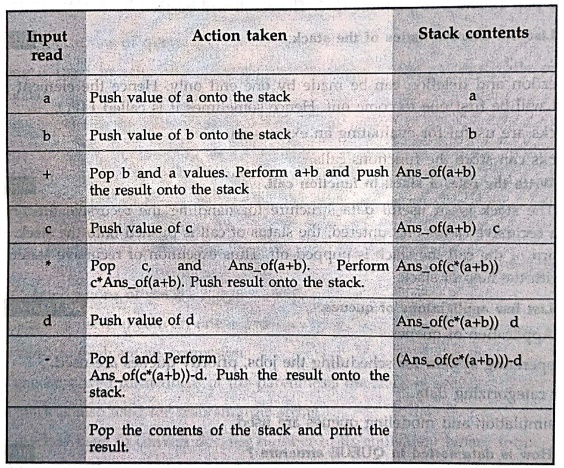
9. Evaluate
the value of expression ab+c*d‒ using stack
Ans. :
10.
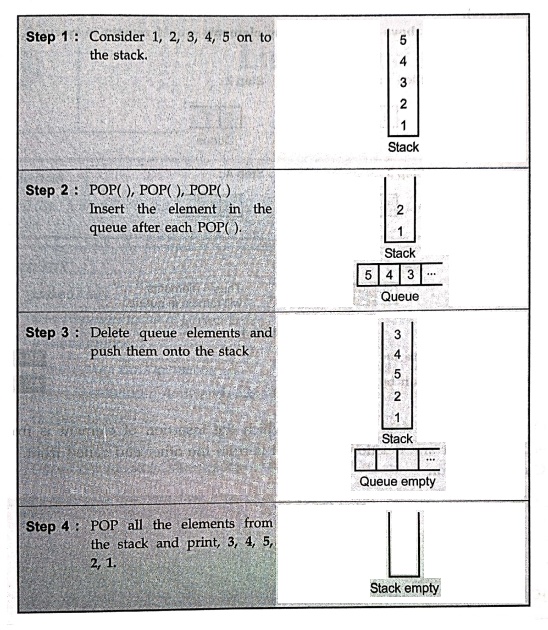
Consider a sequence of input 1, 2, 3, 4, 5. How will you make use of stack and
queue both in order to get the sequence 3, 4, 5, 2, 1.
Answer:
Step 1: Consider 1, 2, 3, 4, 5 on to the stack.
Step 2: POP( ), POP( ), POP( ) Insert the element in the queue after each POP().
Step 3: Delete queue elements and push them onto the stack
Step 4:
POP all the elements from the stack and print, 3, 4, 5, 2, 1.
11. What
is the time complexity of push() and POP() operation ?
Answer:
Push
operation ‒ O(1).
Pop
operation O(1).
12.
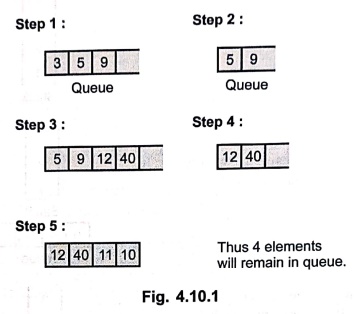
Consider the following code,
Q.front =
‒1;
Q.rear = ‒1;
insert(3);
insert(5);
insert(9);
cout<<deleteq();
insert(12);
insert(40);
cout<<deleteq(
);
cout<<deleteq():
insert(11);
insert(10);
After
executing above code, how many elements would remain in queue ?
Answer:
13. Write
a short note on queue.
OR
What do
you mean by queue ADT ?
Answer:
•
Queue is a linear data structure in which the insertion of element is from one
end called rear and deletion of element is from the other end called front.
• C representation
struct queue
{
Int que[size];
int front;
int rear:
}Ο;
Data Structures using C PlusPlus: Chapter 4: Stacks and Queues : Tag: Data Structure, C++ Programing : Data Structures using C++ Program - Stacks and Queues: Two Marks Important Questions and Answers
Data Structures using C PlusPlus: Chapter 4: Stacks and Queues
Under Subject
Data Structures using CPlusPlus
CS25C05 2nd Semester ECE Dept | 2025 Regulation | 2nd Semester 2025 Regulation
Related Subjects
English Essentials II
EN25C02 2nd Semester | 2025 Regulation | 2nd Semester 2025 Regulation

Tamils and Technology தமிழர்களும் தொழில்நுட்பமும்
UC25H02 2nd Semester | 2025 Regulation | 2nd Semester 2025 Regulation
Linear Algebra
MA25C02 2nd Semester | 2025 Regulation

Electron Devices
EC25C01 2nd Semester ECE Dept | 2025 Regulation | 2nd Semester 2025 Regulation
Data Structures using CPlusPlus
CS25C05 2nd Semester ECE Dept | 2025 Regulation | 2nd Semester 2025 Regulation

Circuits and Network Analysis
EC25C02 2nd Semester ECE Dept | 2025 Regulation | 2nd Semester 2025 Regulation

Re-Engineering for Innovation
ME25C05 2nd Semester | 2025 Regulation | 2nd Semester 2025 Regulation
Engineering Drawing - Laboratory
ME25C01 2nd Semester | 2025 Regulation | 2nd Semester 2025 Regulation
Data Structures using CPlusPlus - Laboratory
CS25C05 2nd Semester ECE Dept | 2025 Regulation | 2nd Semester 2025 Regulation
Devices and Circuits Laboratory
EC25C03 2nd Semester ECE Dept | 2025 Regulation | 2nd Semester 2025 Regulation