Basic Electronics and Electrical Engineering: Practical Experimentation
To measure the earth resistance
All the electrical installations and appliances should be earthed properly for ensuring human safety.
To measure the earth resistance.
Aim:
To measure the earth
resistance.
Apparatus required
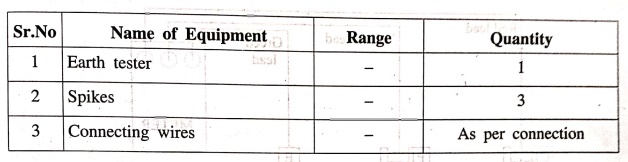
Theory
All the electrical
installations and appliances should be earthed properly for ensuring human
safety. A separate wire, known as earth wire runs along the supply line and is
connected to the ground through an earth electrode. The total resistance of the
earthing system should be small so that in the event of any fault, the fault
current is sufficiently high to blow off the fuse. The earth resistance is the
resistance offered by the soil and the electrode to the flow of earth leakage
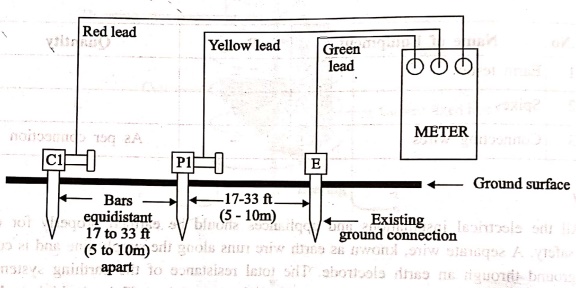
current, which will flow in case of earth fault only. The earth tester is a
special type of ohmmeter which sends ac through earth and dc through the
measuring instruments as shown in Fig. The direction of flow of current in the
ground keeps on alternating due to current reverse whereas current directions
in the two reverser and potential reverser are mounted on the main shaft of
hand driven dc generator. The working principle of an earth tester is identical
to that of megger. There are two moving coil viz. potential and current coil,
which are deflected in the magnetic field of a permanent magnet. The hand
driven generator or a set of batteries supply power to these coils. It has four
terminals P1, E1, P2 and E2.
Terminals P1 and E1 are shorted to form a common point
which is connected to the earth electrode under test. The other two terminals E2
and P2 are connected to the auxiliary electrode A and B
respectively. The value of earth resistance is indicated directly on the scale
when the test button is pressed. The value of earth resistance depends upon the
soil condition and its moisture contents. In hilly areas the earth resistance
is higher if electrodes are not place properly in contact with the earth. Water
content in the soil decreased the earth resistance. The normal value of earth
resistance should lie between 1 to 2 Ω.
Procedure
1. Connect the earth
tester as shown in Fig.
2. Switch ON the earth
tester
3. Adjust the
resistance range button between 10Ω to 1000Ω and set to 10Ω.
4. Change the position
of electrode B by 1m on the either side and observe the earth resistance by
pressing the test button.
Observation table

Conclusion
__________________
Basic Electronics and Electrical Engineering: Practical Experimentation : Tag: Basic Engineering : - To measure the earth resistance
Basic Electronics and Electrical Engineering: Practical Experimentation
Under Subject

Basic Electronics and Electrical Engineering
EE25C04 1st Semester ECE Dept | 2025 Regulation | 2nd Semester 2025 Regulation
Related Subjects

English Essentials I
EN25C01 1st Semester | 2025 Regulation | 1st Semester 2025 Regulation

தமிழர் மரபு - Heritage of Tamils
UC25H01 1st Semester | 2025 Regulation | 1st Semester 2025 Regulation

Applied Calculus
MA25C01 Maths 1 M1 - 1st Semester | 2025 Regulation | 1st Semester 2025 Regulation

Applied Physics I
PH25C01 1st Semester | 2025 Regulation | 1st Semester 2025 Regulation

Applied Chemistry I
CY25C01 1st Semester | 2025 Regulation | 1st Semester 2025 Regulation
Makerspace
ME25C04 1st Semester | 2025 Regulation | 1st Semester 2025 Regulation
Computer Programming C
CS25C01 1st Semester | 2025 Regulation | 1st Semester 2025 Regulation

Computer Programming Python
CS25C02 1st Semester | 2025 Regulation | 1st Semester 2025 Regulation
Fundamentals of Electrical and Electronics Engineering
EE25C03 1st Semester | 2025 Regulation | 1st Semester 2025 Regulation

Introduction to Mechanical Engineering
ME25C03 1st Semester | 2025 Regulation | 1st Semester 2025 Regulation

Introduction to Civil Engineering
CE25C01 1st Semester Civil Department | 2025 Regulation | 1st Semester 2025 Regulation
Essentials of Computing
CS25C03 1st Semester - AID CSE IT Department | 2025 Regulation | 1st Semester 2025 Regulation

Applied Physics I Laboratory
PH25C01 1st Semester practical Laboratory Manual | 2025 Regulation | 1st Semester Laboratory 2025 Regulation

Applied Chemistry I Laboratory
CY25C01 1st Semester practical Laboratory Manual | 2025 Regulation | 1st Semester Laboratory 2025 Regulation

Computer Programming C Laboratory
CS25C01 1st Semester practical Laboratory Manual | 2025 Regulation | 1st Semester Laboratory 2025 Regulation

Computer Programming Python Laboratory
CS25C02 1st Semester practical Laboratory Manual | 2025 Regulation | 1st Semester Laboratory 2025 Regulation
Engineering Drawing
ME25C01 EEE Mech Dept | 2025 Regulation | 2nd Semester 2025 Regulation
Basic Electronics and Electrical Engineering
EE25C04 1st Semester ECE Dept | 2025 Regulation | 2nd Semester 2025 Regulation