Basic Electronics and Electrical Engineering: Chapter 3: Transformer
Transformer: 2 Marks Important Questions with Answers
Basic Electronics and Electrical Engineering: Chapter 3: Transformer : 2 Marks Important Questions with Answers
CHAPTER 3: TRANSFORMER
2 Marks Important Questions with Answers
1.
What is the function of a transformer?
Transformer is a static
device that
(a) Transfers electric
power from one circuit to another.
(b) It does so without
change of frequency.
(c) It accomplishes
this by electro‒magnetic induction.
2.
State the different types of single phase transformer based on construction.
(i) Core type
transformer;
(ii) Shell type
transformer
(iii) Berry type
transformer.
3.
What is an ideal transformer?
An ideal transformer is
one that has
(i) no winding
resistance.
(ii) no leakage flux.
(iii) no iron losses in
the core.
(iv) no I2R
Loss (copper loss)
4.
What are turns ratio and transformation ratio of transformer?
The transformation
ratio is defined as the ratio of the secondary voltage to primary voltage. It
is denoted by K,
K = E2/E1
= N2/N1 = I1/I2
Turns ratio
n or a
= V1/V2 = E1/E2 = N1/N2
For step up
transformer, K>1 i.e., N2 > N1.
5.
Write the e.m.f equation of two winding transformer.
E1= 4.44 f ϕm N1 Volts
E2 = 4.44 f ϕm N2 Volts
Where
ϕm = Maximum
flux in the core, in Wb
N1 = No. of
turns in primary winding
N2 = No. of
turns in secondary winding
f = Supply frequency in
Hz
6.
What is the purpose of laminating the core in a transformer?
To reduce the eddy
current loss, transformer cores are laminated.
7.
How does change in frequency affect the operation of a given transformer?
(a) Iron loss increases
with decrease in frequency.
(b) Since total loss is
greater at lower frequency, the temperature is increased with decrease in
frequency.
c) Reactive drop is
affected, regulation at low power factors decrease with decrease in frequency.
8.
Write the name of material used for transformer core.
Transformer core is made
up of high grade of silicon steel.
9.
What are the losses in a transformer? How will you minimise them?
There are two losses
occur in transformer.
(i) Iron losses or Core
losses.
(ii) Copper losses.
Iron losses includes
Hysteresis loss and Eddy current loss. Hysteresis loss is reduced by making
transformer core high grade of silicon steel. Eddy current loss is minimised by
laminating the transformer core.
Copper loss is
minimised by reducing the leakage flux which is linked with both primary and
secondary windings.
10.
What is the condition for maximum efficiency of a transformer?
Copper Loss = Iron Loss
is the condition for maximum efficiency of transformer.
11.
Mention three phase transformer connections.
(a) Star - Star
(b) Star ‒ Delta
(c) Delta ‒ Delta
(d) Delta - Star
(e) Open ‒ Delta
(f) Scott Connections.
12.
Why transformer ratings is expressed in terms of kVA?
Output power of a
transformer is depending upon the type of load connected to it (i.e., resistive
load, inductive load or capacitive load). The value of output side power factor
will vary with the type of loads. Also, the core loss depends on the voltage
and copper loss depends on the current. So the transformer cannot be given
rating interms of KW (Active power) as other electrical machines given. Hence
the transformer is rated in KVA (i.e., apparent power).
13.
Give the expressions for the load current when transformer operates its maximum
efficiency
Copper loss = Iron loss
is the condition for
maximum efficiency of transformer.
The output current
corresponding to maximum efficiency is
I2 = √(Wi/R02)
14.
What are the components of magnetic losses in transformer and on what factors
do they depend?
The components of
magnetic or iron losses in transformer mention as
(i) Hysteresis loss Wh
= μ Bmax1.6 f V
Watts
(ii) Eddy current loss
We = Ke Bmax2 f2 t2 Watts
Where,
Hysteresis loss and
Eddy current loss depends on frequency and maximum flux density.
15.
Why is the range of efficiency in Transformer higher than those of other
electrical machines?
There are 3 types of
losses which can be occurred in an electrical machine
• No load loss (or)
constant loss.
• Copper loss (or)
variable loss (or) I2R loss.
• Mechanical loss.
As the transformer is a
static device, there will not be the presence of mechanical losses. Hence, the
range of efficiency in Transformer is higher than those of other (rotating) electrical
machines.
16.
What is a transformer?
It is a static device
which will transform electrical energy from one circuit to another circuit,
without change in frequency.
It works on mutual - induction
principle.
17.
Define voltage transformation ratio of transformers. Also write the condition
for step‒up transformer.
The transformation
ratio is defined as the ratio of the secondary voltage to primary voltage. It
is denoted by K.
From the emf equation
of a transformer,
E2/E1 = N2/N1
= K
• If N2 >
N1 i.e., K > 1, then the transformer is called as step‒up
transformer.
• If N2 <
N1 i.e., K< 1, then the transformer is called as step‒down transformer.
18.
Define efficiency of transformer.
It is defined as the
ratio of output power to the input power. It will always represented in
percentage.
% η = [ Output power / Input power ] × 100
% η = [ Output power /
(Output power + coreless + copper loss) ] × 100
19.
Define voltage regulation.
It is defined as the
ratio of change in voltage from no‒load to full load with respect to no‒load
voltage.
% Voltage regulation =
[ Change in voltage from no load to full load / No load voltage ] × 100
20.
What are the constructional difference between core type and shell type
transformer?
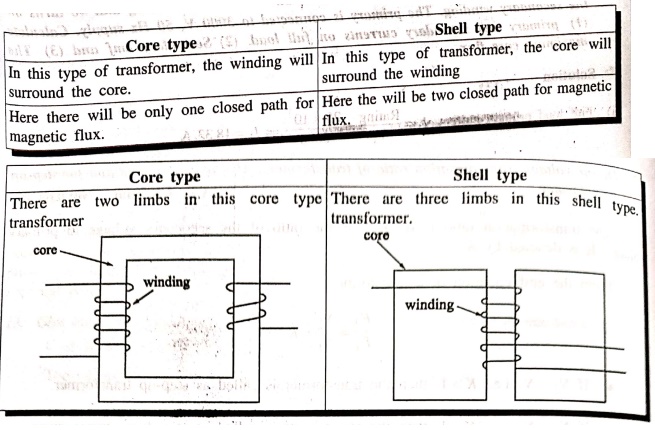
Core type
i. In this type of
transformer, the winding will surround the core.
ii. Here there will be
only one closed path for magnetic flux.
iii. There are two
limbs in this core type transformer
Shell type
i. In this type of
transformer, the core will surround the winding.
ii. Here the will be
two closed path for magnetic flux.
iii. There are three
limbs in this shell type transformer.
21.
A single phase, 2200/250 V, 50 Hz transformer has a net core area of 36 cm2
and a maximum flux density of 6 wb/m2. Calculate the number of turns
of primary and secondary.
Primary Voltage, E1
= 4.44 f Bm AN1
N1 = E1
/ ( 4.44 f Bm A )
= 2200 / (4.44×50×6×36×10‒4)
N1 = 458.79
= 459 turns
Secondary voltage, E2
= 4.44 f Bm AN2
N2 = E2
/ ( 4.44 f Bm A )
= 250 / (4.44×50×6×36×10‒4)
N2 = 52.14 =
52 turns
22.
An ideal 25 kVA transformer has 500 turns on the primary winding and 40 turns
on the secondary winding. The primary is connected to 3000 V, 50 Hz supply.
Calculate (1) primary and secondary currents on full load. (2) Secondary emf
and (3) The maximum core flux.
Solution
(i) Full load primary
current, I1 = Rating / V1 = (25×103) / 3000
⇒
I1 = 18.33 A
By transformation
ratio, K = V2/V1 = N2/N1
⇒
V2 = 3000 × 40/500 = 240 V
(ii) Full load
secondary current, I2 = Rating / V2 = (25×103)
/ 240
⇒ I2 =
104.17 A
(iii) Maximum core
flux, ϕm
V1 = 4.44 f ϕm N1
ϕm = V1
/ (4.44 f N1)
= 3000 / (4.44×50×500)
⇒
ϕm
= 0.027 = 27 mwb
23.
What are the types of transformers based on construction?
(i) Core type
transformer
(ii) Shell type
transformer
(iii) Berry type
transformer.
24.
In a single phase transformer, Np = 350 turns, Ns=1050 turns, Ep
= 400 V. Find Es.
Solution
ES/EP
= NS/NP
ES = [NS/NP]
× EP
= (1050/350) × 400
Es = 1200 V
Basic Electronics and Electrical Engineering: Chapter 3: Transformer : Tag: Basic Engineering : - Transformer: 2 Marks Important Questions with Answers
Basic Electronics and Electrical Engineering: Chapter 3: Transformer
Under Subject

Basic Electronics and Electrical Engineering
EE25C04 1st Semester ECE Dept | 2025 Regulation | 2nd Semester 2025 Regulation
Related Subjects

English Essentials I
EN25C01 1st Semester | 2025 Regulation | 1st Semester 2025 Regulation

தமிழர் மரபு - Heritage of Tamils
UC25H01 1st Semester | 2025 Regulation | 1st Semester 2025 Regulation
Applied Calculus
MA25C01 Maths 1 M1 - 1st Semester | 2025 Regulation | 1st Semester 2025 Regulation
Applied Physics I
PH25C01 1st Semester | 2025 Regulation | 1st Semester 2025 Regulation

Applied Chemistry I
CY25C01 1st Semester | 2025 Regulation | 1st Semester 2025 Regulation
Makerspace
ME25C04 1st Semester | 2025 Regulation | 1st Semester 2025 Regulation
Computer Programming C
CS25C01 1st Semester | 2025 Regulation | 1st Semester 2025 Regulation
Computer Programming Python
CS25C02 1st Semester | 2025 Regulation | 1st Semester 2025 Regulation
Fundamentals of Electrical and Electronics Engineering
EE25C03 1st Semester | 2025 Regulation | 1st Semester 2025 Regulation
Introduction to Mechanical Engineering
ME25C03 1st Semester | 2025 Regulation | 1st Semester 2025 Regulation

Introduction to Civil Engineering
CE25C01 1st Semester Civil Department | 2025 Regulation | 1st Semester 2025 Regulation
Essentials of Computing
CS25C03 1st Semester - AID CSE IT Department | 2025 Regulation | 1st Semester 2025 Regulation

Applied Physics I Laboratory
PH25C01 1st Semester practical Laboratory Manual | 2025 Regulation | 1st Semester Laboratory 2025 Regulation

Applied Chemistry I Laboratory
CY25C01 1st Semester practical Laboratory Manual | 2025 Regulation | 1st Semester Laboratory 2025 Regulation

Computer Programming C Laboratory
CS25C01 1st Semester practical Laboratory Manual | 2025 Regulation | 1st Semester Laboratory 2025 Regulation

Computer Programming Python Laboratory
CS25C02 1st Semester practical Laboratory Manual | 2025 Regulation | 1st Semester Laboratory 2025 Regulation
Engineering Drawing
ME25C01 EEE Mech Dept | 2025 Regulation | 2nd Semester 2025 Regulation
Basic Electronics and Electrical Engineering
EE25C04 1st Semester ECE Dept | 2025 Regulation | 2nd Semester 2025 Regulation