Data Structures using C PlusPlus: Chapter 3: Analysis of Algorithms and Arrays
Analysis of Algorithms and Arrays: Two Marks Important Questions and Answers
Data Structures using C++ Program
Data Structures using C PlusPlus: Chapter 3: Analysis of Algorithms and Arrays: Anna University Part A Two Marks Important Questions and Answers
Data
Structures using C ++
Chapter
3: Analysis of Algorithms and Arrays
Two Marks Questions with Answers
1. What
are the drawbacks in using the standard unit of time, to measure the runtime of
an algorithm?
Answer:
The
runtime of an algorithm can not be measured in standard unit of time because in
multiuser system running time depends on many factors such as –
1)
System load
2)
Number of other programs running
3)
Instruction set used
4)
Speed of underlying hardware
If
we use standard unit of time such as seconds, milliseconds, minutes and so on
for measuring the runtime of algorithm then we get varied result for same set
of input data. Hence the time complexity given in terms of frequency count.
2. What
are the measures that are used to measure the complexity of an algorithm?
Answer:
The
time complexity and the space complexity are the two measures that are used to
measure the complexity of an algorithm.
3. Write
the concept of time and space complexity.
OR
How do
you measure the efficiency of an algorithm.
Answer:
Time
complexity is the amount of time required by an algorithm to execute. For
computing the time complexity the frequency count of the basic operation in the
algorithm is computed. This frequency count is then denoted in terms of
asymptotic notations to express the time complexity of an algorithm. The space
complexity is an amount of space required by an algorithm. The space complexity
is denoted in terms of asymptotic notations.
4. Differentiate
time complexity from space complexity.
Answer:
Time
complexity is amount of time required by a program to execute.
The
space complexity is amount of space required by a program to execute.
5. Establish
the relation between O and Ω.
Answer:
The
notation O represents the upper bound of algorithm's running time. The omega
notation Ω represents the lower bound of algorithm's running time.
The
theta notion represents the running time between upper and lower bound. If f(n)
and g(n) are two functions then, f(n) = Ө (n) if and only if f(n) f(n) = O
(g(n)) and f(n) = Ω g(n)).
6. If
f(n) = amnm +..... a1n+a0, then
prove that f(n) = O(nm).
Answer:
Let,
f(n)
= amnm + am‒1n m‒1 + am‒2nm‒2
+...+a0
If
we treate aim as a constant then the equation (1) becomes
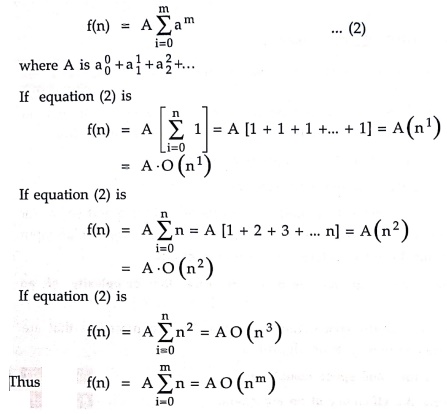
Thus
neglecting the constant term we will have
f(n)
= O(nm)
7. Using
the step count method analyze the time complexity when 2 m x n matrices are
added.
Ans. :
For
computing the step count for the matrix addition, consider the following code ‒
1. for (i
←0; i < m; i++)
2. {
3. for (j 0; j < n; j++)
4. {
5. C[i][j] = A[i][j] + B[i][j]
6. }
7. }
Statement Step count
i←0 ‒ 1
i<m ‒ m + 1
i
++ ‒ m
j←0 ‒ m
j←n ‒ (n +
1) m
j++ ‒ (n +
1) m
C[i][j]=A[i][j]
+ B[i][j] ‒ n(m)
Total 3mn + 5m + 2
By
neglecting constants, the time complexity =
O(mn)
8. An
array has exactly n nodes. They are filled from the set {0, 1, 2, ..., n − 1,
n}. There are no duplicates in the list. Design an O(n) worst case time
algorithm to find which one of the elements from the above set is missing in
the array.
Ans :
Algorithm: GetMissing (Array a[0..n])
{
total = (n + 1) * (n +
2)/2 //Finding sum of all the elements
from 0 to n
for
(i← 0 to n) do
total ‒ = a[i] //subtracting each number from total
return
total // Remaining will be missing element
}
9. What
is the best,worst and average case time complexities of linear search
algorithm?
Answer:
The
O(n) is the best,worst and average case time complexity of linear search
algorithm.
10. Define Big oh notation.
Answer:
Let
f(n) and g(n) be two non‒negative functions.
Let
n0 and constant c are two integers such that n0 denotes
some value of input and n> n0. Similarly c is some constant such
that c > 0. We can write
f(n)≤
c*g(n)
then
f(n) is big oh of g(n). It is also denoted as f(n) ϵ O (g(n)). In other words
f(n) is less than g(n) if g(n) is multiple of some constant c.
11. Define
Big omega notation.
Answer:
A
function f(n) is said to be in Ω (g(n)) if f(n) is bounded below by some
positive constant multiple of g(n) such that
f(n)
≥ c* g(n) For all n ≥ no
It
is denoted as f(n) ϵ Ω (g(n)). Following graph illustrates the curve for Ω
notation.
12. Define Big theta notation.
Answer:
Let
F(n) and g(n) be two non negative functions. There are two positive constants
namely c1 and c2 such that
c1 ≤ g(n) ≤ c2 g(n)
Then
we can say that
f(n)
ϵ Ө (g(n))
13. List
the asymptotic classes in increasing order.
Answer:
1.
Constant(1)
2.
Logarithmic(log n)
3.
Linear(n)
4.
n log n
5.
Quadratic (n2)
6.
cubic(n3)
7.
Exponential((2n)
8.
Factorial(n!)
14. The
(log n)th smallest number of n unsorted numbers can be determined in O(n)
average, case time (True/False)
Answer:
False.
The (log n)th smallest number of n unsorted numbers can be determined in O(n)
worst‒case time.
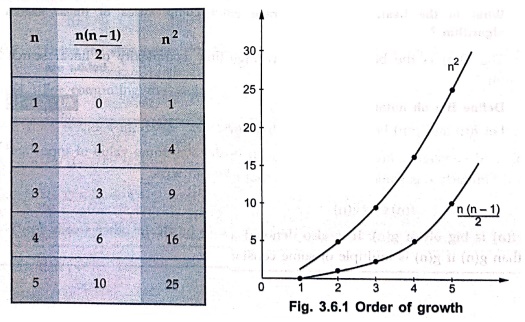
15. Compare
the orders of growth of n(n‒1)/2 and n2.
Ans. :
For
comparing the orders of growth of n(n‒1)/2 and n2 we consider some
sample values of n.
16. Give
the time complexity 1 + 3 + 5 + 7 + ... + 999.
Answer:
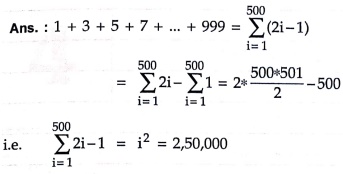
Hence
time complexity is O(n)2.
17. How
to measure an algorithm's running time?
Answer:
To
measure the algorithm's running time, its basic operation is identified. Then
the frequency count of this basic operation is calculated. And finally applying
the asymptotic notations for basic operations, the time complexity is
calculated.
18. What
do you mean by "Worst case efficiency" of an algorithm ?
Answer:
Worst
case time complexity is a time complexity when algorithm runs for a longest
time.
Data Structures using C PlusPlus: Chapter 3: Analysis of Algorithms and Arrays : Tag: Data Structure, C++ Programing : Data Structures using C++ Program - Analysis of Algorithms and Arrays: Two Marks Important Questions and Answers
Data Structures using C PlusPlus: Chapter 3: Analysis of Algorithms and Arrays
Under Subject
Data Structures using CPlusPlus
CS25C05 2nd Semester ECE Dept | 2025 Regulation | 2nd Semester 2025 Regulation
Related Subjects

English Essentials II
EN25C02 2nd Semester | 2025 Regulation | 2nd Semester 2025 Regulation

Tamils and Technology தமிழர்களும் தொழில்நுட்பமும்
UC25H02 2nd Semester | 2025 Regulation | 2nd Semester 2025 Regulation
Linear Algebra
MA25C02 2nd Semester | 2025 Regulation

Electron Devices
EC25C01 2nd Semester ECE Dept | 2025 Regulation | 2nd Semester 2025 Regulation
Data Structures using CPlusPlus
CS25C05 2nd Semester ECE Dept | 2025 Regulation | 2nd Semester 2025 Regulation

Circuits and Network Analysis
EC25C02 2nd Semester ECE Dept | 2025 Regulation | 2nd Semester 2025 Regulation

Re-Engineering for Innovation
ME25C05 2nd Semester | 2025 Regulation | 2nd Semester 2025 Regulation
Engineering Drawing - Laboratory
ME25C01 2nd Semester | 2025 Regulation | 2nd Semester 2025 Regulation
Data Structures using CPlusPlus - Laboratory
CS25C05 2nd Semester ECE Dept | 2025 Regulation | 2nd Semester 2025 Regulation
Devices and Circuits Laboratory
EC25C03 2nd Semester ECE Dept | 2025 Regulation | 2nd Semester 2025 Regulation