Data Structures using C PlusPlus: Chapter 3: Analysis of Algorithms and Arrays
Asymptotic Notations
Questions: 1. Elaborate on asymptotic notations with examples. 2. Prove that for any two functions f(n) and g(n), we have f(n) f(n) = Ө(g(n)) if and only if f(n) = O (g(n)) and f(n) = Ω (g(n)). 3. Discuss in detail all the asymptotic notations with examples. 4. Give the definition and graphical representation of O‒notation. 5. Explain briefly Big oh Notation, Omega Notation and Theta Notations. Give examples. 6. What are the rules of manipulate Big ‒ oh expressions and about the typical growth rates of algorithm? 7. Define Big O notation, Big Omega and Big Theta notation. Depict the same graphically and explain.
Asymptotic
Notations
•
To choose the best algorithm, we need to check efficiency of each algorithm.
The efficiency can be measured by computing time complexity of each algorithm.
Asymptotic notation is a shorthand way to represent the time complexity.
•
Definition : Asymptotic
notations are mathematical tools used in algorithm analysis to describe the
running time or space requirement of an algorithm in terms of input size (n).
•
Using asymptotic notations we can give time complexity as "fastest
possible", "slowest possible" or "average time".
Various
notations
such as Ω Ө, and O used are called asymptotic
notions.
1. Big oh Notation
•
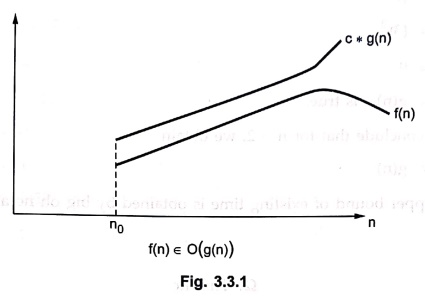
The Big oh notation is denoted by
'O'. It is a method of representing the upper
bound of algorithm's running time. Using big oh notation we can give
longest amount of time taken by the algorithm to complete.
Definition
•
Let f(n) and g(n) be two non‒negative functions.
•
Let n0 and constant c are two integers such that n0
denotes some value of input and n > n0. Similarly c is some
constant such that c > 0. We can write
f(n)
≤ c*g(n)
then
f(n) is big oh of g(n). It is also denoted as f(n) ϵ O (g(n)). In other words f(n) is less than g(n) if g(n) is
multiple of some constant c.
Example :
Consider function f(n) = 2n + 2 and g(n) = n2. Then we have to find
some constant c, so that f(n) ≤ c* g(n). As f(n) = 2n + 2 and g(n) = n2
then we find c for n = 1 then
f(n)
= 2n+ 2
= 2(1) + 2
f(n)
= 4
and
g(n)
= n2
= (1)2
g(n) = 1
i.e.
f(n)
> g(n)
If
n = 2 then,
f(n)
= 2(2) + 2
= 6
g(n)
= (2)2
g(n)
= 4
i.e.
f(n)
> g(n)
If
n = 3 then,
f(n)
= 2(3)+2
= 8
g(n)
=
(3)2
g(n)
= 9
i.e.
f(n)
< g(n) is true.
Hence
we can conclude that for n > 2, we obtain
f(n)
< g(n)
Thus
always upper bound of existing time is obtained by big oh notation.
2. Omega Notation
•
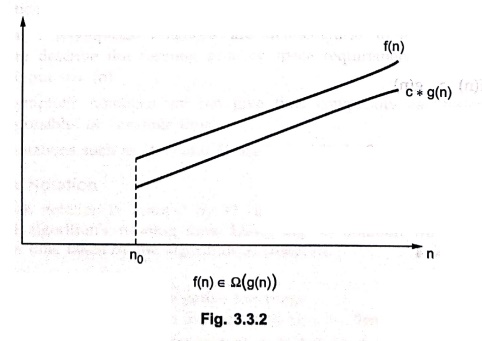
Omega notation is denoted by 'Ω'. This notation is used to represent the lower bound of algorithm's running
time. Using omega notation we can denote shortest amount of time taken by
algorithm.
Definition
A
function f(n) is said to be in Ω (g(n)) if f(n) is bounded below by some
positive constant multiple of g(n) such that
f(n) ≥ c* g(n)
For
all n ≥ n0
It
is denoted as f(n) ϵ Ω (g(n)). Following graph illustrates
the curve for Ω notation.
Example :
Consider
f(n) = 2n2 + 5 and g(n) = 7n
Then
if n = 0
f(n) = 2(0)2 +5
= 5
g(n) = 7 (0)
= 0 i.e. f(n) > g(n)
But
if n = 1
f(n) = 2(1)2 +5
= 7
g(n) = 7(1)
= 7 i.e. f(n) = g(n)
If
n = 3 then,
f(n) = 2(3)2 +5
= 18+ 5
= 23
g(n) = 7(3)
= 21
i.e.
f(n) > g(n)
Thus
for n > 3 we get f(n) > c* g(n).
It
can be represented as
2n2+5 ϵ Ω (n)
Similarly
any
n3 ϵ Ω (n)2
3. Ө Notation
•
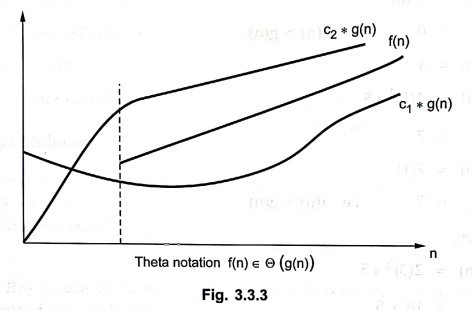
The theta notation is denoted by Ө. By this method the running time is between
upper bound and lower bound.
Definition
•
Let f(n) and g(n) be two non negative functions. There are two positive
constants namely c1 and c2 such that
c1
* g(n) ≤ f(n) ≤ c2 * g(n)
Then
we can say that
f(n)
ϵ Ө (g(n))
Example :
If
f(n) = 2n + 8 and g(n) = 7n.
where n ≥
2
Similarly
f(n) = 2n + 8
g(n) = 7n
i.e. 5n < 2n + 8 < 7n For n ≥ 2
Here c1 = 5 and c2 = 7 with n0
= 2.
The
theta notation is more precise with both big oh and omega notation.
Example: 1
Show the following equalities
are correct.
i) 5 n2‒6 n
= Ө (n2)
ii) n! = O(nn)
iii) n3 + 106n2
= Ө (n3)
iv) 2 n2 2n+n
log n = Ө (n2 2n)
Solution :
i)
5 n2‒ 6 n = Ө (n2)
The
given function f(n) ϵ Ө (g (n)) only when f(n) can be represented as
c1
* g(n) ≤ f(n) ≤ c2 * g(n)
f(n)
= 5 n2‒ 6 n. This can be denoted as n2 ≤ 5 n2‒
6 n ≤ 5 n2 for all n ≥ 2.
Where
g(n) = n2, c1 = 1 and c2 = 5. Hence given
equality holds true.
ii)
n! = O(nn)
The
given function f(n) ϵ O (g(n)) only
when f(n) can be represented by
f(n) ≤ c * g(n).
Here f(n) = n! and g(n) = nn
The
equation can be represented as,
n.(n − 1).(n − 2) ....1 ≤ n . n . n . ...n for all n≥1
This
shows that f(n) ≤ c*g(n)
where c = 1.
Hence
given equality holds true.
iii)
n3+106n2 = Ө(n3)
The
given function is f(n) ϵ Ө (g (n)), only
when f(n) can be represented as
c1
* g (n) ≤ f(n) ≤ c2 * g (n).
f(n)
= n3 + 106 n2, f(n) = n3.
This
can be denoted as ‒
n3
≤ n3 + 106 n2 ≤ 107n3
and c1 = 1, c2 = 107 for
all n ≥ 1
Hence
given equality is true.
iv)
2 n2 2n + n log n = Ө (n22n)
The
given function f(n) ϵ Ө (g(n)), only
when f(n) can be represented as
c1*
g (n) f(n) ≤ c2 * g(n).
f(n)
= 2 n2 2n + n log n. This can also be denoted as ‒
c1n2
2n ≤ 2 n2 2n + n log n ≤ c2 n2
2n
c1 ≤ 2 + ( n log n / n22n) ≤ c2
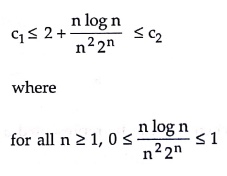
where for all n ≥ 1, 0 ≤ ( n log n / n22n)
≤ 1
with c1 = 2, c2
= 3 and n0
= 1
Hence
given equality is true.
Example: 2
State whether following
equality is correct or wrong?
5n3 + 4 n = Ω(n2)
Solution :
To
prove that given function f(n) ϵ Ω(g(n)), only when f(n) can be represented as
f(n) ≥ c * g(n) where n ≥ n0.
Here,
assume, f(n) = 5n3 + 4 n and g(n) = n2.
5n3 + 4n ≥ n2 when c = 1, n0 = 0
for all n ≥ n0. This shows that
given equality is true.
Example: 3
State whether following
equality is correct or wrong?
10n3 + n log
n + 9 = O(n2).
Solution :
We
assume that, we have obtained the values of c n0 in such a way that
n >= n0 and we have 10n3+ n log n + 9 < c n2.
Now Let, m = max(n0, ceiling (c/10)), then
We
have,
10
m3 + m log m + 9 < cm2
= 10 m3+ m log m + 9 − cm2
< 0
= m2(10 m ‒ c) + m log m + 9
< 0
But
10 m ‒ c > 0, hence
m2(10
m ‒ c) + m log m + 9 < 0 is not possible.
That
means there are no such values of c and n0 such that n ≥ n0
and
10
n3 + n log n + 9 < c n2. Hence given equality is
wrong.
Example: 4
Derive a loose bound on
the following equation:
f(x) = 35x8 ‒
22x7 +14x5 ‒2x4 ‒4x2+x‒15
Solution :
Let,
f(n) and g(n) are two non‒negative functions.
Let
c be some constant.
The
equation
f(n) ≤ c*g(n)
then f(n) = ϵ O(g(n) with tight bound.
But
if f(n) < c*g(n)
then f(n) ϵ O(g(n) with loose bound.
Consider
the function
f(x) = 35x8‒22x7
+14x5 ‒2x4 ‒4x2 +x‒15
and g(x)
= x8
If x =
1, then
f(x)
= 35(1)8 − 22(1)7 +14(1)5 −2(1)4
−4(1)2 +1‒15
f(x)
= 7
g(x) = x8 = (1)8
If
we assume c = 35 then
We
will always get
f(x)
< g(x) for x ≥1
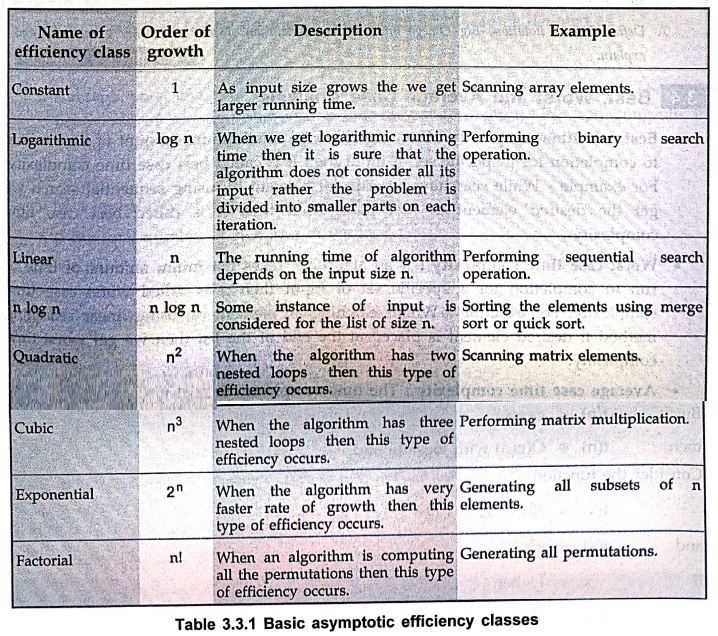
4. Basic Efficiency Classes
•
We can have different efficiency classes and each class possessing certain
characteristic. Let us see the classification of different order of growth
Review Questions
1. Elaborate on
asymptotic notations with examples.
2. Prove that for any
two functions f(n) and g(n), we have f(n) f(n) = Ө(g(n)) if and only if f(n) =
O (g(n)) and f(n) = Ω (g(n)).
3. Discuss in detail
all the asymptotic notations with examples.
4. Give the definition
and graphical representation of O‒notation.
5. Explain briefly Big
oh Notation, Omega Notation and Theta Notations. Give examples.
6. What are the rules
of manipulate Big ‒ oh expressions and about the typical growth rates of
algorithm?
7. Define Big O
notation, Big Omega and Big Theta notation. Depict the same graphically and
explain.
Data Structures using C PlusPlus: Chapter 3: Analysis of Algorithms and Arrays : Tag: Data Structure, C++ Programing : - Asymptotic Notations
Data Structures using C PlusPlus: Chapter 3: Analysis of Algorithms and Arrays
Under Subject

Data Structures using CPlusPlus
CS25C05 2nd Semester ECE Dept | 2025 Regulation | 2nd Semester 2025 Regulation
Related Subjects

English Essentials II
EN25C02 2nd Semester | 2025 Regulation | 2nd Semester 2025 Regulation

Tamils and Technology தமிழர்களும் தொழில்நுட்பமும்
UC25H02 2nd Semester | 2025 Regulation | 2nd Semester 2025 Regulation

Linear Algebra
MA25C02 2nd Semester | 2025 Regulation

Electron Devices
EC25C01 2nd Semester ECE Dept | 2025 Regulation | 2nd Semester 2025 Regulation
Data Structures using CPlusPlus
CS25C05 2nd Semester ECE Dept | 2025 Regulation | 2nd Semester 2025 Regulation

Circuits and Network Analysis
EC25C02 2nd Semester ECE Dept | 2025 Regulation | 2nd Semester 2025 Regulation

Re-Engineering for Innovation
ME25C05 2nd Semester | 2025 Regulation | 2nd Semester 2025 Regulation

Engineering Drawing - Laboratory
ME25C01 2nd Semester | 2025 Regulation | 2nd Semester 2025 Regulation

Data Structures using CPlusPlus - Laboratory
CS25C05 2nd Semester ECE Dept | 2025 Regulation | 2nd Semester 2025 Regulation
Devices and Circuits Laboratory
EC25C03 2nd Semester ECE Dept | 2025 Regulation | 2nd Semester 2025 Regulation