Data Structures using C PlusPlus: Chapter 3: Analysis of Algorithms and Arrays
Best, Worst and Average Case Analysis
Data Structures
Data Structures using C++: Analysis of Algorithms and Arrays
Best,
Worst and Average Case Analysis
• Best case time complexity :
If
an algorithm takes minimum amount of time to run to completion for a specific
set of input then it is called best case time complexity. For example ‒ While
searching a particular element by using sequential search we get the desired
element at first place itself then it is called best case time complexity.
• Worst case time complexity :
If
an algorithm takes maximum amount of time to run to completion for a specific
set of input then it is called worst case time complexity. For example ‒ While
searching an element by using linear searching method if desired element is
placed at the end of the list then we get worst time complexity.
• Average case time complexity :
The
time complexity that we get for certain set of inputs is as a average same.
Then for corresponding input such a time complexity is called average case time
complexity.
• Algorithmic example :
Consider
following algorithm. This algorithm is for sequential search.
Algorithm
Seq_search(A[0... n‒1 ],key)
//
Problem Description: This algorithm is for searching the
//key
element from an array A[0...n‒1] sequentially.
for i= 0
to n‒1 do
if(A[i]=key)then
return i
Analysis
1. Best case analysis :
In
above searching algorithm the element key is searched from the list of n
elements. If the key element is present at first
location in the list(A[0...n‒1]) then algorithm run for a very short time
and thereby we will get the best case time complexity. Hence in terms of big‒oh
notation the time complexity can be denoted as
T(n)
= O(1)
2. Worst case analysis :
Worst
case time complexity is a time complexity when algorithm runs for a longest
time. In above searching algorithm the element key is searched from the list of
n elements. If the key element is present at nth location then clearly the
algorithm will run for longest time and thereby we will get the worst case time
complexity. We can denote the worst case time complexity as
T(n)
= n
Hence
in terms of big‒oh notation the time complexity can be denoted as
T(n)
= O(n)
3. Average case analysis :
This
type of complexity gives information about the behaviour of an algorithm on
specific or random input. We can compute the average case time complexity as
follows ‒
Let,
P
be a probability of getting successful search.
n
is the total number of elements in the list.
•
The first match of the element will occur at ith location. Hence probability of
occurring first match is P/n for every ith element.
•
The probability of getting unsuccessful search is (1 ‒ p).
•
Now, we can find average case time complexity T(n) as ‒
T(n)
= Probability of successful search + Probability of unsuccessful search
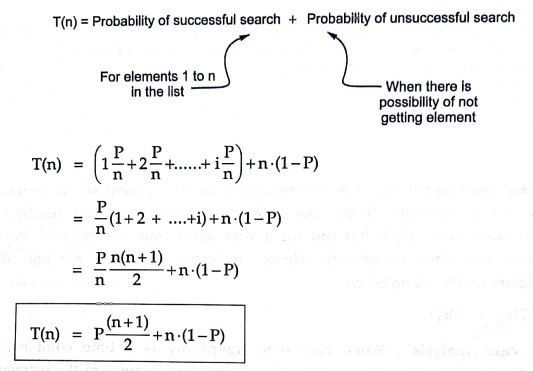
T(n)
= (1 p/n + 2 p/n + ....+ i p/n) + n.(1‒P)
=
p/n (1+2+...+i) + n.(1‒P)
=
p/n n(n+1)/ 2 + n.(1‒P)
T(n) = P (n+1)/2 + n.(1‒P)
This
is general formula for computing average case time complexity.
In
equation (3.4.1) we will put different values of P
If P = 0, we get
T(n)
= 0 (n+1)/2 + n (1‒0)
T(n) = n
If
P =1, we get
T(n)
=1(n+1)/2 + n.(1‒1)
T(n)
= (n+1) / 2
That
means the algorithm scans about the half of the elements from the list.
Hence
time complexity can be denoted in terms of big oh notation as
T(n) = O(n)
Hence
we can summarize the time complexity of sequential search in best case, worst
case and average case in the form of Big‒oh notation as
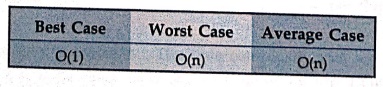
Best Case ‒ O(1)
Worst Case ‒ O(n)
Average Case ‒ O(n)
Data Structures using C PlusPlus: Chapter 3: Analysis of Algorithms and Arrays : Tag: Data Structure, C++ Programing : Data Structures - Best, Worst and Average Case Analysis
Data Structures using C PlusPlus: Chapter 3: Analysis of Algorithms and Arrays
Under Subject
Data Structures using CPlusPlus
CS25C05 2nd Semester ECE Dept | 2025 Regulation | 2nd Semester 2025 Regulation
Related Subjects
English Essentials II
EN25C02 2nd Semester | 2025 Regulation | 2nd Semester 2025 Regulation
Tamils and Technology தமிழர்களும் தொழில்நுட்பமும்
UC25H02 2nd Semester | 2025 Regulation | 2nd Semester 2025 Regulation
Linear Algebra
MA25C02 2nd Semester | 2025 Regulation

Electron Devices
EC25C01 2nd Semester ECE Dept | 2025 Regulation | 2nd Semester 2025 Regulation
Data Structures using CPlusPlus
CS25C05 2nd Semester ECE Dept | 2025 Regulation | 2nd Semester 2025 Regulation

Circuits and Network Analysis
EC25C02 2nd Semester ECE Dept | 2025 Regulation | 2nd Semester 2025 Regulation

Re-Engineering for Innovation
ME25C05 2nd Semester | 2025 Regulation | 2nd Semester 2025 Regulation
Engineering Drawing - Laboratory
ME25C01 2nd Semester | 2025 Regulation | 2nd Semester 2025 Regulation
Data Structures using CPlusPlus - Laboratory
CS25C05 2nd Semester ECE Dept | 2025 Regulation | 2nd Semester 2025 Regulation
Devices and Circuits Laboratory
EC25C03 2nd Semester ECE Dept | 2025 Regulation | 2nd Semester 2025 Regulation