Data Structures using C PlusPlus: Chapter 3: Analysis of Algorithms and Arrays
Introduction to Analysis of Algorithms
Data Structures using C++ Program
The efficiency of an algorithm can be decided by measuring the performance of an algorithm. We can measure the performance of an algorithm by computing two factors.
Introduction
to Analysis of Algorithms
•
The efficiency of an algorithm can be decided by measuring the performance of
an algorithm. We can measure the performance of an algorithm by computing two
factors.
1.
Amount of time required by an
algorithm to execute.
2.
Amount of storage required by an
algorithm.
•
This is popularly known as time
complexity and space complexity of
an algorithm.
1. Space Complexity
•
The space complexity can be defined as amount
of memory required by an algorithm to run.
•
To compute the space complexity we use two factors : Constant and instance characteristics. The space requirement S(p)
can be given as :
S(p) = C
+ Sp
where C is a constant i.e. fixed part and it
denotes the space of inputs and outputs. This space is an amount of space taken
by instruction, variables and identifiers. And Sp is a space dependent upon instance characteristics. This is a
variable part whose space requirement depends on particular problem instance.
•
Consider three examples of algorithms to compute the space complexity.
Example: 1
Algorithm
Add (a,b,c)
//Problem Description: This algorithm computes the addition
//of three elements
//Input: a,b, and c are of floating type
//Output: The addition is returned
return a+b+c
The
space requirement for algorithm given in Example 1 is
S(p)=C
Ө
(Sp) = 0
If
we assume that a, b and c occupy one word size then total size comes to be 3.
Example: 2
Algorithm
Add (x,n)
//Problem Description: The algorithm performs addition of
//all the elements in an array. Array is of floating type.
//Input: An array x and n is total number of elements in
//array
//Output: returns sum which is of data type float.
sum ← 0.0
for ← I ← 1 to n do
sum ← sum+x[i]
return sum
The
space requirement for the above given algorithm is ‒
S(p) ≥(n
+ 3)
The
'n' space required for x[ ], one unit space for n, one unit for i and one unit
for sum.
Example: 3
Algorithm Add (x,n)
//Problem Description: This is a recursive algorithm which
//computes addition of all the elements in an array x[]
//Input: x[i] is of floating type, total number of elements
//in an array
//Output: returns addition of n elements of an array
return Add (x,n−1)+x[n]
The
space requirement is ‒
S(p) ≥
3(n + 1)
The
internal stack used for recursion includes space for formal parameters, local
variables and return address. The space required by each call to function Add
requires atleast three words (space for n values + space for return address +
pointer to x [ ]). The depth of recursion in n+1 (n times call to function and
one return call). The recursion stack space will be ≥ 3(n+1).
2. Time Complexity
•
The time complexity of an algorithm is the amount of computer time required by
an algorithm to run to completion.
It is difficult to compute the time complexity
in terms of physically clocked time. For instance in
multiuser system, executing time depends on many factors such as –
•
System load
•
Number of other programs running
•
Instruction set used
•
Speed of underlying hardware.
The
time complexity is therefore given in terms of frequency count.
Frequency count is
a count denoting number of times of execution of statement.
For example
•
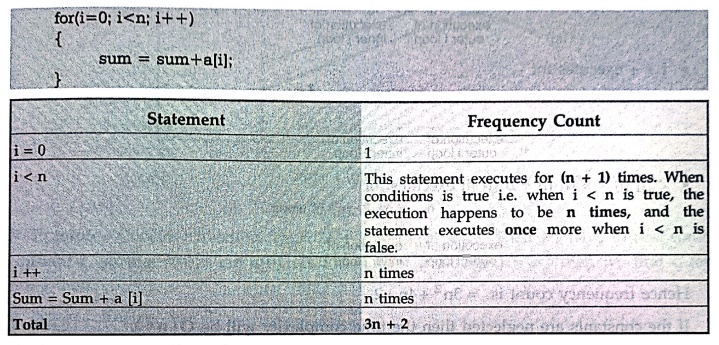
If we write a code for calculating sum of n numbers in an array then we can
find its time complexity using frequency count. This frequency count denotes
how many times the particular statement is executed.
for(i=0; i<n; i++)
{
sum = sum+a[i];
}
Thus
we get frequency count to be 3n+2.
The time complexity is normally denoted in terms of Oh notation (O). Hence if
we neglect the constants then we get the time complexity to be O (n)
Another
example
prad
will ins &
Let us consider another example. The following
code is typically used to perform matrix addition.
for(i=0; i<n; i++)
{
for(j=0; j<n; j++)
{
c[i][j] =
a[i][j]+b[i][j]
}
}
The
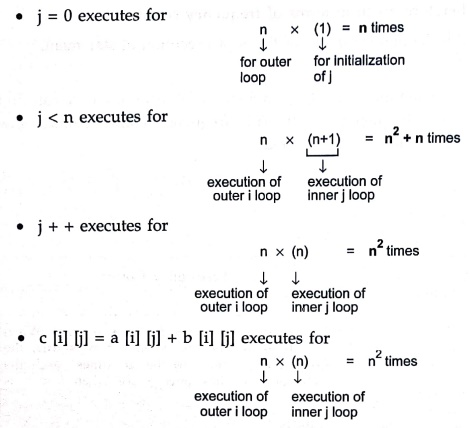
frequency count can be computed as follows.
•
i = 0 executes once Frequency
count = 1
•
i < n executes for n+1 times.
• i + + executes for n times.
Hence
frequency count is = 3n2+4n+2
If
the constants are neglected then the time complexity will be O(n2).
Data Structures using C PlusPlus: Chapter 3: Analysis of Algorithms and Arrays : Tag: Data Structure, C++ Programing : Data Structures using C++ Program - Introduction to Analysis of Algorithms
Data Structures using C PlusPlus: Chapter 3: Analysis of Algorithms and Arrays
Under Subject
Data Structures using CPlusPlus
CS25C05 2nd Semester ECE Dept | 2025 Regulation | 2nd Semester 2025 Regulation
Related Subjects

English Essentials II
EN25C02 2nd Semester | 2025 Regulation | 2nd Semester 2025 Regulation

Tamils and Technology தமிழர்களும் தொழில்நுட்பமும்
UC25H02 2nd Semester | 2025 Regulation | 2nd Semester 2025 Regulation
Linear Algebra
MA25C02 2nd Semester | 2025 Regulation

Electron Devices
EC25C01 2nd Semester ECE Dept | 2025 Regulation | 2nd Semester 2025 Regulation
Data Structures using CPlusPlus
CS25C05 2nd Semester ECE Dept | 2025 Regulation | 2nd Semester 2025 Regulation

Circuits and Network Analysis
EC25C02 2nd Semester ECE Dept | 2025 Regulation | 2nd Semester 2025 Regulation

Re-Engineering for Innovation
ME25C05 2nd Semester | 2025 Regulation | 2nd Semester 2025 Regulation
Engineering Drawing - Laboratory
ME25C01 2nd Semester | 2025 Regulation | 2nd Semester 2025 Regulation
Data Structures using CPlusPlus - Laboratory
CS25C05 2nd Semester ECE Dept | 2025 Regulation | 2nd Semester 2025 Regulation
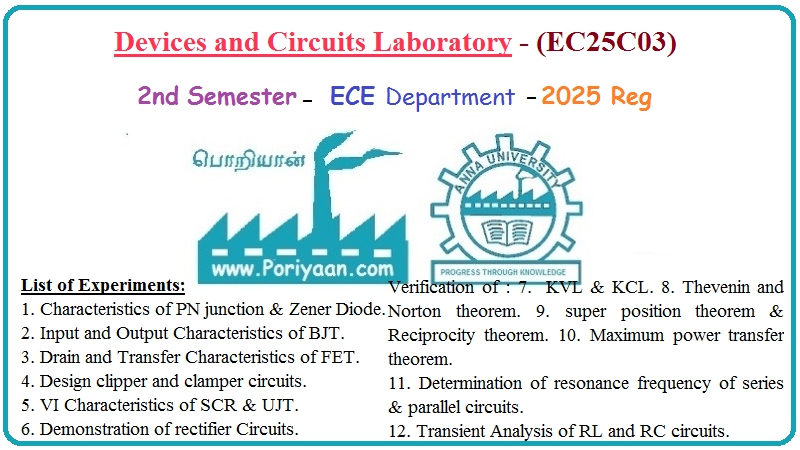
Devices and Circuits Laboratory
EC25C03 2nd Semester ECE Dept | 2025 Regulation | 2nd Semester 2025 Regulation