Data Structures using C PlusPlus: Chapter 6: Trees
Application of Trees: Set Representation and Union, Find Operations
Questions: 1. Write C++ code for the implementation of different types of tree traversals. State few tree applications. 2. How can you construct an expression tree? Describe your answer with an example. 3. Discuss how sets are represented ? 4. Explain union find operations? 5. Explain the algorithm for union and find operations in disjoint sets.
Application
of Trees: Set Representation and Union, Find Operations
Trees
represent the hierachical structure hence associated with this structure there
are many applications of trees which are listed below.
1.
The trees are used in data compression
techniques for encoding the compressed data.
2.
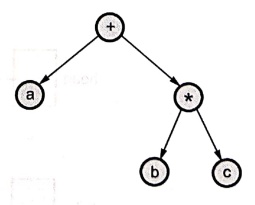
The expression trees are special
type of trees in which the root/parent
node is for operator and child nodes
hold the values of operands.
For example :
The expression a + (b*c) can be represented with the help of trees as.
Here
from this expression tree we can generate infix, prefix, postfix expressions by
traversing the tree in inorder, preorder and postorder manner respectively.
infix
expression a+(b*c)
prefix
expression +a*bc
postfix
expression abc*+
3.
The tree is a useful data structure used by the complier in the parsing phase. The parse tree for the tokens is
generated for particular programming statement and then complier checks for the syntax errors.
4.
Trees are also used in game playing
such as Tic Tac Toe. The trees built
in the game playing are called decision
trees.
5.
As data is arranged systematically in binary
search trees, the binary search trees are used in sorting and searching of records.
1. Set Representation
A
set data structure is a data structure that contains the partitioned sets.
These partitioned sets are separate non overlapping sets.
For
example consider a set S = {S1, S2, ... Sk} in
which each member Si represents the distinct set. These sets are dynamic sets.
Representing
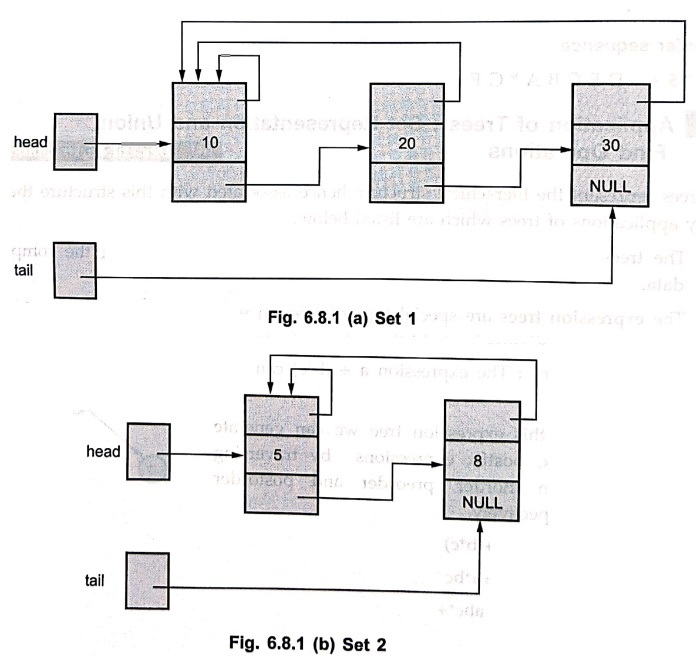
set using linked list is the most convenient method. The representation for
sets (10, 20, 30} and {5, 8} can be ‒
For
each set a linked list is created. The head node is the starting node of each
set and tail node points to the last node of the set.
2. Union and Find Operations
•
There are two tasks that are performed on set data structure
■
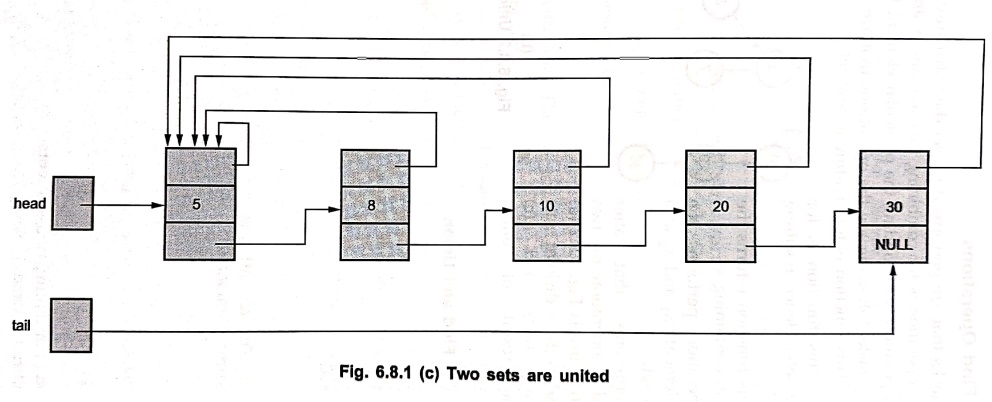
Union : This operation is for
combining two sets into a single set.
■
Find : This operation is for finding
the particular element from the disjoint sets.
•
To support these tasks following are the operations that are used:
1. MakeSet(x) :
This function is for creating a new set.
2. Union(x,y) :
This function is for uniting two sets. Hence resulting set is Sx U Sy.
• FindSet(x):
This function returns the pointer to the set containing x.
•
The union operation performs the union of two elements X1 and X2
at a time from each set.
•
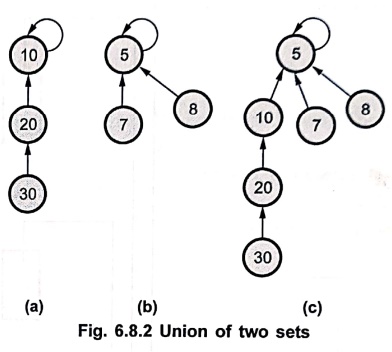
Fig. 6.8.2 represents that after performing
union operation on two sets, the tree structure is Fig. 6.8.2 (a) and (b)
represents two disjoint sets represented as trees and (c) represents the result
of union operation.
Algorithms for Makeset, Find and Union
Algorithm Makeset (x)
{
// Problem Description : This algorithm
creates
// the set with x element
x.parent <‒x //Here x. parent means
parent of x
}
Algorithm Find (x)
{
// Problem Description: This algorithm is
// for returning the desired element
if (x.parent = x) then
return x
else
return Find (x.parent)
}
Algorithm Union (x1,
x2)
{
// Problem Description: For uniting two
elements
// x1 and x2 this algorithm is used
x1Root <‒ Find (x1)
x2Root <‒ Find (x2)
x1Root.parent <‒ x2Root
}
Review Questions
1. Write C++ code for
the implementation of different types of tree traversals. State few tree
applications.
2. How can you
construct an expression tree? Describe your answer with an example.
3. Discuss how sets
are represented ?
4. Explain union find
operations?
5. Explain the
algorithm for union and find operations in disjoint sets.
Data Structures using C PlusPlus: Chapter 6: Trees : Tag: Data Structure, C++ Programing : - Application of Trees: Set Representation and Union, Find Operations
Data Structures using C PlusPlus: Chapter 6: Trees
Under Subject
Data Structures using CPlusPlus
CS25C05 2nd Semester ECE Dept | 2025 Regulation | 2nd Semester 2025 Regulation
Related Subjects
English Essentials II
EN25C02 2nd Semester | 2025 Regulation | 2nd Semester 2025 Regulation
Tamils and Technology தமிழர்களும் தொழில்நுட்பமும்
UC25H02 2nd Semester | 2025 Regulation | 2nd Semester 2025 Regulation
Linear Algebra
MA25C02 2nd Semester | 2025 Regulation

Electron Devices
EC25C01 2nd Semester ECE Dept | 2025 Regulation | 2nd Semester 2025 Regulation
Data Structures using CPlusPlus
CS25C05 2nd Semester ECE Dept | 2025 Regulation | 2nd Semester 2025 Regulation

Circuits and Network Analysis
EC25C02 2nd Semester ECE Dept | 2025 Regulation | 2nd Semester 2025 Regulation

Re-Engineering for Innovation
ME25C05 2nd Semester | 2025 Regulation | 2nd Semester 2025 Regulation
Engineering Drawing - Laboratory
ME25C01 2nd Semester | 2025 Regulation | 2nd Semester 2025 Regulation
Data Structures using CPlusPlus - Laboratory
CS25C05 2nd Semester ECE Dept | 2025 Regulation | 2nd Semester 2025 Regulation
Devices and Circuits Laboratory
EC25C03 2nd Semester ECE Dept | 2025 Regulation | 2nd Semester 2025 Regulation