Data Structures using C PlusPlus: Chapter 6: Trees
Threaded Binary Trees
C++ Program
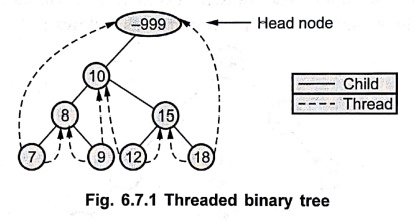
A threaded binary tree is a binary tree in which the NULL pointers of nodes are replaced with special pointers (threads) that point to the inorder predecessor or inorder successor of the node.
Threaded
Binary Trees
• Basic concept : A
threaded binary tree is a binary tree in which the NULL pointers of nodes are
replaced with special pointers (threads) that point to the inorder predecessor
or inorder successor of the node.
•
These "threads" make inorder traversal faster and eliminate the need
for recursion or stacks.
•
We will discuss the inoder threading
technique. The typical threaded binary tree looks like this
•
The typical 'C' structure of the node is
typedef struct thread
{
int data;
int lth,rth;
struct thread *left;
struct thread *right;
}Th;
•
The basic idea in inorder threading is that the left thread should point to the
predecessor and the right thread points to the successor. Here we are assuming
the head node as the starting node and the root node of the tree is attached to
left of head node.
•
Let us see the C++ program for the creation of threaded binary tree.
C++ Program
/************************************************************************
Program For Implementation Of Inorder Threaded Binary Search
Treeand perform insertion, deletion and display of tree.
*** *********************************************************************/
#include<iostream>
using namespace std;
class thread
{
private:
typedef struct bst
{
int data;
int lth,rth;
struct bst *left,
*right;
}node;
node *dummy;
node *New,*root, *temp, *parent;
public:
thread();
void create(); //All The implementation Details are hidden!
void display();
void find();
void delet();
};
/*
‒‒‒‒‒‒‒‒‒‒‒‒‒‒‒‒‒‒‒‒‒‒‒‒‒‒‒‒‒‒‒‒‒‒‒‒‒‒‒‒‒‒‒‒‒‒‒‒‒‒‒‒‒‒‒‒‒‒‒‒‒‒‒‒‒‒‒‒‒‒‒
The constructor defined
‒‒‒‒‒‒‒‒‒‒‒‒‒‒‒‒‒‒‒‒‒‒‒‒‒‒‒‒‒‒‒‒‒‒‒‒‒‒‒‒‒‒‒‒‒‒‒‒‒‒‒‒‒‒‒‒‒‒‒‒‒‒‒‒‒‒‒‒‒‒‒
*/
thread::thread()
{
root=NULL;
}
/*
‒‒‒‒‒‒‒‒‒‒‒‒‒‒‒‒‒‒‒‒‒‒‒‒‒‒‒‒‒‒‒‒‒‒‒‒‒‒‒‒‒‒‒‒‒‒‒‒‒‒‒‒‒‒‒‒‒‒‒‒‒
The create function
‒‒‒‒‒‒‒‒‒‒‒‒‒‒‒‒‒‒‒‒‒‒‒‒‒‒‒‒‒‒‒‒‒‒‒‒‒‒‒‒‒‒‒‒‒‒‒‒‒‒‒‒‒‒‒‒‒‒‒‒‒‒
*/
void thread::create()
{
void insert(node *,node
*);
New=new node;
New‒>left=NULL;
New‒>right=NULL;
New‒>lth=0;
New‒>rth=0;
cout<<"\n
Enter The Element
cin>>New‒>data;
if(root= = NULL)
{ // Tree is not Created
root=New;
dummy=new node;
dummy‒>data= ‒999;
dummy‒>left=root;
root‒>left=dummy;
root‒>right=dummy;
}
else
insert(root,New);
}
/*
‒‒‒‒‒‒‒‒‒‒‒‒‒‒‒‒‒‒‒‒‒‒‒‒‒‒‒‒‒‒‒‒‒‒‒‒‒‒‒‒‒‒‒‒‒‒‒‒‒‒‒‒‒‒‒‒‒‒‒‒
The display function
‒‒‒‒‒‒‒‒‒‒‒‒‒‒‒‒‒‒‒‒‒‒‒‒‒‒‒‒‒‒‒‒‒‒‒‒‒‒‒‒‒‒‒‒‒‒‒‒‒‒‒‒‒‒‒‒‒‒‒‒‒‒
*/
void thread::display()
{
void inorder(node *,node *dummy);
if(root= =NULL)
cout<<"Tree
Is Not Created";
else
{
cout<<"\n
The Tree is : ";
inorder(root,dummy);
}
}
/*
‒‒‒‒‒‒‒‒‒‒‒‒‒‒‒‒‒‒‒‒‒‒‒‒‒‒‒‒‒‒‒‒‒‒‒‒‒‒‒‒‒‒‒‒‒‒‒‒‒‒‒‒‒‒‒‒‒‒‒‒‒‒‒‒‒‒‒‒‒‒‒
The find function which calls the routine for searching an
element
‒‒‒‒‒‒‒‒‒‒‒‒‒‒‒‒‒‒‒‒‒‒‒‒‒‒‒‒‒‒‒‒‒‒‒‒‒‒‒‒‒‒‒‒‒‒‒‒‒‒‒‒‒‒‒‒‒‒‒‒‒‒‒‒‒‒‒‒‒‒‒‒
*/
void thread::find()
{
node *search(node
*,node *,int,node **);
int key;
cout<<"\n
Enter The Element Which You Want To Search";
cin>>key;
temp=search(root,
dummy,key,&parent);
if(temp= = NULL)
cout<<"\nElement
is Not Present";
else
cout<<"
It's Parent Node is "<<parent‒>data;
}
/*
‒‒‒‒‒‒‒‒‒‒‒‒‒‒‒‒‒‒‒‒‒‒‒‒‒‒‒‒‒‒‒‒‒‒‒‒‒‒‒‒‒‒‒‒‒‒‒‒‒‒‒‒‒‒‒‒‒‒‒‒‒‒‒‒‒‒‒‒‒‒‒
The delet function which calls the routine for deletion of an
element
‒‒‒‒‒‒‒‒‒‒‒‒‒‒‒‒‒‒‒‒‒‒‒‒‒‒‒‒‒‒‒‒‒‒‒‒‒‒‒‒‒‒‒‒‒‒‒‒‒‒‒‒‒‒‒‒‒‒‒‒‒‒‒‒‒‒‒‒‒‒‒‒
*/
void thread::delet()
{
void del(node *,node *,int);
int key;
cout<<"\n
Enter The Element U wish to Delete";
cin>>key;
del(root,dummy,key);
}
/*
‒‒‒‒‒‒‒‒‒‒‒‒‒‒‒‒‒‒‒‒‒‒‒‒‒‒‒‒‒‒‒‒‒‒‒‒‒‒‒‒‒‒‒‒‒‒‒‒‒‒‒‒‒‒‒‒‒‒‒‒‒‒‒‒‒‒‒‒‒‒‒
This function is for creating a binary search tree
‒‒‒‒‒‒‒‒‒‒‒‒‒‒‒‒‒‒‒‒‒‒‒‒‒‒‒‒‒‒‒‒‒‒‒‒‒‒‒‒‒‒‒‒‒‒‒‒‒‒‒‒‒‒‒‒‒‒‒‒‒‒‒‒‒‒‒‒‒‒‒
*/
void insert(node *root,node *New)
{
if(New‒>data<root‒>data)
{
if(root‒>lth= =0)
{
New‒>left=root‒>left;
New‒>right=root;
root‒>left=New;
root‒>lth=1;
}
else
insert(root‒>left,New);
}
if(New‒>data>root‒>data)
{
if(root‒>rth= =0)
{
New‒>right=root‒>right;
New‒>left=root;
root‒>rth=1;
root‒>right=New;
}
else
insert(root‒>right,New);
}
}
*/
‒‒‒‒‒‒‒‒‒‒‒‒‒‒‒‒‒‒‒‒‒‒‒‒‒‒‒‒‒‒‒‒‒‒‒‒‒‒‒‒‒‒‒‒‒‒‒‒‒‒‒‒‒‒‒‒‒‒‒‒‒
The search function
‒‒‒‒‒‒‒‒‒‒‒‒‒‒‒‒‒‒‒‒‒‒‒‒‒‒‒‒‒‒‒‒‒‒‒‒‒‒‒‒‒‒‒‒‒‒‒‒‒‒‒‒‒‒‒‒‒‒‒‒
*/
node *search(node *root,node "dummy,int key,node **parent)
{
node *temp;
int flag=0;
temp=root;
while((temp! =dummy))
{
if(temp‒>data= =key)
{
cout<<"\n
The "<<temp‒>data<<" Element is Present";
flag=1;
return temp;
}
*parent=temp;
if(temp‒>data>key)
temp=temp‒>left;
else
temp=temp‒>right;
}
return NULL;
}
/*
‒‒‒‒‒‒‒‒‒‒‒‒‒‒‒‒‒‒‒‒‒‒‒‒‒‒‒‒‒‒‒‒‒‒‒‒‒‒‒‒‒‒‒‒‒‒‒‒‒‒‒‒‒‒‒‒‒‒‒
This function is for deleting a node from binary search tree
There exists three possible cases for deletion of a node
‒‒‒‒‒‒‒‒‒‒‒‒‒‒‒‒‒‒‒‒‒‒‒‒‒‒‒‒‒‒‒‒‒‒‒‒‒‒‒‒‒‒‒‒‒‒‒‒‒‒‒‒‒‒‒‒‒‒‒‒
*/
void del(node *root,node *dummy,int key)
{
node *temp,*parent,*temp_succ;
node *search(node *,node *,int,node **);
int flag=0;
temp=search(root,dummy,key,&parent);
if(root =temp)
{
cout<<"\n
Its Root Node Which Can Not Be Deleted!!";
return;
}
//deleting a node with two children
if(temp‒>lth= =1 && temp‒>rth= =1)
{
parent=temp;
temp_succ=temp‒>right;//Finding
Inorder successor
while(temp_succ‒>lth=
=1)
{
flag=1;
parent=temp_succ;
temp_succ=temp_succ>left;
}
if(flag= =0)
{
temp‒>data=temp_succ‒>data;
parent‒>right=temp_succ‒>right;
parent‒>rth=0;
}
else//inorder successor is on left subbranch.
// and
it has to be traversed
{
temp‒>data=temp_succ‒>data;
parent‒>rth=0;
parent‒>lth=0;
parent‒>left=temp_succ‒>left;
}
cout<<" Now Deleted it!";
return;
}
//deleting a node having only one child
//The node to be deleted has left child
if(temp‒>lth= =1
&& temp‒>rth‒=0)
{
if(parent‒>left= =temp)
{
(temp‒>left)‒>right=parent;
parent‒>left=temp‒>left;
}
else
{
(temp‒>left)‒>right=temp‒>right;
parent‒>right=temp‒>left;
}
temp=NULL;
delete temp;
cout<<" Now Deleted it!";
return;
}
//The node to be deleted has right child
if(temp‒>lth= =0 && temp‒>rth!=0)
{
if(parent‒>left= =temp)
{
parent‒>left=temp‒>right;
(temp‒>right)‒>left=temp‒>left;
(temp‒>right)‒>right=parent;
}
else
{
parent‒>right=temp‒>right;
(temp‒>right)‒>left=parent;
}
temp=NULL;
delete temp;
cout<<" Now Deleted it!";
retum;
}
//deleting a node which is having no child
if(temp‒>lth= =0 && temp‒>rth= =0)
{
if(parent‒>left= =temp)
{
parent‒>left=temp‒>left;
parent‒>lth=0;
}
else
{
parent‒>right=temp‒>right;
parent‒>rth=0;
cout<<"
Now Deleted it!";
return;
}
}
/*
‒‒‒‒‒‒‒‒‒‒‒‒‒‒‒‒‒‒‒‒‒‒‒‒‒‒‒‒‒‒‒‒‒‒‒‒‒‒‒‒‒‒‒‒‒‒‒‒‒‒‒‒‒‒‒‒‒‒‒‒‒‒‒‒‒‒‒‒‒‒‒‒‒‒‒‒
The inorder function
‒‒‒‒‒‒‒‒‒‒‒‒‒‒‒‒‒‒‒‒‒‒‒‒‒‒‒‒‒‒‒‒‒‒‒‒‒‒‒‒‒‒‒‒‒‒‒‒‒‒‒‒‒‒‒‒‒‒‒‒‒‒‒‒‒‒‒‒‒‒‒‒‒‒‒‒
*/
void inorder(node *temp,node *dummy)
{
while(templ=dummy)
{
while(temp‒>lth= =1)
temp=temp‒>left;
cout<<"
"<<temp‒>data;
while(temp‒>rth= =0)
{
temp=temp‒>right;
if(temp= =dummy)
return;
cout<<"
"<<temp‒>data;
}
temp=temp‒>right;
}
}
/*
‒‒‒‒‒‒‒‒‒‒‒‒‒‒‒‒‒‒‒‒‒‒‒‒‒‒‒‒‒‒‒‒‒‒‒‒‒‒‒‒‒‒‒‒‒‒‒‒‒‒‒‒‒‒‒‒‒‒‒‒‒‒‒‒‒‒‒‒‒‒‒‒‒‒‒
The main function
‒‒‒‒‒‒‒‒‒‒‒‒‒‒‒‒‒‒‒‒‒‒‒‒‒‒‒‒‒‒‒‒‒‒‒‒‒‒‒‒‒‒‒‒‒‒‒‒‒‒‒‒‒‒‒‒‒‒‒‒‒‒‒‒‒‒‒‒‒‒‒‒‒‒‒
*/
void main()
{
int choice;
char ans='N';
thread th;
clrscr();
do
{
clrscr();
cout<<"\n\t
Program For Threaded Binary Tree";
cout<<"\n1.Create
\n2.Display \n3.Search \n4.Delete";
cin>>choice;
switch(choice)
{
case 1:do
{
th.create();
cout<<"\n
Do u Want To enter More Elements?(y/n)";
ans=getch();
} while (ans= ='y');
break;
case 2:th.display();
break;
case 3:th.find();
break;
case 4:th.delet();
break;
}
cout<<"\n\nWant To See Main Menu?(y/n)";
ans=getche();
while(ans= ='y');
}
Output
Program For Threaded
Binary Tree.
1.Create
2.Display
3.Search
4.Delete1
Enter The Element 4
Do u Want To enter
More Elements?(y/n)
Enter The Element 2
Do u Want To enter
More Elements?(y/n)
Enter The Element 3
Do u Want To enter
More Elements?(y/n)
Enter The Element 1
Do u Want To enter
More Elements?(y/n)
Enter The Element 6
Do u Want To enter
More Elements?(y/n)
Enter The Element 5
Do u Want To enter
More Elements?(y/n)
Enter The Element 7
Do u Want To enter
More Elements?(y/n)
Want To See Main Menu?(y/n)
Program For Threaded
Binary Tree
1.Create
2.Display
3.Search
4.Delete2
The Tree is: 1 2 3 4 5
6 7
Want To See Main
Menu?(y/n)
Program For Threaded
Binary Tree
1.Create
2.Display
3.Search
4.Delete3
Enter The Element
Which You Want To Search1
The 1 Element is
Present It's Parent Node is 2
Want To See Main
Menu?(y/n)
Program For Threaded
Binary Tree
1.Create
2.Display
3.Search
4.Delete4
Enter The Element U
wish to Delete2
The 2 Element is
Present Now Deleted it!
Want To See Main
Menu?(y/n)
Program For Threaded
Binary Tree
1.Create
2.Display
3.Search
4.Delete2
The Tree is: 1 3 4 5 6
7
Want To See Main
Menu?(y/n)
Logic explanation for threaded binary tree ‒
In
thread binary tree, the NULL pointers
are avoided. Instead of left NULL pointer the link points to inorder
predecessor of that node. Similarly instead of right NULL pointer the link
points to inorder successor of that node.
There
are two additional fields in each node named as 1th and rth these fields
indicate whether left or right thread
is present. Thread present means the NULL link is replaced by a link to inorder
predecessor or inorder successor. To represent that there exists thread the lth
or rth Fields are set to 0. Let us take one example to explain how a threaded
binary tree gets created. Suppose we want to create a threaded binary tree for
the nodes haivng values ‒
10, 8, 6, 12, 9, 11, 14
Initially
we will create a dummy node which will act as a header of the tree.
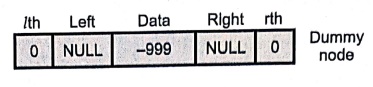
Now
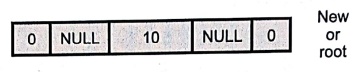
let us take first value i.e. 10. The node with value 10 will be the root node
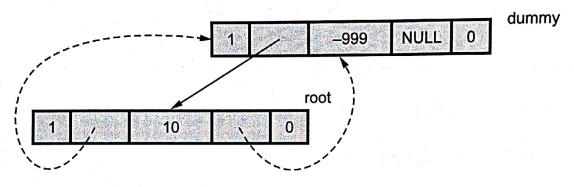
we will attach this root node as left child of dummy node.
The
NULL links of root's left and right child will be pointed to dummy.
Now
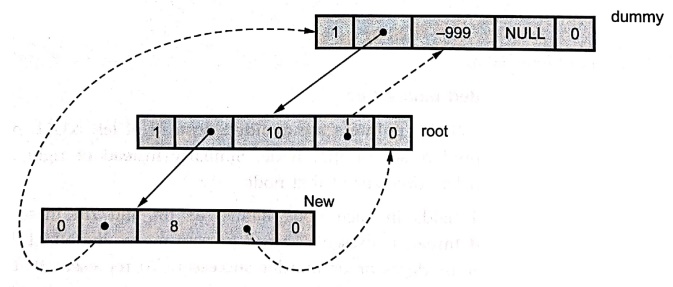
next comes 8. The 8 will be compared with 10, as the value is less than 10, we
will attach 8 as left child of 10 and we will set root's lth field to 1,
indicating that the node 10 is having left child. See then how the links are
arranged.
New
→ left = root left
New
→ right = root;
root
→ left = New;
root
→ Ith = 1;
Note
that the left link of node 8 points to its inorder predecessor and right link
of node 8 points to its inorder successor.
Next
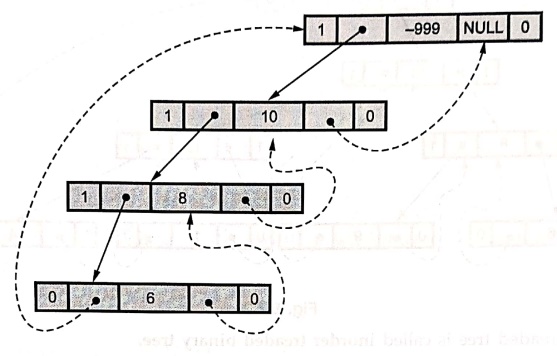
comes 6. The value 6 will be first compared with root i.e. with 10. As 6 is
less than 10, we will move on left sub‒branch. The 6 will then be compared with
8, so we have to move on left sub‒branched of 8. But 1th of node 8 is 0,
indicating that there is no left child to 8, so we will attach 6 as left child
to 8.
Then
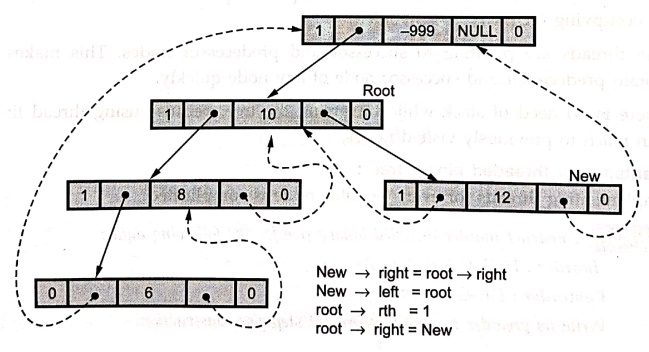
comes 12. We will compare 12 with 10. As 12 is greater than 10, we will attach
the node 12 as right child of 10.
New
→right = root → right
New
→ left = root
root
→rth = 1
root
→ right = New
Note
that the left field of node 12 points to its inorder predecessor and right
field of node 12 points to its inorder sussessor. Thus by attaching 9, 11, 14
as appropriate children, the threaded binary tree will look like this ‒
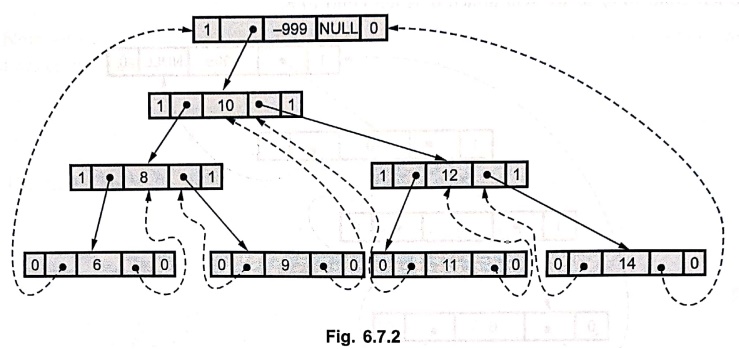
Such
a threaded tree is called inorder treaded binary tree.
Advantages of threaded binary tree :
1.
In threaded binary tree there is no NULL pointer present. Hence memory wastage
in occupying NULL links is avoided.
2.
The threads are pointing to successor and predecessor nodes. This makes us to
obtain predecessor and successor node of any node quickly.
3.
There is no need of stack while traversing the tree, because using thread links
we can reach to previously visited nodes.
Disadvantages of threaded binary tree :
1.
Implementing threads for every possible node is complicated.
Example : 1
Construct inorder
threaded binary tree for the following data:
Inorder : D‒E+C $ B*A‒G*F
Postorder : DE‒C+B$A*GF*‒
Write its preorder
traversal. Represent stepwise construction.
Solution: Step 1:
Inorder : D‒E+C$B*A‒G*F
Postorder : DE‒C+B$A*GF*‒
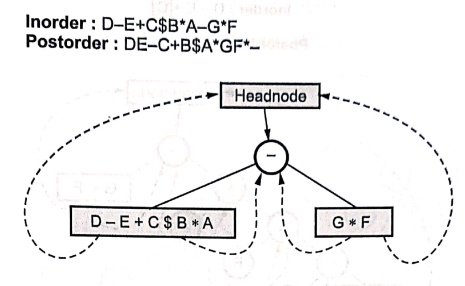
The
last node in postorder sequence ‒. is It is actually a root node. We will
locate ‒ in inorder sequence. Left sequence of "‒" represent left
subtree and right sequence of "‒" represent right subtree.
Step 2:
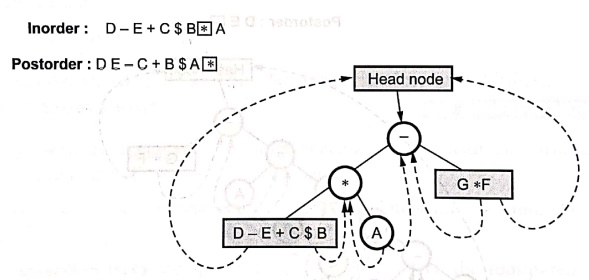
Step 3:
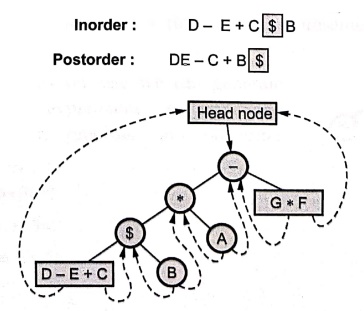
Step 4:
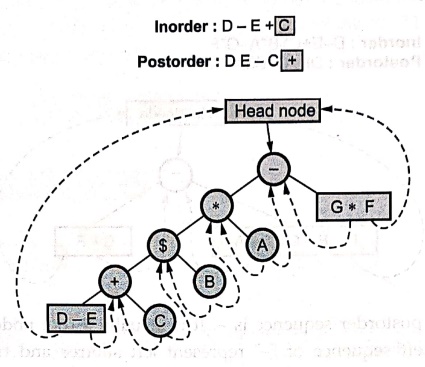
Step 5:
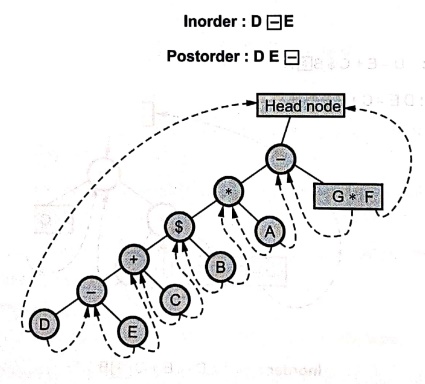
Step 6:
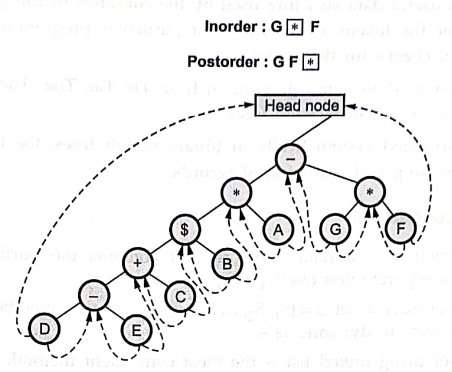
is
the required threaded binary tree.
Preorder sequence
‒ * $+ D E C B A * G F
Data Structures using C PlusPlus: Chapter 6: Trees : Tag: Data Structure, C++ Programing : C++ Program - Threaded Binary Trees
Data Structures using C PlusPlus: Chapter 6: Trees
Under Subject
Data Structures using CPlusPlus
CS25C05 2nd Semester ECE Dept | 2025 Regulation | 2nd Semester 2025 Regulation
Related Subjects

English Essentials II
EN25C02 2nd Semester | 2025 Regulation | 2nd Semester 2025 Regulation

Tamils and Technology தமிழர்களும் தொழில்நுட்பமும்
UC25H02 2nd Semester | 2025 Regulation | 2nd Semester 2025 Regulation
Linear Algebra
MA25C02 2nd Semester | 2025 Regulation

Electron Devices
EC25C01 2nd Semester ECE Dept | 2025 Regulation | 2nd Semester 2025 Regulation
Data Structures using CPlusPlus
CS25C05 2nd Semester ECE Dept | 2025 Regulation | 2nd Semester 2025 Regulation

Circuits and Network Analysis
EC25C02 2nd Semester ECE Dept | 2025 Regulation | 2nd Semester 2025 Regulation

Re-Engineering for Innovation
ME25C05 2nd Semester | 2025 Regulation | 2nd Semester 2025 Regulation
Engineering Drawing - Laboratory
ME25C01 2nd Semester | 2025 Regulation | 2nd Semester 2025 Regulation
Data Structures using CPlusPlus - Laboratory
CS25C05 2nd Semester ECE Dept | 2025 Regulation | 2nd Semester 2025 Regulation
Devices and Circuits Laboratory
EC25C03 2nd Semester ECE Dept | 2025 Regulation | 2nd Semester 2025 Regulation