Data Structures using C PlusPlus: Chapter 6: Trees
Binary Search Tree
Data Structures using C++ Program
Questions: 1. Give an algorithm for searching in BST. OR Write algorithm to locate an element from binary search tree. 2. Write the routines to insert and remove a node from binary search tree.
Binary
Search Tree
Definition:
A Binary Search Tree is a binary tree in which :
•
Left subtree contains only nodes with values less than the node's value.
•
Right subtree contains only nodes with values greater than the node's value.
•
Both left and right subtrees must also be binary search trees.
The
binary search tree is based on the binary search algorithm. While creating the
binary search tree the data is systematically arranged. That means values at
left subtree < root node value < Right subtree values. See the Fig.
6.6.1.
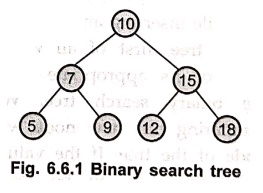
If
you observe the Fig. 6.6.1 carefully, you will find that the left value <
parent value < right value is followed throughout the tree.
Various
operations that can be performed on binary search tree are ‒
1. Insertion of a node
in a binary tree.
2. Deletion of some
element from the binary search tree.
3. Searching of an
element in the binary tree.
4. Display of binary
tree.
Let
us discuss each operation one by one ‒
1. Insertion of a node in a binary tree
Algorithm:
1.
Read the value for the node which is to be created, and store it in a node
called New.
2.
Initially if (root!=NULL) then root=New.
3.
Again read the next value of node created in New.
4.
If (New‒>value < root‒>value) then attach New node as a left child of root
otherwise attach New node as a right
child of root.
5.
Repeat step 3 and 4 for constructing required binary search tree completely.
void bintree::insert(node *root,node *New)
{
if(New‒>data < root‒>data)
{
if(root‒>left= =NULL) //
Attaching left node to the current node.
root‒>left=New;
else
insert(root‒>left,New); // If the
root node has already some left child, then move on to left subtree
}
if(New‒>data>root‒>data)
{
if(root‒>right= =NULL)
root‒>right=New;
else
insert(root‒>right,New);
}
}
While
inserting any node in binary search tree, first of all we have to look for its
appropriate position in the binary search tree. We start comparing this new
node with each node of the tree. If the value of the node which is to be
inserted is greater than the value of current node we move on to the right sub‒branch
otherwise we move on to the left sub‒branch. As soon as the appropriate
position is found attach this new node as left or right child appropriately.
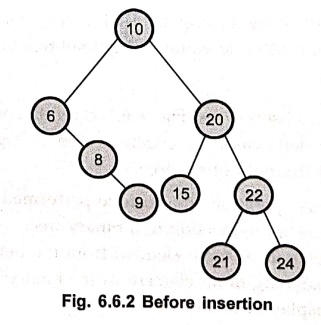
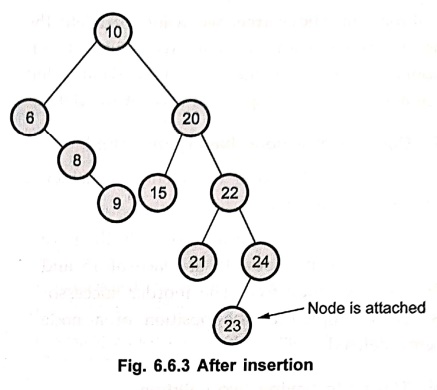
In
the Fig. 6.6.2 if we want to insert 23. Then we will start comparing 23 with
value of root node i.e. 10. As 23 is greater than 10, we will move on right sub‒tree.
Now we will compare 23 with 20 and move right, compare 23 with 22 and move
right. Now compare 23 with 24 but it is less than 24. We will move on left
branch of 24. But as there is NULL node as left child of 24, we can attach 23
as left child of 24.
2. Deletion of an element from the binary tree
For
deletion of any node from binary search tree there are three cases which are
possible.
i.
Deletion of leaf node.
ii.
Deletion of a node having one child.
iii.
Deletion of a node having two children.
Let
us discuss the above cases one by one.
i. Deletion of leaf
node.
This
is the simplest deletion, in which we set the left or right pointer of parent
node as NULL.
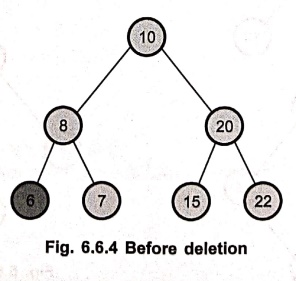
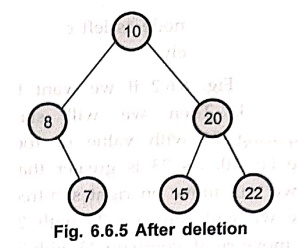
From
the above tree, we want to delete the node having value 6 then we will set left
pointer of its parent node as NULL. That is left pointer of node having value 8
is set to NULL.
ii. Deletion of a node
having one child.
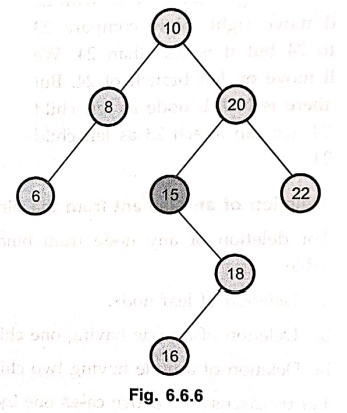
To
explain this kind of deletion, consider a tree as given below.
If
we want to delete the node 15, then we will simply copy node 18 at place of 15
and then set the node free. The inorder successor is always copied at the
position of a node being deleted.
iii. The node having
two children
Again,
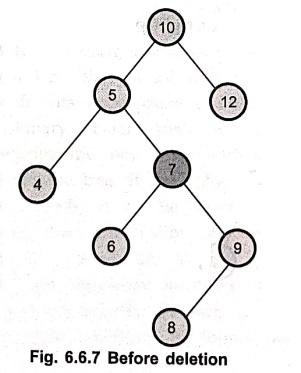
let us take some example for discussing this kind of deletion.
Let
us consider that we want to delete node having value 7. We will then find out
the inorder successor of node 7. The inorder succesor will be simply copied at
location of node 7. Thats it!
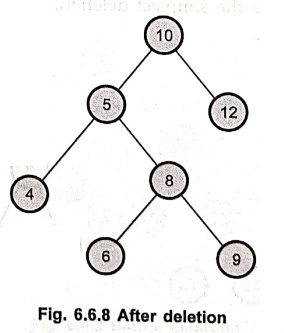
That
means copy 8 at the position where value of node is 7. Set left pointer of 9 as
NULL. This completes the deletion procedure.
void bintree::del(node *root,int key),
{
node *temp_succ;
if(root= =NULL)
cout<<"Tree is not Created!";
else
{
temp=root;
search(&temp,key,&parent);
//temp node is to be
deleted
/*deleting a node with
two children*/
if(temp‒>left! =NULL&&temp‒>right!=NULL)
{
parent=temp;
temp_succ=temp‒>right; //temp is node which is to be deleted. Parent is a node which keeps track of parent node. temp and temp_succ is for keeping track of successor of temp node.
while(temp_succ‒>left!=
NULL)
{
parent = temp_succ;
temp_succ=temp_succ‒>left;
<‒‒‒‒‒‒‒‒‒‒‒Moving to leftmost sub‒tree
// Copying the successor node's data to temp node. Thus contents of
temp node gets deleted.
}
temp‒>data=temp_succ‒>data;
//copying the immediate
successor
temp‒>right=NULL;
cout<<" Now
Deleted it!";
return;
}
/*deleting a node having only one child*/
/*The node to be deleted has left child*/
if(temp‒>left!= NULL &&temp‒>right= = NULL)
{
if(parent‒>left= =temp)<‒‒‒‒‒‒‒‒‒‒‒
Finding the parent of temp
parent‒>left=temp‒>left;
else
parent‒>right=temp‒>left;
temp=NULL;
delete temp;
cout<<" Now
Deleted it!";
return;
}
/*The node to be deleted has right child*/
if(temp‒>left= =NULL &&temp‒>right!=NULL)
{
if(parent‒>left= =temp)
parent‒>left=temp‒>right;
else
parent‒>right=temp‒>right;
}
temp=NULL;
delete temp;
cout<<" Now Deleted it!";
return;
}
/*deleting a node which is having no child*/
if(temp‒>left= =NULL &&temp‒>right= =NULL)
{
if(parent‒>left= =temp)
parent‒>left=NULL;
else
parent‒>right=NULL;
cout<<" Now
Deleted it!";
return;
}
}
}
3. Searching a node from binary search tree.
Algorithm
1.
The node which is to be searched in the BST is assumed as key node.
2.
Compare key node with root node, assume it as current node.
3.
If value of key node is greater than current node then we search on right sub
branch.
4.
If value of key node is less than current node then we search on left sub
branch.
5.
If value of key node is equal to current node then we declarer "node is
found".
6.
Otherwise we declare "node is not found".
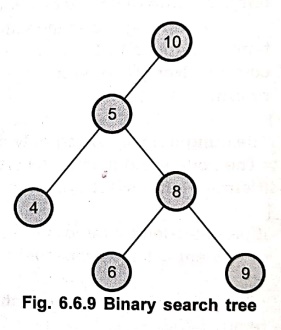
In
the above tree, if we want to search for value 9. Then we will compare 9 with
root node 10. As 9 is less than 10 we will search on left sub‒branch. Now
compare 9 with 5, but 9 is greater than 5. So we will move on right sub‒branch.
Now compare 9 with 8 but as 9 is greater than 8 we will move on right sub‒branch.
As the node we will get holds the value 9. Thus the desired node can be
searched. Let us see the 'C' implementation of it.
The
routine is as given below.
void bintree::search(node **temp,int key,node **parent)
{
if(*temp= =NULL)
cout<<endl<<<"Tree
is Not Created"<<endl;
else
{
while(*temp!= NULL)
{
if((*temp)‒>data=
=key)
{
cout<<"\nThe"<<(*temp)‒>data<<"Element
is Present";
break;
}
*parent=*temp://stores
the parent value<‒‒‒‒‒‒ //• Marking the
parent node
if((*temp)‒>data>key)
<‒‒‒‒‒‒ //• If current node is greater than key
*temp=(*temp)‒>left;
<‒‒‒‒‒‒ //• Search for the left subtree
else
*temp=(*temp)‒>right;
}
}
return;
}
We
can display a tree in inorder fashion. Hence the complete implementation is
given below along with appropriate output.
/**************************************************************************
Program For Implementation Of Binary Search Tree and perform
insertion deletion,searching,display of tree.
**************************************************************************/
#include<iostream>
using namespace std;
class bintree
{
typedef struct bst
{
int data;
struct bst
*left,*right;
}node;
node *root,*New,*temp, *parent;
public:
bintree()
{
root=NULL;
}
void create();
void display();
void delet();
void find();
void insert(node *,node *);
void inorder(node *);
void search(node **,int,node **);
void del(node *,int);
};
void bintree::create()
{
New = new node;
New‒>left=NULL;
New‒>right=NULL;
cout<<"\n
Enter The Element ";
cin>>New‒>data;
if(root= =NULL)
root=New;
else
;
}
insert(root,New);
}
void bintree::insert(node *root,node *New)
{
if(New‒>data < root‒>data)
{
if(root‒>left= =
NULL)
root‒>left=New;
else
insert(root‒>left,New);
}
if(New‒>data > root‒>data)
{
if(root‒>right= =NULL)
root‒>right=New;
else
insert(root‒>right,New);
}
}
void bintree::display()
{
if(root= NULL)
cout<<"Tree Is Not Created";
else
{
cout<<"\n The Tree is: ";
inorder(root);
}
}
void bintree::inorder(node *temp)
{
if(temp!=NULL)
{
inorder(temp‒>left);
cout<<" "<<<temp‒>data;
inorder(temp‒>right);
}
}
void bintree::find()
{
int key;
cout<<"\n Enter The Element Which You Want To
Search";
cin>>key;
temp=root;
search(&temp,key,&parent);
if(temp= =NULL)
cout<<"\n Element is not present";
else
cout<<"\nParent of node "<<<temp‒>data<<"is
"<<parent‒>data;
void bintree::search(node **temp,int key,node **parent)
{
if(*temp= =NULL)
cout<<endl<<"Tree is Not
Created"<<endl;
else
{
while(*temp!= NULL)
{
if((*temp)‒>data==key)
{
cout<<"\nThe"<<(*temp)‒>data<<"Element
is Present";
break;
}
*parent=*temp://stores the parent value
if((*temp)‒>data>key)
*temp=(*temp)‒>left;
else
*temp=(*temp)‒>right;
}
}
return;
}
void bintree::delet()
{
int key;
cout<<"\n Enter The Element U wish to Delete";
cin>>key;
if(key= =root‒>data)
{
bintree();//assigning a value NULL to root
}
else
del(root,key);
}
/*
This function is for deleting a node from binary search tree.
There exist three possible cases for deletion of a node
*/
void bintree::del(node *root,int key)
{
node *temp_succ;
if(root= =NULL)
cout<<"Tree is not Created!";
else
{
temp=root;
search(&temp,key,&parent);
//temp node is to be deleted
/*deleting a node with two children*/
if(temp‒>left!=NULL&&temp‒>right!=NULL)
{
parent=temp;
temp_succ=temp‒>right;
while(temp_succ‒>left!= NULL)
{
parent=temp_succ;
temp_succ=temp_succ‒>left;
}
temp‒>data=temp_succ‒>data;
//copying the immediate successor
temp‒>right = NULL;
cout<<" Now Deleted it!":
return;
}
/*deleting a node having only one child*/
/*The node to be deleted has left child*/
if(temp‒>left!= NULL &&temp‒>right= = NULL)
{
if(parent‒>left= =temp)
parent‒>left=temp‒>left;
else
parent‒>right=temp‒>left;
temp=NULL;
delete temp;
cout<<" Now Deleted it!";
return;
}
/*The node to be deleted has right child*/
if(temp‒>left= =NULL &&temp‒>right!= NULL)
{
if(parent‒>left= =temp)
parent‒>left=temp‒>right;
else
parent‒>right=temp‒>right;
temp=NULL;
delete temp;
cout<<" Now Deleted it!";
return;
}
/*deleting a node which is having no child*/
if(temp‒>left= =NULL &&temp‒>right= =NULL)
{
if(parent‒>left= =temp)
parent‒>left=NULL;
else
parent‒>right=NULL;
cout<<" Now Deleted it!";
return;
}
}
}
void main()
{
int choice;
char ans='N';
bintree tr;
cout<<"\n\t Program For Binary Search Tree ";
do
{
cout<<"\n1.Create\n2.Search\n3.Delete\n4.Display";
cout<<"\n\n Enter your choice :";
cin>>choice;
switch(choice)
{
case 1:do
{
tr.create();
cout<<"Do
u Want To enter More elements?(y/n)"<<endl;
ans=getche();
}while(ans= ='y');
break;
case 2:tr.find();
break;
case 3:tr.delet();
break;
case 4:tr.display();
break;
}
}while(choice!=5);
}
Output
Program For Binary
Search Tree
1.Create
2.Search
3.Delete
4.Display
Enter your choice :1
Enter The Element 10
Do u Want To enter
More elements?(y/n)
y
Enter The Element 8
Do u Want To enter
More elements?(y/n)
y
Enter The Element 7
Do u Want To enter
More elements? (y/n)
y
Enter The Element 9
Do u Want To enter
More elements?(y/n)
y
Enter The Element 12
Do u Want To enter
More elements?(y/n)
y
Enter The Element 11
Do u Want To enter
More elements?(y/n)
y
Enter The Element 13
Do u Want To enter
More elements?(y/n).
n
1.Create
2.Search
3.Delete
4.Display
Enter your choice :4
The Tree is : 7 8 9 10
11 12 13
1.Create
2.Search
3.Delete
4.Display
Enter your choice :2
Enter The Element
Which You Want To Search 13
The13Element is
Present
Parent of node 13is 12
1.Create
2.Search
3.Delete
4.Display
Enter your choice :3
Enter The Element U
wish to Delete 12
The 12 Element is
Present Now Deleted it!
1.Create
2.Search
3.Delete
4.Display
Enter your choice :4
The Tree is: 7 8 9 10
11 13
1.Create
2.Search
3.Delete
4.Display
Enter your choice :3
Enter The Element U
wish to Delete 11
The11Element is
Present Now Deleted it!
1.Create
2.Search
3.Delete
4.Display
Enter your choice :4
The Tree is : 7 8 9 10
13
1.Create
2.Search
3.Delete
4.Display
Enter your choice :3
Enter The Element U
wish to Delete7
The7Element is Present
Now Deleted it!
1.Create
2.Search
3.Delete
4.Display
Enter your choice :4
The Tree is: 8 9 10 13
1.Create
2.Search
3.Delete
4.Display
Enter your choice :5
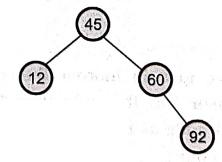
Example :
1
Draw the binary search
tree for the following input list 25, 45, 12, 60, 75, 92, 10. Trace an
algorithm to delete the nodes 25, 75, 10 from the tree.
Solution :
The creation of binary search tree is :
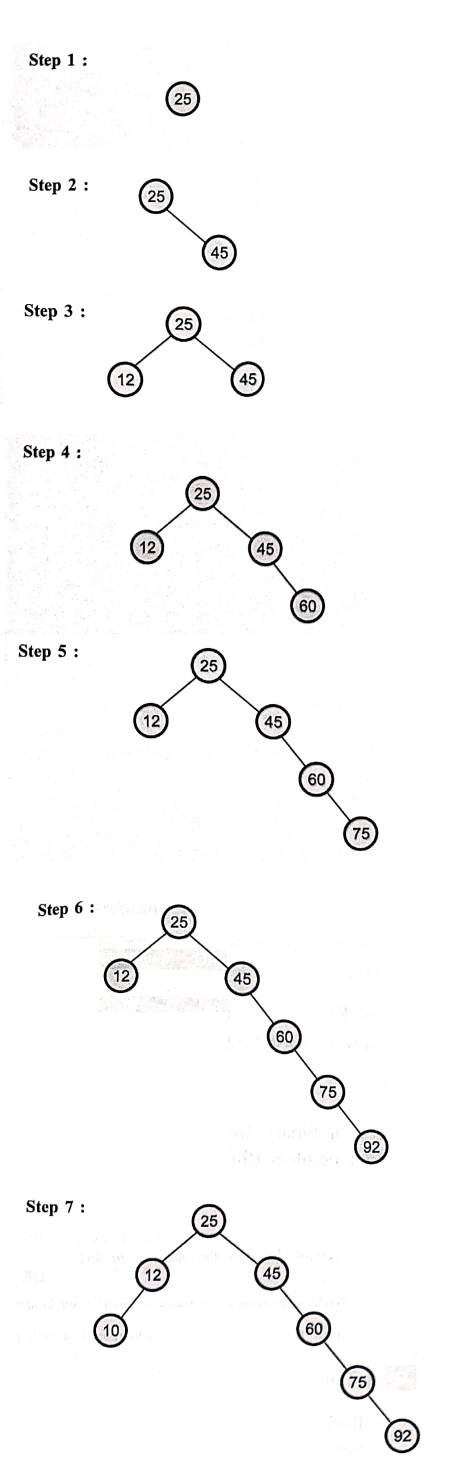
The
deletion of nodes 25, 75 and 10 is as follows:
Step 1 :
Delete
25
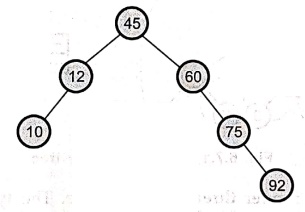
The
node 25 is the root node. The inorder successor of node 25 is 45. We will
replace 25 by 45. Thus the binary search tree then becomes as follows:
Step 2 :
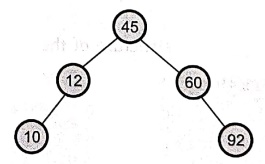
Delete
75
The
node 75 has only one right child. We will replace 75 by 92. And then 75 will be
removed. The binary tree then becomes :
Step 3 :
Delete
10
The
node 10 is a leaf node. Hence simply make it NULL. The binary search tree will
then be as follows:
Review Questions
1. Give an algorithm
for searching in BST.
OR
Write algorithm to
locate an element from binary search tree.
2. Write the routines
to insert and remove a node from binary search tree.
Data Structures using C PlusPlus: Chapter 6: Trees : Tag: Data Structure, C++ Programing : Data Structures using C++ Program - Binary Search Tree
Data Structures using C PlusPlus: Chapter 6: Trees
Under Subject
Data Structures using CPlusPlus
CS25C05 2nd Semester ECE Dept | 2025 Regulation | 2nd Semester 2025 Regulation
Related Subjects

English Essentials II
EN25C02 2nd Semester | 2025 Regulation | 2nd Semester 2025 Regulation

Tamils and Technology தமிழர்களும் தொழில்நுட்பமும்
UC25H02 2nd Semester | 2025 Regulation | 2nd Semester 2025 Regulation

Linear Algebra
MA25C02 2nd Semester | 2025 Regulation

Electron Devices
EC25C01 2nd Semester ECE Dept | 2025 Regulation | 2nd Semester 2025 Regulation
Data Structures using CPlusPlus
CS25C05 2nd Semester ECE Dept | 2025 Regulation | 2nd Semester 2025 Regulation

Circuits and Network Analysis
EC25C02 2nd Semester ECE Dept | 2025 Regulation | 2nd Semester 2025 Regulation

Re-Engineering for Innovation
ME25C05 2nd Semester | 2025 Regulation | 2nd Semester 2025 Regulation
Engineering Drawing - Laboratory
ME25C01 2nd Semester | 2025 Regulation | 2nd Semester 2025 Regulation
Data Structures using CPlusPlus - Laboratory
CS25C05 2nd Semester ECE Dept | 2025 Regulation | 2nd Semester 2025 Regulation
Devices and Circuits Laboratory
EC25C03 2nd Semester ECE Dept | 2025 Regulation | 2nd Semester 2025 Regulation