Data Structures using C PlusPlus: Chapter 6: Trees
Trees (Data Structures): Two Marks Important Questions and Answers
Data Structures using C++ Program
Data Structures using C++ Program: Anna University Part A Two Marks Important Questions and Answers
Data Structures using C ++
Chapter 6: Trees
Two Marks Questions with Answers
1. Give
various implementation of tree.
Answer:
The
tree can be implemented by two ways
1. Sequential
implementation ‒ The tree is implemented using arrays in
this type of implementation.
2. Linked
implementation ‒ The tree is implemented or represented
using linked list.
2. Define
: Binary tree.
Answer:
A
binary tree is a finite set of nodes which is either empty or consists of root
and two disjoint binary trees called the left subtree and right subtree.
3. Define
complete binary tree.
Answer:
A
complete binary tree is a tree in which every node except the leaf nodes should
have exactly two children not necessarily on the same level.
4. How is
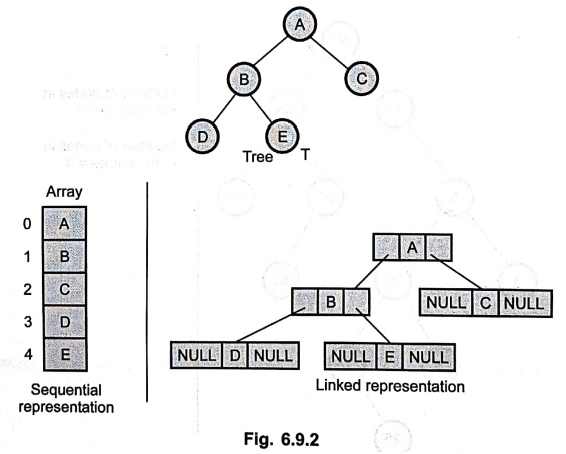
binary tree represented using an array ? Give an example.
Answer:
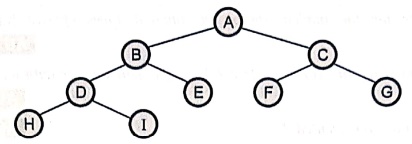
In
an array root node will be at position 1. Its left child will be at position 2
and right child will be at position 3. Hence the nodes of tree are placed in
array using following formula ‒
Parent
(n) = floor (n‒1)/2
left
(n) = (2n + 1)
right (n) = (2n + 2)
Consider
tree as given below.
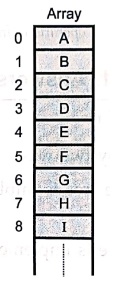
It
will be placed in an array as given below.
5. Define
binary search tree.
Answer:
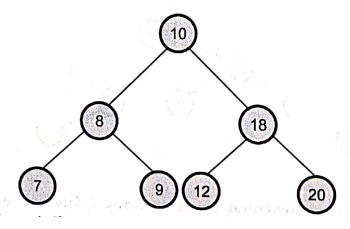
Binary
search tree is a binary tree in which each node is systematically arranged i.e.
the left child has less value than its parent node and right child has greater
value than its parent node. The searching of any node in such a tree becomes
efficient in this type of tree.
For example ‒
6. Which
tree representation is mostly preferred by the developers Sequential or linked?
Justify.
Answer:
There
are two ways of representing the binary tree ‒ and linked representation. The
linked representation is normally preferred by sequential representation
developers because in the linked representation the binary tree is represented
using linked list. Hence the tree with any number of nodes can be created.
Secondly there is no wastage or shortage of the memory in this representation.
7. State
the properties of binary search tree.
Answer:
Following
are some important properties of binary search tree ‒
1.
The left node should contain the key value which is less than its parent node's
key value.
2.
The right node should have the key value which is greater than its parent
node's key value.
3.
Both the left and right subtrees must also be binary search trees.
8. When
does a binary tree become binary search tree?
Answer:
If
the node containing the value less than the value of the parent node is
attached as a left child and a node containing the value greater than the value
of the parent node is attached as a right child then that binary tree becomes
the binary search tree. Refer Fig. 6.7.1.
9. When
the tree is called complete binary tree?
Answer:
The
complete binary tree is a full binary tree in which every node has zero or two
children and all the leaves are at the same depth.
10. Why
it said that the searching a node in a binary search tree is efficient than
that of a
simple binary tree?
Answer:
In
the binary search tree the nodes are arranged in such a way that the left node
is having less data value than rot node value. And the right nodes are having
larger value than that of root. Because of this while searching any node the
value of target node will be compared with the parent node and accordingly
either left sub branch or right sub branch will be searched. This procedure
will be repeated if required. So one has to compare only particular branches.
Thus searching becomes efficient.
11. What
is the time complexity of binary search tree?
Answer:
The
time complexity of binary search tree is n log2n.
12. List the applications of trees.
Answer:
In
computer networking such as Local Area Network (LAN), Wide Area Networking
(WAN), internetworking.
2.
In telephone cabling graph theory is effectively used.
3.
In job scheduling algorithms the graphs are used.
13. In
tree construction which is the suitable efficient data structure ?
Answer:
The
linked list is the efficient data structure for constructing the trees. Because
using linked list there is no wastage of memory or shortage of memory. The
nodes can be allocated or deallocated as per the requirements.
14. Find
the maximum number of nodes in complete binary tree if d is the depth.
Answer:
The
maximum number of nodes in a complete binary tree with depth d are 2d+1 ‒
1. For example ‒ If the depth of a complete binary tree d = 2, then total
number of nodes are: 22+1 – 1 = 7
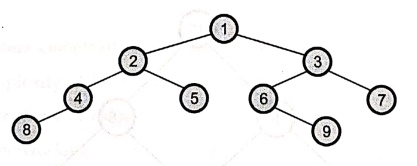
15. In
the given binary tree, using array(the index starts from 1), you can store the
node 4 at ‒‒‒‒‒‒‒‒‒position? How?
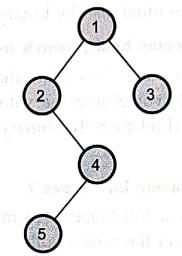
Answer:
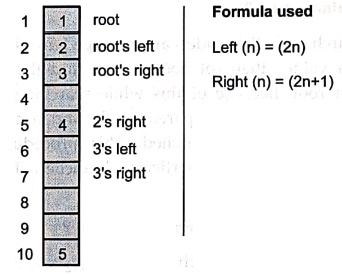
The
node 4 is stored at 5th position because the array representation of
tree is ‒
16. Consider
following tree on deleeing 7, draw the resultant tree structure.
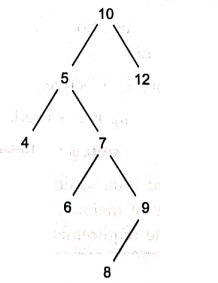
Answer:
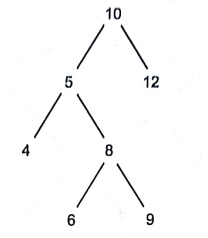
On
deleting a node with two child nodes, its place is replaced by its inorder
successor. Hence the resultant tree structure will be ‒
17. A
binary search tree is created by inserting following integers ‒ 50, 14, 65, 5,
20, 57, 91, 3, 8, 37, 60, 25. Mention the number of nodes in left and right
subtree.
Answer:
The
binary search tree will be ‒
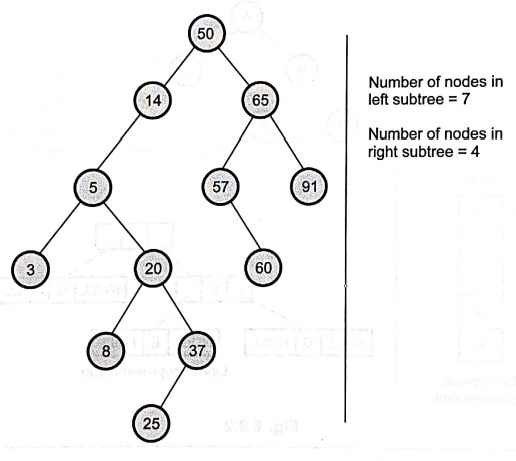
Number
of nodes in left subtree = 7
Number
of nodes in right subtree= 4
18. What
is a tree?
Answer:
i)
There is a specially designated node called root.
ii)
The remaining nodes are partitioned into n>=0 disjoint sets T1, T2,
T3, ..... ‚Tn
where
T1, T2, T3, ...,Tn are called the
sub‒trees of the root.
19. Draw
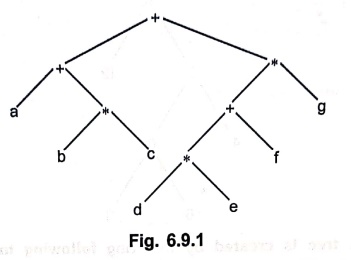
expression tree for (a + b * c) + ((de + f) * g).
Answer:
The
expression tree is as follows:
20. What
are the two ways of representing binary tree?
Answer:
The
two ways of representing a binary tree are
1.
Sequential representation
2.
Linked representation
Data Structures using C PlusPlus: Chapter 6: Trees : Tag: Data Structure, C++ Programing : Data Structures using C++ Program - Trees (Data Structures): Two Marks Important Questions and Answers
Data Structures using C PlusPlus: Chapter 6: Trees
Under Subject
Data Structures using CPlusPlus
CS25C05 2nd Semester ECE Dept | 2025 Regulation | 2nd Semester 2025 Regulation
Related Subjects
English Essentials II
EN25C02 2nd Semester | 2025 Regulation | 2nd Semester 2025 Regulation
Tamils and Technology தமிழர்களும் தொழில்நுட்பமும்
UC25H02 2nd Semester | 2025 Regulation | 2nd Semester 2025 Regulation
Linear Algebra
MA25C02 2nd Semester | 2025 Regulation

Electron Devices
EC25C01 2nd Semester ECE Dept | 2025 Regulation | 2nd Semester 2025 Regulation
Data Structures using CPlusPlus
CS25C05 2nd Semester ECE Dept | 2025 Regulation | 2nd Semester 2025 Regulation

Circuits and Network Analysis
EC25C02 2nd Semester ECE Dept | 2025 Regulation | 2nd Semester 2025 Regulation

Re-Engineering for Innovation
ME25C05 2nd Semester | 2025 Regulation | 2nd Semester 2025 Regulation
Engineering Drawing - Laboratory
ME25C01 2nd Semester | 2025 Regulation | 2nd Semester 2025 Regulation
Data Structures using CPlusPlus - Laboratory
CS25C05 2nd Semester ECE Dept | 2025 Regulation | 2nd Semester 2025 Regulation
Devices and Circuits Laboratory
EC25C03 2nd Semester ECE Dept | 2025 Regulation | 2nd Semester 2025 Regulation