Data Structures using C PlusPlus: Chapter 6: Trees
Traversals
Trees | Data Structures
Questions: 1. Describe briefly the various tree traversals. 2. Discuss the different methods traversing a binary tree with algorithm.
Traversals
Definition:
Tree traversal refers
to the process of visiting every node of a tree data structure exactly once in
a specific order.
Since
trees are non‒linear, traversals provide a systematic way to access all nodes.
For these traversals we will use some notations as follows:
L
means move to the left child.
R
means move to the the right child.
D
means the root/parent node.
Now,
with this L, R, D one can have six different combinations of L, R, D nodes.
Such as LDR, LRD, DLR, DRL, RLD, RDL. But from computing point of view we will
have three different ways of traversing a tree. Those three combinations will
be LDR, DLR, LRD. Those are called Inorder, Preorder and Postorder traversals.
Common traversal techniques :
1. Inorder traversal :
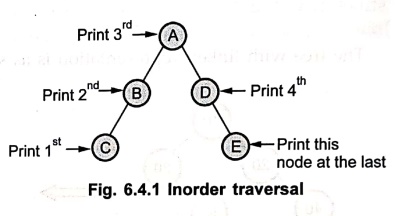
C‒B‒A‒D‒E
is the inorder traversal i.e. first we go towards the leftmost node i.e. C so
print that node C. Then go back to the node B and print B. Then root node A
then move towards the right sub‒tree print Print D and finally E. Thus we are
following the tracing sequence of LDR. This type of traversal is called inorder
traversal. The basic principal is to traverse left sub‒tree then root and then
the right sub‒tree.
2. Preorder traversal :
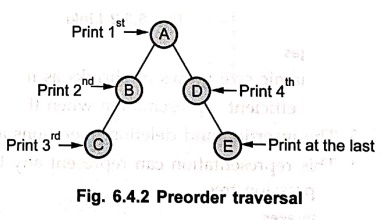
A‒B‒C‒D‒E is the preorder traversal of the
Fig. 6.4.2. We are following DLR path. i.e. data at the root node will be
printed first then we move on the left sub‒tree and go on printing the data till we reach to the
leftmost node. Print the data at that node and then move to the right subtree.
Follow the same DLR principle at each sub‒tree and go on printing the data
accordingly.
3. Postorder traversal :
From
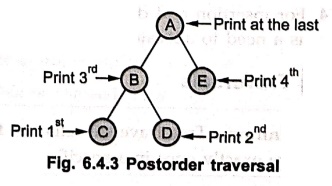
Fig. 6.4.3 the postorder sequence isod C‒D‒B‒E‒A. In the postorder traversal we
are following the LRD principle i.e. move to the leftmost node check if right
sub‒tree is there or not if not then print the leftmost node, if right subtree
is there move towards the rightmost node. The key idea here is that at each sub‒tree
we are following the LRD principle and print the data accordingly.
1. Recursive inorder traversal
Algorithm :
If
tree is not empty then
a.
Traverse the left sub‒tree in inorder.
b.
Visit the root node.
c.
Traverse the right sub tree in inorder.
The
recursive routine for inorder traversal is as given below.
void _TREE CLASS::inorder(node *temp)
{
if(temp!=NULL)
{
inorder(temp‒>left);<‒‒‒‒‒‒‒‒‒‒‒‒Moving to leftmost node
cout<<"
"<<<temp‒>data;
inorder(temp‒>right);<‒‒‒‒‒‒‒‒‒‒‒Moving to rightmost node
}
}
2. Recursive preorder traversal
Algorithm :
If
tree is not empty then
a.
Visit the root node.
b.
Traverse the left sub‒tree in preorder.
c.
Traverse the right sub‒tree in preorder.
The
recursive routine for preorder traversal is as given below.
void TREE_ CLASS::preorder(node *temp)
{
if(temp!= NULL)
{
cout<<""<<<temp‒>data;
preorder(temp‒>left);
preorder(temp‒>right);
}
}
3. Recursive postorder traversal
Algorithm :
If
tree is not empty then
a.
Traverse the left sub‒tree in postorder.
b.
Traverse the right sub‒tree in postorder.
c.
Visit the root node.
The
recursive routine for postorder traversal is as given below.
void TREE_ CLASS::postorder(node *temp)
{
if(temp!=NULL)
{
postorder(temp‒>left);
postorder(temp‒>right);
cout<<"
"<<temp‒>data;
}
}
Example : 1
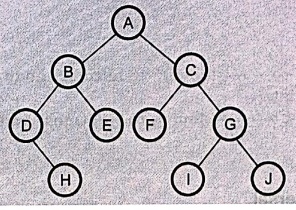
Traverse the tree given
below using inorder, preorder and postorder traversals.
Solution :
Inorder :
D H B E A F C I G J
Preorder :
A B D H E C F G I J
Postorder :
D H E B F I J G C A
Example : 2
Write an algorithm to
traverse binary tree level by level, with each level of the tree being
traversed from left to right.
Solution: Algorithm
1.
Start by visiting the root node.
2.
Insert the node in a queue then insert one dummy node in the queue. This dummy
node is used as a mark for change in the level.
3.
Delete the node.
3
(a) If the deleted node is not a dummy node then print its data and insert its
left node (if exists) in the queue, then insert the right node (if exists) in
the queue.
3
(b) Else insert the dummy node. Then go to a new line, so that the contents of
next level gets printed on the new line.
4.
Repeat step 3 until the queue is not empty.
The
pseudo C algorithm is as given below ‒
void tree::display()
{
dummy = new btree;
if ( dummy = = NULL)
cout<<"Insufficient Memory\n";
dummy‒>left = root;
dummy‒>right = NULL;
dummy‒>data = ' ';
temp = dummy ‒>left;
enque(temp); //inserting the node in the queue
enque(dummy);
temp = deque();//deleting the node from the queue
while (front != rear)
{
if ( temp != dummy)
{
cout<<"
"<<temp‒>data;
if ( temp ‒>left
!= NULL)
enque(temp ‒> left);
if (temp‒>right
!= NULL)
enque(temp
‒> right);
}
else
{
enque(temp);
cout<<"\n";
}
temp = deque();
}
}
Review Questions
1. Describe briefly
the various tree traversals.
2. Discuss the
different methods traversing a binary tree with algorithm.
Data Structures using C PlusPlus: Chapter 6: Trees : Tag: Data Structure, C++ Programing : Trees | Data Structures - Traversals
Data Structures using C PlusPlus: Chapter 6: Trees
Under Subject
Data Structures using CPlusPlus
CS25C05 2nd Semester ECE Dept | 2025 Regulation | 2nd Semester 2025 Regulation
Related Subjects

English Essentials II
EN25C02 2nd Semester | 2025 Regulation | 2nd Semester 2025 Regulation

Tamils and Technology தமிழர்களும் தொழில்நுட்பமும்
UC25H02 2nd Semester | 2025 Regulation | 2nd Semester 2025 Regulation
Linear Algebra
MA25C02 2nd Semester | 2025 Regulation

Electron Devices
EC25C01 2nd Semester ECE Dept | 2025 Regulation | 2nd Semester 2025 Regulation
Data Structures using CPlusPlus
CS25C05 2nd Semester ECE Dept | 2025 Regulation | 2nd Semester 2025 Regulation

Circuits and Network Analysis
EC25C02 2nd Semester ECE Dept | 2025 Regulation | 2nd Semester 2025 Regulation

Re-Engineering for Innovation
ME25C05 2nd Semester | 2025 Regulation | 2nd Semester 2025 Regulation
Engineering Drawing - Laboratory
ME25C01 2nd Semester | 2025 Regulation | 2nd Semester 2025 Regulation
Data Structures using CPlusPlus - Laboratory
CS25C05 2nd Semester ECE Dept | 2025 Regulation | 2nd Semester 2025 Regulation
Devices and Circuits Laboratory
EC25C03 2nd Semester ECE Dept | 2025 Regulation | 2nd Semester 2025 Regulation