Digital Principles and Computer Organization: Chapter 10: Parallel Processing
Array Processor
SIMD, Attached Array Processor
Questions: 1. What is an array processor ? 2. Draw and explain the typical functional structure of a SIMD array processor. 3. Write a short note on attached array processor. 4. What is an array processor? Explain the different types of array processor. 5. What is array processors? Explain attached array processors and SIMD array processors.
Array Processor
•
An array processor is synchronous
parallel computer with multiple arithmetic logic units. These arithmetic logic
units are also known as processing
elements (PE), which can operate in parallel in a lock step fashion. By
replication of ALUs the array processors can achieve the spatial parallelism.
As PEs are synchronized to perform the same function at the same time, the
array processor can handle single instruction and multiple data streams.
Because of this reason, array processors are also known as SIMD processors.
1. SIMD Array Processor
•
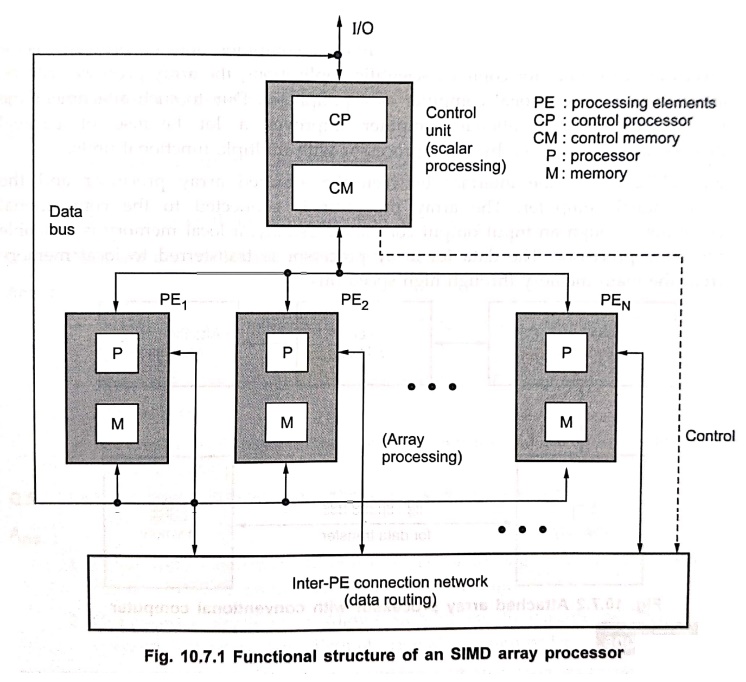
Fig. 10.7.1 shows the typical functional structure of an SIMD array processor.
As shown in Fig. 10.7.1, all PEs are synchronized and controlled by single
control unit. Each PE is an ALU with attached working registers and local
memory. The PEs are interconnected by a data–routing network. The control unit
(CU) consists of control processor (CP) and control memory (CM). The system and
user programs are executed under control of CU. The user programs are loaded
into CU memory from an external source.
•
The function of CU is to decode all the instructions and determine where the
decoded instructions should be executed.
■
Scalar instructions – Executed
directly inside the CU
■ Vector instructions –
They are broadcast to PEs for through duplicate arithmetic units (PEs)
•
All the PEs perform the same function synchronously in a lock step fashion
under the command of CU. Vector operands are distributed to PE memories before
parallel execution in the array of PEs. The distributed data can be loaded into
PE memories from an external source via system data bus or via CU in a
broadcast mode using control bus. Masking schemes are used to control the
status of each PE during execution of vector instruction. A masking vector is
used to control the status of all PEs. In other words not all PEs need to
participate in the execution of vector instruction.
2. Attached Array Processor
•
To enhance the performance of conventional computer and to provide vector
processing capability for complex scientific applications, the array processor
can be attached to a conventional computer as a peripheral. Due to such
attachment the performance of conventional computer improves a lot because of
parallel processing support given by array processor with multiple functional
units.
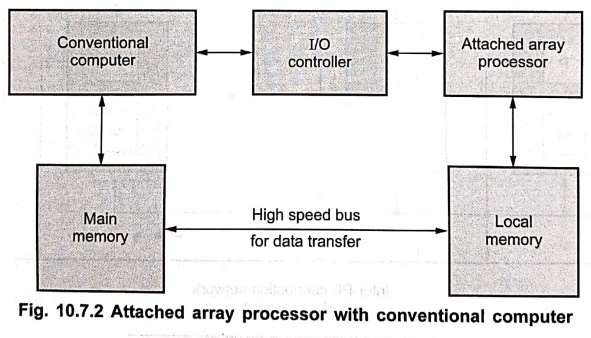
• Fig. 10.7.2 shows the interface between the attached array processor and the conventional computer. The array processor is connected to the conventional computer through an input output controller. Usually, a local memory is available for array processor. The data for array processor is transferred to local memory from the main memory through high speed bus.
Review Questions
1. What is an array
processor ?
2. Draw and explain
the typical functional structure of a SIMD array processor.
3. Write a short note
on attached array processor.
4. What is an array
processor? Explain the different types of array processor.
5. What is array
processors? Explain attached array processors and SIMD array processors.
Digital Principles and Computer Organization: Chapter 10: Parallel Processing : Tag: : SIMD, Attached Array Processor - Array Processor
Digital Principles and Computer Organization: Chapter 10: Parallel Processing
Under Subject
Digital Principles and Computer Organization
CS25C06 2nd Semester AIDS, CSE, IT, CSE(CY) Dept | 2025 Regulation | 2nd Semester 2025 Regulation
Related Subjects

English Essentials II
EN25C02 2nd Semester | 2025 Regulation | 2nd Semester 2025 Regulation

Tamils and Technology தமிழர்களும் தொழில்நுட்பமும்
UC25H02 2nd Semester | 2025 Regulation | 2nd Semester 2025 Regulation
Linear Algebra
MA25C02 2nd Semester | 2025 Regulation
Applied Physics (CSIE) II
PH25C03 2nd Semester AIDS, CSE, IT, CSE(CY) Dept | 2025 Regulation | 2nd Semester 2025 Regulation
Digital Principles and Computer Organization
CS25C06 2nd Semester AIDS, CSE, IT, CSE(CY) Dept | 2025 Regulation | 2nd Semester 2025 Regulation

Basic Electrical and Electronics Engineering
EE25C01 2nd Semester | 2025 Regulation | 2nd Semester 2025 Regulation
Python for Data Science
AD25201 2nd Semester AIDS Dept | 2025 Regulation | 2nd Semester 2025 Regulation

Re-Engineering for Innovation
ME25C05 2nd Semester | 2025 Regulation | 2nd Semester 2025 Regulation
Python for Data Science - Laboratory
AD25201 2nd Semester AIDS Dept | 2025 Regulation | 2nd Semester 2025 Regulation