Digital Principles and Computer Organization: Chapter 10: Parallel Processing
Parallel Processing: Two Marks Important Questions and Answers
Digital Principles and Computer Organization
Digital Principles and Computer Organization: Chapter 10: Parallel Processing: Anna University Part A Two Marks Important Questions and Answers
Digital Principles and Computer Organization:
Chapter 10: Parallel Processing
Two
Marks Questions with Answers
1. What
is Instruction–Level Parallelism (ILP)?
Answer: Instruction–Level
Parallelism (ILP) is a technique that allows multiple independent instructions
from a single program to be executed simultaneously to improve processor
performance. It increases instruction throughput by overlapping or
parallelizing instruction execution.
2. What
is the main goal of ILP ?
Answer:
The
main goal of ILP is to improve the speed and efficiency of program execution by
identifying and executing independent instructions in parallel rather than
sequentially.
3. State
any two benefits of ILP.
Answer:
1.
Increases instruction throughput – more instructions are completed per unit time.
2.
Reduces overall program execution time by overlapping instruction execution.
4. What
are the challenges in implementing ILP ?
Answer:
•
Instruction dependencies : Some
instructions depend on results of previous ones.
• Resource limitations
:
Limited number of functional units to execute instructions.
• Control complexity :
Managing dependencies and execution order increases hardware complexity.
5. List
and briefly explain two techniques used to achieve ILP.
Answer:
1. Pipelining :
Divides instruction execution into stages so multiple instructions can be
processed simultaneously in different stages.
2. Out–of–order
execution : Allows instructions to execute as soon
as their operands are ready, regardless of original program order.
6. What
is the difference between pipelining and superscalar execution ?
Answer:
•
Pipelining overlaps stages of multiple instructions within a single pipeline.
•
Superscalar execution uses multiple pipelines or execution units to execute
multiple instructions in the same clock cycle.
7. What
is data forwarding in ILP ?
Answer: Data forwarding (also
called bypassing) is a technique that allows the result of one instruction to
be used directly by the next instruction without waiting for it to be written
back to a register, reducing execution delays.
8. Define
parallel processing.
Answer:
To
fulfil increasing demands for higher performance it is necessary to process
data concurrently to achieve better throughput instead of processing each
instruction sequentially as in a conventional computer. Processing data
concurrently is known as parallel
processing. There are two basic ways by which we can achieve parallelism.
9. Define
multiprocessors.
Answer:
Multiple processors : System
may have two or more processors operating concurrently.
Multiprocessor system :
A computer system with at least two processors is called multiprocessor system.
quio olgnia wolls.
10. Define
multiprocessor system.
Answer:
A
computer system with at least two processors is called multiprocessor system.
11. Define
task–level or process level parallelism.
Answer: Utilizing multiple
processors for executing independent programs simultaneously is known as Task–level
parallelism or process–level parallelism.
12. Define
parallel processing program.
Answer: It is referred to a
single program that runs on multiple processors simultaneously.
13. What
is cluster ?
Answer: A set of computers
connected over a local area network that function as a single large
multiprocessor is called cluster.
14. What
is multicore ?
Answer: A multicore is an
architecture design that places multiple processors on a single die (computer
chip) to enhance performance and allow simultaneous processing of multiple
tasks more efficiently.
15. What do you mean by CMPs ?
Answer: The multicore
architecture designs that allow single chip multiprocessing are known as Chip Multiprocessors (CMPs).
16. What
are the limitations to increase clock frequency or processor speed?
Answer:
■ Higher
frequency requires more power.
■ More
power consumption results it harder and more expensive to cool the system
■ More
power consumption also affects sizing and packaging considerations.
17. Define
SMPS.
One
of the important aspect of multicore architecture is that, there is no real
lange significant difference between programming for multiple processors in
separate packages and programming for multiple processors contained in a single
package on a single chip. Thus software developers who are familiar with
multiprocessing can easily switch to multicore development.
These
multicores are almost always Shared
Memory Processors (SMPs), as they usually share a single physical address
space.
18. State
the Amdahl's law?
Answer: It states that the
performance improvement to be gained from using some faster mode of execution
is limited by the fraction of the time the faster mode can be used.
19. What
is the use of Amdahl's law ?
Answer: It tells us how much
faster a task can be executed using the machine with the enhancement as compare
to the original machine.
20.
Define strong scaling.
Answer: Speedup achieved on a
multiprocessor without increasing the size of the problem is called strong
scaling.
21.
Define weak scaling.
Answer: Speedup achieved on a
multiprocessor while increasing the size of the problem proportionally to the
increase in the number of processors is called weak scaling.
22. List
four major groups of computers defined by Micheal J. Flynn.
OR
What is
Flynn's classification.
Answer:
•
Single Instruction Stream–Single Data stream (SISD).
•
Single Instruction Stream–Multiple Data streams (SIMD).
•
Multiple Instruction Streams–Single Data stream (MISD).
•
Multiple Instruction Streams–Multiple Data streams (MIMD).
23. What
is SISD ?
Answer: SISD stands for Single
Instruction stream, Single Data stream, a uniprocessor.
24. What
is MIMD ?
Answer: MIMD stands for
Multiple Instruction streams, Multiple Data streams, a multiprocessor.
25. What
is SIMD ?
Answer: SIMD stands for Single
Instruction stream, Multiple Data streams, multiprocessor. The same instruction
is applied to many data streams, as in a vector processor or array processor.
26. What
is data–level parallelism ?
Answer: Parallelism achieved
by performing the same operation on independent data is known as data–level
parallelism.
27. Give
example for each class in Flynn's classification.
The
classification made by Micheal J. Flynn divides computers into four major
groups.
■
Single Instruction Stream–Single Data stream (SISD).
■
Single Instruction Stream–Multiple Data streams (SIMD).
■
Multiple Instruction Streams–Single Data stream (MISD).
■
Multiple Instruction Streams–Multiple Data streams (MIMD).
28. What
is a superscalar processor ?
Answer: A superscalar
processor is a CPU that can issue and execute multiple instructions per
clock cycle by using several
parallel execution units. It exploits Instruction–Level
Parallelism (ILP) and has hardware like parallel pipelines, advanced
decoding, and instruction issue logic.
29. What
is the role of the Program Control Unit (PCU) in a superscalar processor ?
Answer: The PCU fetches and
decodes multiple instructions simultaneously. It works with instruction
schedulers to supply parallel pipelines with a continuous stream of
instructions.
30. What
is the meaning of instruction issue degree (k)?
Answer: Instruction issue
degree (k) refers to the maximum number
of instructions a processor can issue in one clock cycle.
Example
: If k = 4 → processor can dispatch 4 instructions simultaneously.
31. What
are the main types of dependencies that affect superscalar execution ?
Answer: Superscalar processors
must manage :
• Data dependencies (RAW,
WAR, WAW)
•
Control dependencies (due to
branches)
•
Resource conflicts (multiple
instructions needing the same unit)
32. What
is a structural hazard in superscalar execution ?
Answer: A structural hazard
occurs when two or more instructions require the same hardware resource at the
same time (e.g., ALU, FPU, LSU).
This
prevents parallel execution and may cause stalls.
33. What
is data dependency checking, and why is it important?
Answer: Data dependency
checking ensures that instructions issued in parallel are independent.
It
prevents hazards like RAW, WAR, and WAW, allowing the CPU to issue only safe
instructions that won't produce incorrect results.
34. What
is an instruction–issue policy?
Answer: An instruction–issue
policy defines how many instructions
and which instructions can be issued
per cycle. It determines whether issuing is
in–order, out–of–order, or hybrid,
affecting overall ILP and CPU performance.
35. What
is the difference between in–order and out–of–order issue ?
Answer:
•
In–order issue : Instructions are
issued in the exact sequence they are fetched.
•
Out–of–order issue : Instructions are
issued based on data availability
and resource availability, not
strictly in program order.
•
Out–of–order increases ILP and performance.
36. What
is register renaming ?
Answer: Register renaming is a
hardware technique that maps architectural registers to a larger set of physical
registers to eliminate false dependencies like WAR and WAW.
37. What
problem does register renaming solve ?
Answer: Register renaming
removes false dependencies :
• Anti–dependency (WAR)
• Output dependency
(WAW)
This
allows more instructions to execute in parallel and enables out–of–order
execution.
38. What
is a Register Alias Table (RAT)?
Answer: The Register Alias
Table (Map Table) stores the mapping between architectural registers and physical
registers, ensuring each instruction uses the correct, latest value.
39. How
does register renaming improve ILP?
Answer:
By
eliminating false dependencies, register renaming exposes more parallelism. Hence, more instructions can be issued
simultaneously, improving throughput.
40. What
is the role of physical registers in renaming ?
Answer: Physical registers act
as temporary storage locations for
instruction results. Each new instruction is assigned a fresh physical register, avoiding overwriting problems.
41. Why
do superscalar CPUs require complex instruction scheduling hardware ?
Answer:
Because
they must check :
•
Data dependencies
•
Structural hazards
•
Control hazards
Scheduling
ensures only independent instructions
execute in parallel, avoiding incorrect program behavior.
42. What
is a vector processor ?
Answer: A vector processor is
a CPU designed to perform operations on entire
arrays (vectors) of data in a single instruction. It uses vector registers
and pipelines to achieve high performance on scientific and mathematical
computations.
43. What
is vectorization ?
Answer: Vectorization is the
process of converting scalar operations into vector operations so that multiple
data elements can be processed simultaneously using vector instructions.
44. What
are vector registers ?
Answer: Vector registers are
special high–capacity registers that can store multiple data elements (e.g., 64 or 128 elements). They allow a
single instruction to operate on all elements in the register.
45. What
is the main advantage of vector processors ?
Answer: The main advantage is
high throughput for repetitive
arithmetic operations on large data sets (matrix multiplication, scientific
simulations, graphics). They reduce loop overhead and improve parallelism.
46. What
do you mean by vector pipeline ?
Answer: A vector pipeline
allows each stage of the pipeline to operate on different elements of a vector
simultaneously, achieving high speed by overlapping operations on consecutive
elements.
47. What
is a vector instruction?
Answer: A vector instruction
performs the same operation on multiple
data elements at once. Example :
ADDV
V1, V2 → V3 adds all elements of V1 and V2.
48. What
are the limitations of vector processors ?
Answer:
•
Not suitable for irregular data or
operations that depend on previous results
•
Requires programmer/compiler vectorization
•
Works best only on large, continuous
arrays
49. What
type of parallelism is used in vector processors ?
Answer: Vector processors use Data–Level Parallelism (DLP), where
multiple data elements are processed in parallel using a single instruction.
50. What
is an array processor ?
Answer: An array processor is
a type of parallel processor containing multiple
ALUs arranged in an array, all
executing the same instruction simultaneously on different data. It follows the
SIMD architecture.
51. What
are processing elements (PEs) ?
Answer: Processing Elements
are small, simple ALUS present in an array processor. Each PE performs the same
operation on its local data under the control of a central unit.
52. What
is the main advantage of array processors ?
Answer: They provide very high
performance for :
•
Matrix operations
•
Image processing
•
Large–scale simulations.
Because
many data items are processed in parallel using many PEs.
53. What
is a systolic array ?
Answer: A systolic array is a
special array processor in which data flows rhythmically between PEs like a
heartbeat, improving speed and reducing memory access.
54. What
is the difference between vector processors and array processors ?
Answer:
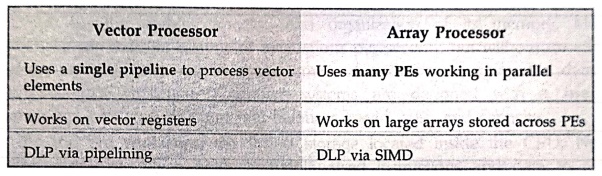
Vector Processor
1.
Uses a single pipeline to process vector elements
2.
Works on vector registers
3.
DLP via pipelining
Array Processor
1.
Uses many PEs working in parallel
2.
Works on large arrays stored across PEs
3.
DLP via SIMD
55. Why
are array processors suitable for matrix operations ?
Answer: Matrix multiplication
requires performing the same operation on many data items, which is ideal for
SIMD processing with multiple PEs.
56. What
is the role of the control unit in an array processor ?
Answer: The control unit sends
the same instruction to all PEs, synchronizing their operation while each PE
processes different data.
Digital Principles and Computer Organization: Chapter 10: Parallel Processing : Tag: : Digital Principles and Computer Organization - Parallel Processing: Two Marks Important Questions and Answers
Digital Principles and Computer Organization: Chapter 10: Parallel Processing
Under Subject
Digital Principles and Computer Organization
CS25C06 2nd Semester AIDS, CSE, IT, CSE(CY) Dept | 2025 Regulation | 2nd Semester 2025 Regulation
Related Subjects

English Essentials II
EN25C02 2nd Semester | 2025 Regulation | 2nd Semester 2025 Regulation

Tamils and Technology தமிழர்களும் தொழில்நுட்பமும்
UC25H02 2nd Semester | 2025 Regulation | 2nd Semester 2025 Regulation
Linear Algebra
MA25C02 2nd Semester | 2025 Regulation
Applied Physics (CSIE) II
PH25C03 2nd Semester AIDS, CSE, IT, CSE(CY) Dept | 2025 Regulation | 2nd Semester 2025 Regulation
Digital Principles and Computer Organization
CS25C06 2nd Semester AIDS, CSE, IT, CSE(CY) Dept | 2025 Regulation | 2nd Semester 2025 Regulation

Basic Electrical and Electronics Engineering
EE25C01 2nd Semester | 2025 Regulation | 2nd Semester 2025 Regulation
Python for Data Science
AD25201 2nd Semester AIDS Dept | 2025 Regulation | 2nd Semester 2025 Regulation

Re-Engineering for Innovation
ME25C05 2nd Semester | 2025 Regulation | 2nd Semester 2025 Regulation
Python for Data Science - Laboratory
AD25201 2nd Semester AIDS Dept | 2025 Regulation | 2nd Semester 2025 Regulation