Digital Principles and Computer Organization: Chapter 10: Parallel Processing
Parallel Processing Concepts
Concept, Definitions
Questions: 1. What is parallel processing ? 2. State the basic ways to achieve parallelism. 3. Explain the Flynn's classification. 4. What is multicore? 5. State the limitations to increase clock frequency or processor speed. 6. Explain the necessity of multicore.
Parallel
Processing Concepts
•
To fulfil increasing demands for higher performance it is necessary to process
data concurrently to achieve better throughput instead of processing each
instruction sequentially as in a conventional computer. Processing data
concurrently is known as parallel
processing. There are two basic ways by which we can achieve parallelism.
These are :
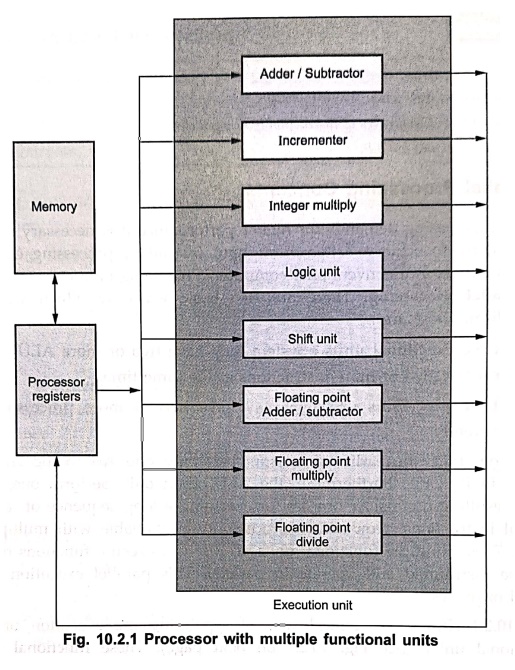
■ Multiple functional
units : System may have two or more ALUS so that they can
execute two or more instructions at the same time.
■ Multiple processors :
System
may have two or more processors operating concurrently.
•
We know that, the earlier processors had only one Arithmetic and Logic Unit
(ALU) in its CPU. Furthermore, the ALU could only perform one function at a
time, resulting quite slow process for executing a long sequence of arithmetic
and logical instructions. Now–a–days processors are available with multiple
functional units. These multiple functional units are used to execute functions
of ALU which can be distributed and operate in parallel. This parallel
execution increases the speed of process.
•
Fig. 10.2.1 shows one typical way of separating the execution unit into eight
functional units. (See Fig. 10.2.1 on next page). These functional units can be
is not operated in parallel to achieve faster execution time. All functional
units are independent of each other, so two operands can be added while third
is being shifted or incremented and so on. These functional units get operands
from processor registers and the result of the operation is stored back in the
processor register/s as shown in Fig.
10.2.1.
Definitions
•
Multiprocessor system : A computer
system with at least two processors is called multiprocessor system. quio
olgnia wolls
• Task–level
parallelism or process–level parallelism : Utilizing
multiple processors for executing independent programs simultaneously is known
as Task–level parallelism or process–level parallelism.
• Parallel processing program : It is referred to a single program that runs on multiple processors simultaneously.
• Cluster : A set of
computers connected over a local area network that function as grid a single
large multiprocessor is called cluster.
Why multicore ?
•
A multicore is an architecture design that places multiple processors on a
single die (computer chip) to enhance performance and allow simultaneous
processing of multiple tasks more efficiently. Each processor is called a core.
The multicore architecture designs are known as Chip Multiprocessors (CMPs) because they allow single chip
multiprocessing.
Limitations to increase clock frequency or processor speed
• One
way to increase system performance is to increase clock frequency or processor
speed. However, this approach has following limitations in terms of cost
effectiveness :
■
Higher frequency requires more power.
■
More power consumption results it harder and more expensive to cool the system
■
More power consumption also affects sizing and packaging considerations.
• Thus,
instead of trying to make the processor faster to gain performance, adding more
processors on a single chip (multicore architecture) is a better approach.
• One
of the important aspect of multicore architecture is that, there is no real
lange significant difference between programming for multiple processors in
separate packages and programming for multiple processors contained in a single
package on a single chip. Thus software developers who are familiar with
multiprocessing can easily switch to multicore development.
• These
multicores are almost always Shared
Memory Processors (SMPs), as they usually share a single physical address
space.
Review Questions
1. What is parallel
processing ?
2. State the basic
ways to achieve parallelism.
3. Explain the Flynn's
classification.
4. What is multicore?
5. State the
limitations to increase clock frequency or processor speed.
6. Explain the
necessity of multicore.
Digital Principles and Computer Organization: Chapter 10: Parallel Processing : Tag: : Concept, Definitions - Parallel Processing Concepts
Digital Principles and Computer Organization: Chapter 10: Parallel Processing
Under Subject
Digital Principles and Computer Organization
CS25C06 2nd Semester AIDS, CSE, IT, CSE(CY) Dept | 2025 Regulation | 2nd Semester 2025 Regulation
Related Subjects

English Essentials II
EN25C02 2nd Semester | 2025 Regulation | 2nd Semester 2025 Regulation

Tamils and Technology தமிழர்களும் தொழில்நுட்பமும்
UC25H02 2nd Semester | 2025 Regulation | 2nd Semester 2025 Regulation

Linear Algebra
MA25C02 2nd Semester | 2025 Regulation
Applied Physics (CSIE) II
PH25C03 2nd Semester AIDS, CSE, IT, CSE(CY) Dept | 2025 Regulation | 2nd Semester 2025 Regulation
Digital Principles and Computer Organization
CS25C06 2nd Semester AIDS, CSE, IT, CSE(CY) Dept | 2025 Regulation | 2nd Semester 2025 Regulation

Basic Electrical and Electronics Engineering
EE25C01 2nd Semester | 2025 Regulation | 2nd Semester 2025 Regulation

Python for Data Science
AD25201 2nd Semester AIDS Dept | 2025 Regulation | 2nd Semester 2025 Regulation

Re-Engineering for Innovation
ME25C05 2nd Semester | 2025 Regulation | 2nd Semester 2025 Regulation
Python for Data Science - Laboratory
AD25201 2nd Semester AIDS Dept | 2025 Regulation | 2nd Semester 2025 Regulation