Digital Principles and Computer Organization: Chapter 6: Sequential Circuits - Counters
Introduction of Counter
Sequential Circuits
Questions: 1. What is counter? 2. State types of counters. 3. Compare synchronous and asynchronous counter. 4. Define modulus of a counter.
Digital Principles and Computer Organization:
Chapter 6: Sequential Circuits – Counters
Introduction
•
A group of flip–flops connected together forms a register. A register is used solely for storing and shifting data
which is in the form of 1s and/or 0s, entered from an external source. It has
no specific sequence of states except in certain very specialized applications.
A counter is a register capable of counting
the number of clock pulses arriving at its clock input. Count represents the
number of clock pulses arrived. On arrival of each clock pulse, the counter is
incremented by one. In case of down counter, it is decremented by one.
•
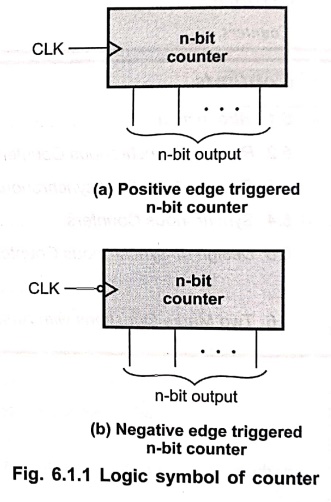
Fig. 6.1.1 shows the logic symbol of a binary counter. External clock is
applied to the clock input of the counter. The counter can be positive edge
triggered or negative edge triggered. The n–bit binary counter has n flip–flops
and it has 2n distinct states of outputs. For example, 2–bit counter
has 2 flip–flops and it has 4(22) distinct states : 00, 01, 10 and
11. Similarly, the 3–bit binary counter has 3 flip–flops and it has 8 (23)
distinct states : 000, 001, 010, 011, 100, 101 110 and 111.
•
The maximum count that the binary counter can count is 2n–1. For
example, in 2–bit binary counter, the maximum count is 22–1 = 3 (11
in binary). After reaching the maximum count the counter resets to 0 on arrival
of the next clock pulse and it starts counting again.
Synchronous counter :
When counter is clocked such that each flip–flop in the counter is triggered at
the same time, the counter is called synchronous counter.
Asynchronous counter /
Ripple counter : A binary asynchronous/ripple consists
of a series connection of complementing flip–flops, with the output of each
flip–flop connected to the clock input of the next higher–order flip–flop. The
flip–flop holding the least significant bit receives the incoming clock pulses.
•
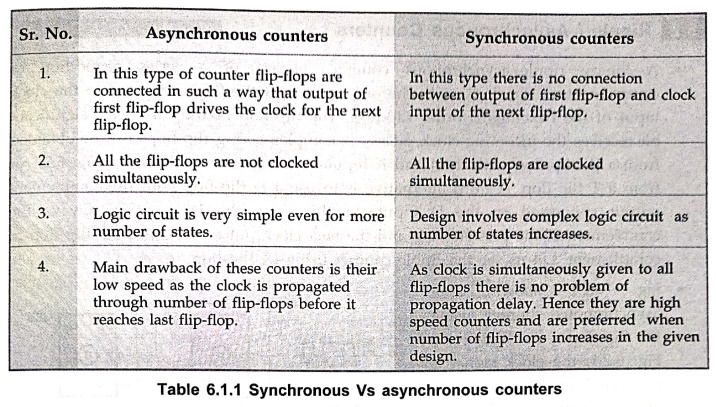
Table 6.1.1 shows the comparison between synchronous and asynchronous counters.
Asynchronous counters
1.
In this type of counter flip–flops are connected in such a way that output of
first flip–flop drives the clock for the next flip–flop.
2.
All the flip–flops are not clocked simultaneously.
3.
Logic circuit is very simple even for more number of states.
4.
Main drawback of these counters is their k of these counters is their low speed
as the clock is propagated through number of flip–flops before it reaches last
flip–flop.
Synchronous counters
1.
In this type there is no connection between output of first flip–flop and clock
input of the next flip–flop.
2.
All the flip–flops are clocked simultaneously.
3.
Design involves complex logic circuit as number of states increases.
4.
As clock is simultaneously given to all flip–flops there is no problem of
propagation delay. Hence they are high speed counters and are preferred when
number of flip–flops increases in the given design.
Modulus of Counter
•
The total number of counts or stable states a counter can indicate is called
'Modulus'. For instance, the modulus of a four–stage counter would be 1610,
since it is capable of indicating 00002 to 11112. The term
'modulo' is used to describe the count capability of counters. For example, mod
6 counter goes through states 0 to 5 and mod 4 counter goes through states 0 – 3.
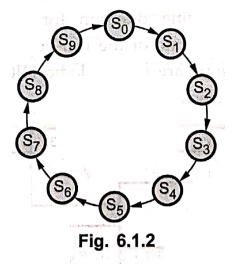
Example: 1
Draw the state diagram
of MOD–10 counter.
Solution :
Review Questions
1. What is counter?
2. State types of
counters.
3. Compare synchronous
and asynchronous counter.
4. Define modulus of a
counter.
Digital Principles and Computer Organization: Chapter 6: Sequential Circuits - Counters : Tag: : Sequential Circuits - Introduction of Counter
Digital Principles and Computer Organization: Chapter 6: Sequential Circuits - Counters
Under Subject
Digital Principles and Computer Organization
CS25C06 2nd Semester AIDS, CSE, IT, CSE(CY) Dept | 2025 Regulation | 2nd Semester 2025 Regulation
Related Subjects

English Essentials II
EN25C02 2nd Semester | 2025 Regulation | 2nd Semester 2025 Regulation

Tamils and Technology தமிழர்களும் தொழில்நுட்பமும்
UC25H02 2nd Semester | 2025 Regulation | 2nd Semester 2025 Regulation
Linear Algebra
MA25C02 2nd Semester | 2025 Regulation
Applied Physics (CSIE) II
PH25C03 2nd Semester AIDS, CSE, IT, CSE(CY) Dept | 2025 Regulation | 2nd Semester 2025 Regulation
Digital Principles and Computer Organization
CS25C06 2nd Semester AIDS, CSE, IT, CSE(CY) Dept | 2025 Regulation | 2nd Semester 2025 Regulation

Basic Electrical and Electronics Engineering
EE25C01 2nd Semester | 2025 Regulation | 2nd Semester 2025 Regulation
Python for Data Science
AD25201 2nd Semester AIDS Dept | 2025 Regulation | 2nd Semester 2025 Regulation

Re-Engineering for Innovation
ME25C05 2nd Semester | 2025 Regulation | 2nd Semester 2025 Regulation
Python for Data Science - Laboratory
AD25201 2nd Semester AIDS Dept | 2025 Regulation | 2nd Semester 2025 Regulation