Digital Principles and Computer Organization: Chapter 6: Sequential Circuits - Counters
Sequential Circuits - Counters: Two Marks Important Questions and Answers
Digital Principles and Computer Organization
Digital Principles and Computer Organization: Chapter 6: Sequential Circuits - Counters: Anna University Part A Two Marks Important Questions and Answers
Digital Principles and Computer Organization:
Chapter 6: Sequential Circuits – Counters
Two Marks Questions
with Answers
1. What is counter?
A
counter is a register capable of counting the number of clock pulses
arriving at its clock input. Count represents the number of clock pulses
arrived. On arrival of each clock pulse, the counter is incremented by one. In
case of down counter, it is decremented by one.
2. What
is Synchronous counter?
When
counter is clocked such that each flip–flop in the counter is triggered at the
same time, the counter is called synchronous counter.
3. What
is Asynchronous counter ?
A
binary asynchronous/ripple consists of a series connection of complementing
flip–flops, with the output of each flip–flop connected to the clock input of
the next higher–order flip–flop. The flip–flop holding the least significant
bit receives the incoming clock pulses.
4. What is the difference between synchronous and asynchronous counter ?
•
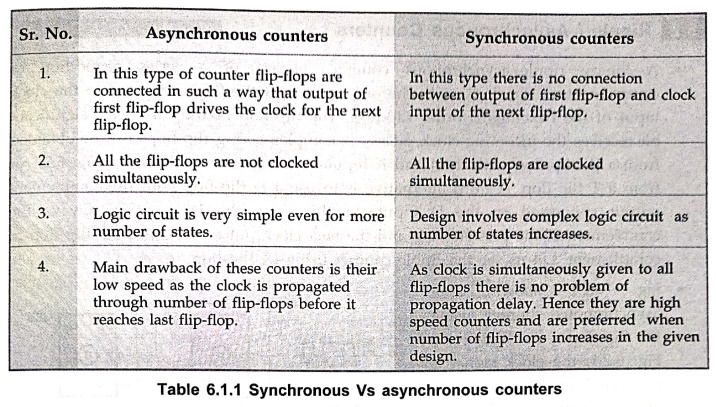
Table 6.1.1 shows the comparison between synchronous and asynchronous counters.
Asynchronous counters
1.
In this type of counter flip–flops are connected in such a way that output of
first flip–flop drives the clock for the next flip–flop.
2.
All the flip–flops are not clocked simultaneously.
3.
Logic circuit is very simple even for more number of states.
4.
Main drawback of these counters is their k of these counters is their low speed
as the clock is propagated through number of flip–flops before it reaches last
flip–flop.
Synchronous counters
1.
In this type there is no connection between output of first flip–flop and clock
input of the next flip–flop.
2.
All the flip–flops are clocked simultaneously.
3.
Design involves complex logic circuit as number of states increases.
4.
As clock is simultaneously given to all flip–flops there is no problem of
propagation delay. Hence they are high speed counters and are preferred when
number of flip–flops increases in the given design.
5. Name
the different types of counter.
Answer: a) Synchronous counter
b)
Asynchronous counter
i)
Up counter
ii)
Down counter
iii)
Modulo – N counter
iv)
Up / Down counter
6. What
is the primary disadvantage of an asynchronous counter ?
Main
drawback of these counters is their k of these counters is their low speed as
the clock is propagated through number of flip–flops before it reaches last
flip–flop.
7. What
is meant by programmable counter? Mention its application.
Answer: A counter that divides an input frequency by a
number which can be programmed, is called programmable
counter.
Applications of
programmable counter
1.
Frequency division
2.
Digital clock
3.
Stop watch
4.
Programmable logic controllers.
8. Define
asynchronous counter.
Answer: The counter in which the output of the current
flip–flop drives the clock input of the net higher–order flip–flop is called
asynchronous counter.
9. What
is up counter ?
Answer: A counter that increments the output by one binary
number each time a clock pulse is applied.
10. What
is down counter ?
Answer: A counter that
decrements the output by one binary number each time a clock pulse is applied.
11. What
is up/down counter?
Answer: A counter, which is
capable of operating as an up counter or down counter, depending on a control
input.
12. What
is a ripple counter ?
A
binary asynchronous/ripple consists of a series connection of complementing
flip–flops, with the output of each flip–flop connected to the clock input of
the next higher–order flip–flop. The flip–flop holding the least significant
bit receives the incoming clock pulses.
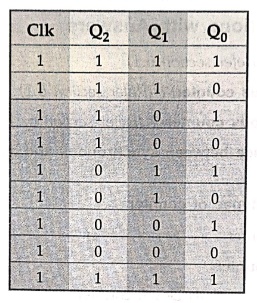
13. Form
the truth table for 3–bit binary down counter.
Answer:
14. What
is the minimum number of flip–flops needed to design a counter of modulus 60 ?
Answer: 2n ≥ 60
n = 6
15. What
is the minimum number of flip–flops required to implement a modulo 21 synchronous
counter ?
Answer: 2n ≥ 21
n = 5
16.
Define synchronous counter.
Answer: When counter is clocked such that each flip–flop
in the counter is triggered at the same time, the counter is called synchronous
counter.
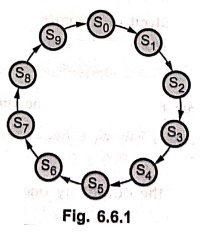
17. Draw
the state diagram of MOD–10 counter.
Answer:
18. What
is meant by modulus of a counter ?
The
total number of counts or stable states a counter can indicate is called
'Modulus'. For instance, the modulus of a four–stage counter would be 1610,
since it is capable of indicating 00002 to 11112. The
term 'modulo' is used to describe the count capability of counters. For example,
mod 6 counter goes through states 0 to 5 and mod 4 counter goes through states
0 – 3.
19. What
is meant by natural count of a counter?
Answer: By the term natural count of a counter we say
that the maximum number of states through which a counter can progress.
20. The
number of flip–flops required for modulo–18 counter is ––––––––––––.
Answer: five.
21. How
many flip–flops are required to build a binary counter that counts from 0 to
1023 ?
Answer: 2n ≥ 1024 n = 10
22. What
are the applications of counter ?
Answer: Applications of
counter are :
•
Frequency division
•
Digital clock
•
Stop watch
•
Programmable logic controllers
23. Write
short note on digital clock.
Answer:
Digital
clock displays seconds, minutes and hours. 1 Hz clock frequency is applied to
the cascaded combination of divide–by–10 counter and divide–by–6 counter forms
divide–by–60 counter. This counter counts seconds from 0–59. The ripple carry
from this counter is applied to the enable input of another pair of divide–by–60
(10 × 6) counter. This counter counts minutes. The hours counter is implemented
with a decade counter and a flip–flop.
24. How
does ripple counter differ from synchronous counter?
A
binary asynchronous/ripple consists of a series connection of complementing
flip–flops, with the output of each flip–flop connected to the clock input of
the next higher–order flip–flop. The flip–flop holding the least significant
bit receives the incoming clock pulses.
Digital Principles and Computer Organization: Chapter 6: Sequential Circuits - Counters : Tag: : Digital Principles and Computer Organization - Sequential Circuits - Counters: Two Marks Important Questions and Answers
Digital Principles and Computer Organization: Chapter 6: Sequential Circuits - Counters
Under Subject
Digital Principles and Computer Organization
CS25C06 2nd Semester AIDS, CSE, IT, CSE(CY) Dept | 2025 Regulation | 2nd Semester 2025 Regulation
Related Subjects

English Essentials II
EN25C02 2nd Semester | 2025 Regulation | 2nd Semester 2025 Regulation

Tamils and Technology தமிழர்களும் தொழில்நுட்பமும்
UC25H02 2nd Semester | 2025 Regulation | 2nd Semester 2025 Regulation

Linear Algebra
MA25C02 2nd Semester | 2025 Regulation

Applied Physics (CSIE) II
PH25C03 2nd Semester AIDS, CSE, IT, CSE(CY) Dept | 2025 Regulation | 2nd Semester 2025 Regulation
Digital Principles and Computer Organization
CS25C06 2nd Semester AIDS, CSE, IT, CSE(CY) Dept | 2025 Regulation | 2nd Semester 2025 Regulation

Basic Electrical and Electronics Engineering
EE25C01 2nd Semester | 2025 Regulation | 2nd Semester 2025 Regulation

Python for Data Science
AD25201 2nd Semester AIDS Dept | 2025 Regulation | 2nd Semester 2025 Regulation

Re-Engineering for Innovation
ME25C05 2nd Semester | 2025 Regulation | 2nd Semester 2025 Regulation

Python for Data Science - Laboratory
AD25201 2nd Semester AIDS Dept | 2025 Regulation | 2nd Semester 2025 Regulation