Python for Data Science: Chapter 5: NumPy and Pandas Libraries
NumPy: Basic array Operations
Python library
Basic Operations - NumPy (Python library) : 1. Join 2. Split 3. Search 4. Sort
Basic
Operations
1. Join
•
Joining means combining two or more
arrays into a single array. In NumPy we can combine the arrays using the
functions like concatenate(), stack(),
hstack() or vstack().
•
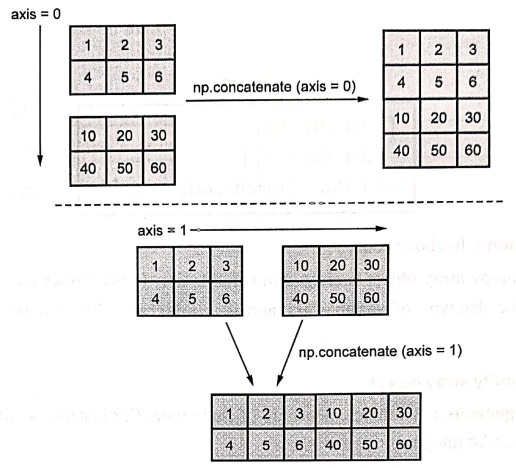
The np.concatenate() function is
used to join two arrays. The concatenation of the two arrays can be done on
axis = 0 (default) or axis = 1. The concept of axis is illustrated by following
example
•
Following code illustrates the use of concatenate function in numpy‒
In [20]:
import numpy as np
a = np.array([[1,2,3],[4,5,6]])
print('First array:')
print(a)
b = np.array([[10,20,30], [40, 50, 60]])
print('Second array:')
print(b)
# both the arrays are of same dimensions
print("Joining the two arrays along axis 0:')
print(np.concatenate((a,b)))
print('Joining the two arrays along axis 1:')
print(np.concatenate ((a,b), axis = 1))
First array:
[[1 2 3]
[4 5 6]]
second array:
[[10 20 30]
[40 50 60]]
Joining the two arrays along axis 0 :
[[1 2 3]
[ 4 5 6]
[10 20 30]
[40 50 60]]
Joining the two arrays along axis 1:
[[ 1 2 3 10 20 30]
[ 4 5 6 40 50 60]]
Python
program for vertical join of two dimensional arrays
import numpy as np
arr1 = np.array([[10,20], [30,40]])
arr2 = np.array([[50,60],[70,80]])
result = = np.vstack((arr1,arr2))
print("Vertical Join: ",result)
Output
Vertical Join: [[10
20]
[30 40]
[50 60]
[70 80]]
Python
program for horizontal join of two dimensional arrays
import numpy as np
arr1 = np.array([[10,20],[30,40]])
arr2 = np.array([[50,60],[70,80]])
result = np.hstack((arr1, arr2))
print("Horizontal Join: ",result)
Output
Horizontal Join: [[10
20 50 60]
[30 40 70 80]]
2. Split
•
Split operation divides one array into multiple smaller arrays. There are
following functions from NumPy by which the array can be split
• np.split():
The np.split() function in NumPy is
used to divide one array into multiple
equal sub‒arrays. The syntax is
np.split(array,n)
where
array is an array which we want to split and n is the number of equal parts.
For
example ‒
Python
program
import numpy as np
arr = np.array([10,20,30,40,50,60])
result = np.split(arr,3)
print(result)
Output
[array([10, 20]), array([30, 40]), array([50,
60])]
The
above code splits the array into 3 equal parts and each part gets 2 elements.
•
np.array_split() : The array_split() allows uneven splitting
when the array length isn't divisible by the number of parts. For an array that
causes uneven split, the np.split( )
raises error but the np.array.split() works fine.
For
example ‒
Python
program
import numpy as np
am = np.array([10,20,30,40,50])
result = np.array_split(arr,3)
print(result)
Output
[array([10, 20]),
array([30, 40]), array([50])]
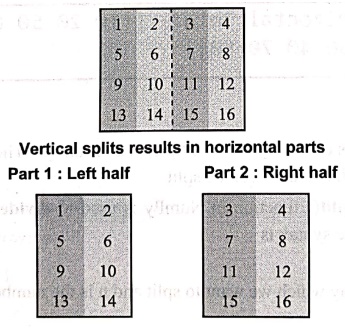
• np.hsplit() : The horizontal split means you are
cutting the array vertically (along the columns). After this split, we end up
with chunks of columns.
Python program
import numpy as np
arr = np.array([[1,2,3,4],
[5,6,7,8],
[9,10,11,12],
[13,14,15,16]])
print(arr,"\n")
h_parts = np.hsplit(arr, 2)
count = 1
for part in h_parts:
print("Part",
count, ":\n", part, "\n")
count += 1
Output
[[ 1 2 3 4]
[ 5 6 7 8]
[ 9 10 11 12]
[13 14 15 16]]
Part 1:
[[ 1 2 ]
[ 5 6 ]
[ 9 10]
[13 14]]
Part 2 :
[[ 3 4]
[ 7 8]
[11 12]
[15 16]]
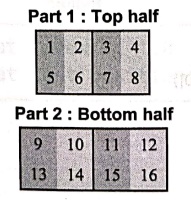
• np.vsplit():
The vertical split means you are cutting the array horizontally(along rows) and
we end up with chunks of rows
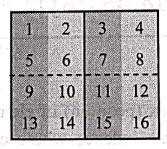
Horizontal splits results in vertical Parts.
Python program
import numpy as np
arr = np.array([[1,2,3,4],
[5,6,7,8],
[9,10,11,12],
[13,14,15,16]])
print(arr, "\n")
v_parts = np.vsplit(arr, 2)
count = 1
for part in v_parts:
print("Part",
count, ":\n", part, "\n")
count += 1
Output
[[ 1 2 3 4]
[ 5 6 7 8]
[ 9 10 11 12]
[13 14 15 16]]
Part 1:
[[1 2 3 4]
[5 6 7 8]]
Part 2:
[[ 9 10 11 12]
[13 14 15 16]]
3. Search
•
Searching means finding the index (position) of
elements that match a condition or value. The function np.where() returns indexes where condition is true. Following
program illustrates the use of this function
Python program
import numpy as np
arr = np.array([10,20,30,40,20,50,20])
result = np.where(arr==20)
print("Index position of 20:",result)
Output
Index position of 20:
(array([1, 4, 6], dtype=int64),)
It
means, position of element 20 in the array is at index 1,4 and 6. Hence is the
output.
4. Sort
•
Sorting means rearranging elements of an array in ascending or descending
order. The function np.sort(array)
is used to sort the array elements. Following program illustrates the use of
this function ‒
Python
program
import numpy as np
arr = np.array([30,40,10,20,50])
result = np.sort(arr)
print(result)
Output
[10 20 30 40 50]
Python for Data Science: Chapter 5: NumPy and Pandas Libraries : Tag: Computer Programming, Python, Data Science : Python library - NumPy: Basic array Operations
Python for Data Science: Chapter 5: NumPy and Pandas Libraries
Under Subject
Python for Data Science
AD25201 2nd Semester AIDS Dept | 2025 Regulation | 2nd Semester 2025 Regulation
Related Subjects

English Essentials II
EN25C02 2nd Semester | 2025 Regulation | 2nd Semester 2025 Regulation

Tamils and Technology தமிழர்களும் தொழில்நுட்பமும்
UC25H02 2nd Semester | 2025 Regulation | 2nd Semester 2025 Regulation

Linear Algebra
MA25C02 2nd Semester | 2025 Regulation

Applied Physics (CSIE) II
PH25C03 2nd Semester AIDS, CSE, IT, CSE(CY) Dept | 2025 Regulation | 2nd Semester 2025 Regulation

Digital Principles and Computer Organization
CS25C06 2nd Semester AIDS, CSE, IT, CSE(CY) Dept | 2025 Regulation | 2nd Semester 2025 Regulation

Basic Electrical and Electronics Engineering
EE25C01 2nd Semester | 2025 Regulation | 2nd Semester 2025 Regulation
Python for Data Science
AD25201 2nd Semester AIDS Dept | 2025 Regulation | 2nd Semester 2025 Regulation

Re-Engineering for Innovation
ME25C05 2nd Semester | 2025 Regulation | 2nd Semester 2025 Regulation
Python for Data Science - Laboratory
AD25201 2nd Semester AIDS Dept | 2025 Regulation | 2nd Semester 2025 Regulation