Python for Data Science: Chapter 5: NumPy and Pandas Libraries
Pandas: Sort and Rank
Python library
The sort_index() function is used to sort series by index labels. The Dataframe.rank() function of Pandas is used to rank the data in different ways.
Sort and
Rank
1) Sorting
The
sort_index() function is used to
sort series by index labels
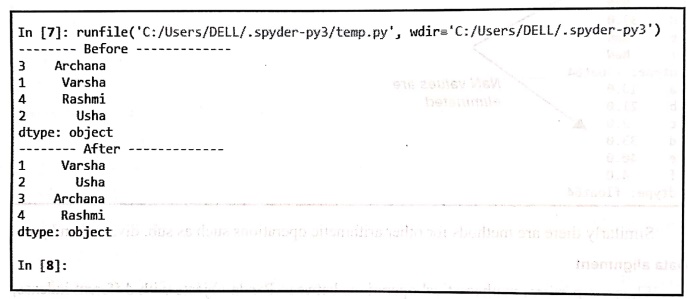
Python program
import pandas as pd
s = pd.Series(["Archana",
"Varsha","Rashmi","Usha"],index=[3,1,4,2])
print("‒‒‒‒‒‒‒‒‒‒‒‒Before‒‒‒‒‒‒‒‒‒‒‒‒‒")
print(s)
print("‒‒‒‒‒‒‒‒ After ‒‒‒‒‒‒‒‒‒‒‒‒‒‒‒")
print(s.sort_index())
Output
For
displaying the data in descending order we write
print(s.sort_index(ascending=False))
We
can also sort the data by values. The sort_values()
function is used for that,
Syntax
dataframe.sort_values(by,
axis, ascending, inplace, kind, na_position, ignore_index, key)
•
by:
It
specifies labels to sort by bq es asbasq hoqmi
• axis: The values can be
0,1,'index', 'columns'. The default 0. The axis to be sorted.
• ascending: bool or list of
bool, default True. Sort ascending vs. descending. Specify list for multiple
sort orders. If this is a list of bools, must match the length of the by.
• inplace:
bool,
default False. If True, perform operation in‒place
• kind: {'quicksort',
'mergesort', 'heapsort'}, default 'quicksort'. Choice of sorting algorithm. See
also ndarray.np.sort for more information. Mergesort is the only stable
algorithm. For DataFrames, this option is only applied when sorting on a single
column or label.
• na_position : {'first', 'last'}, default 'last'.
first puts NaNs at the beginning, last puts NaNs at the end.
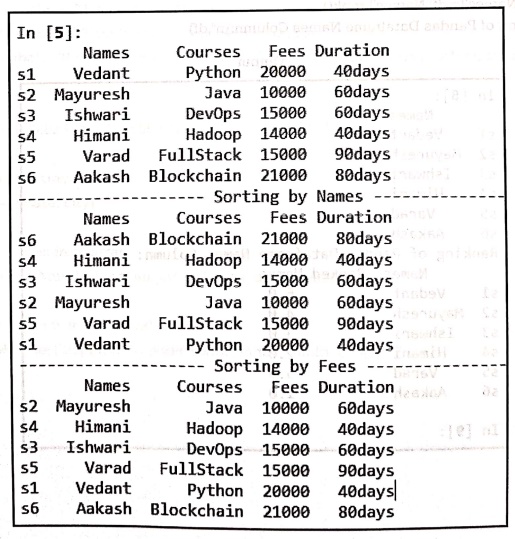
Python code
import pandas as pd
students = {
'Names':["Vedant","Mayuresh","Ishwari","Himani","Varad","Aakash"],
'Courses':["Python","Java", "DevOps",
"Hadoop","FullStack","Blockchain"],
'Fees':[20000,10000,15000,14000,15000,21000],
'Duration': ['40days', '60days', '60days','40days', '90days',
'80days']
}
index_labels = ['s1','s2', 's3','s4', 's5','s6']
df = pd.DataFrame(students, index=index_labels)
print(df)
print("‒‒‒‒‒‒‒‒‒‒‒‒‒‒‒‒‒‒Sorting by Names‒‒‒‒‒‒‒‒‒‒‒‒‒‒‒‒‒‒‒‒‒‒‒")
df1 = df.sort_values(by='Names')
print(df1)
print("‒‒‒‒‒‒‒‒‒‒‒‒‒‒‒‒‒‒Sorting by Courses‒‒‒‒‒‒‒‒‒‒‒‒‒‒‒‒‒‒‒‒‒‒‒")
df2 = df.sort_values(by='Fees')
print(df2)
Output
2) Ranking
The
Dataframe.rank() function of Pandas
is used to rank the data in different ways. After sorting (by default in
ascending order), the position is used to determine the rank that is returned.
If data contains equal values, then they are assigned with the average of the
ranks of each value by default.
The
string values are ranked alphabetically in ascending order if there is any
missing value, they are ignored in the ranking and ranked as NaN.
Following
example illustrates the use of rank()
function.
Python code
import pandas as pd
persons = {
'Names': ["Vedant","Mayuresh",
"Ishwari", "Himani", "Varad","Aakash"]
}
index labels = ['s1','s2','s3°, 's4','s5','s6']
df = pd.DataFrame(persons,index=index_labels)
print(df)
df['Ranked_Names']=df['Names'].rank()
print("Ranking of Pandas Dataframe Names
Column:\n",df)
Output
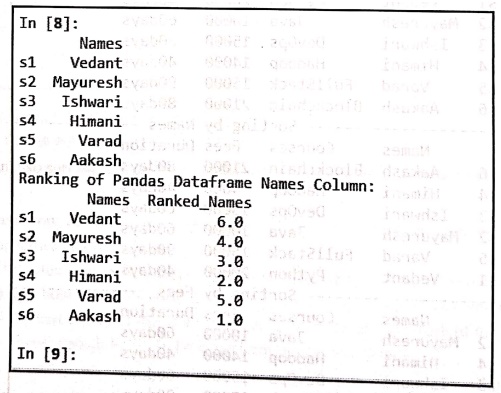
Code explanation:
In above code,
We
have created a data frame containing some names. Then we have applied rank( ) function on the names column.
The names are ranked alphabetically in ascending order.
Another column named Ranked_Names is
created and the corresponding ranks are stored in that columns.
For
instance the name "Akash" has a rank 1.0, "Himani" has a
rank 2.0 because alphabetically A comes before H.
Python for Data Science: Chapter 5: NumPy and Pandas Libraries : Tag: Computer Programming, Python, Data Science : Python library - Pandas: Sort and Rank
Python for Data Science: Chapter 5: NumPy and Pandas Libraries
Under Subject
Python for Data Science
AD25201 2nd Semester AIDS Dept | 2025 Regulation | 2nd Semester 2025 Regulation
Related Subjects

English Essentials II
EN25C02 2nd Semester | 2025 Regulation | 2nd Semester 2025 Regulation

Tamils and Technology தமிழர்களும் தொழில்நுட்பமும்
UC25H02 2nd Semester | 2025 Regulation | 2nd Semester 2025 Regulation
Linear Algebra
MA25C02 2nd Semester | 2025 Regulation

Applied Physics (CSIE) II
PH25C03 2nd Semester AIDS, CSE, IT, CSE(CY) Dept | 2025 Regulation | 2nd Semester 2025 Regulation

Digital Principles and Computer Organization
CS25C06 2nd Semester AIDS, CSE, IT, CSE(CY) Dept | 2025 Regulation | 2nd Semester 2025 Regulation

Basic Electrical and Electronics Engineering
EE25C01 2nd Semester | 2025 Regulation | 2nd Semester 2025 Regulation
Python for Data Science
AD25201 2nd Semester AIDS Dept | 2025 Regulation | 2nd Semester 2025 Regulation

Re-Engineering for Innovation
ME25C05 2nd Semester | 2025 Regulation | 2nd Semester 2025 Regulation
Python for Data Science - Laboratory
AD25201 2nd Semester AIDS Dept | 2025 Regulation | 2nd Semester 2025 Regulation