Python for Data Science: Chapter 5: NumPy and Pandas Libraries
Pandas: Summary Statistics
Python library
Aggregation means combining multiple data items from the data set into a single value. Several commonly used functions like sum(), mean(), avg() are used for aggregation of data.
Summary
Statistics
•
Aggregation means combining multiple
data items from the data set into a single value. Several commonly used
functions like sum(), mean(), avg()
are used for aggregation of data.
•
Pandas provide various library functions to perform aggregation operations.
Some of the functions used in aggregation are as follows ‒
sum()
‒ Compute sum of column values
max()
‒ Compute max of column values
size() ‒
Compute column sizes
first()
‒ Compute first of group values
count()
‒ Compute count of column values
var()
‒ Compute variance of column
min()
‒ Compute min of column values
mean()
‒ Compute mean of column
describe()
‒ Generates descriptive statistics
last()
‒ Compute last of group values
std()
‒ Standard deviation of column
sem()
‒ Standard error of the mean of column
For example ‒
•
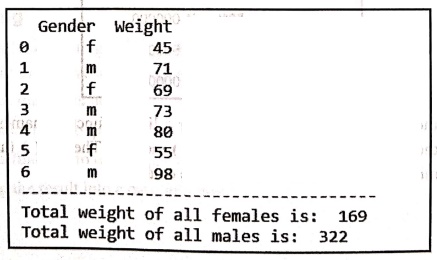
The sum()
function calculates the sum of every value. We can find the total weights of
females and total weights of males using sum() function. The code is as follows
‒
In [4]:
import pandas as pd
data = {'Gender': ['f', 'm', 'f', 'm', 'm', 'f', 'm'], 'Weight :
[45,71,69,73,80,55,98]}
df = pd.DataFrame(data)
print(df)
f = df[ 'Gender'] = = 'f'
female wt = df[f]['Weight'].sum()
print("‒‒‒‒‒‒‒‒‒‒‒‒‒‒‒‒‒‒‒‒‒‒‒‒‒‒‒‒‒‒‒‒‒‒‒‒‒‒‒‒‒‒‒‒‒‒‒")
print("Total weight of all females is: ", female_wt)
m = df['Gender'] = = 'm'
male wt ‒ df[m]['weight'].sum()
print("Total weight of all males is: ",male_wt)
Output
•
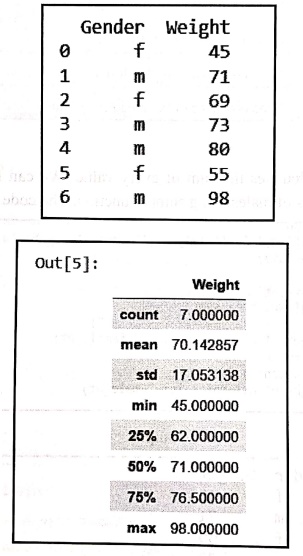
The describe() function gives the
summary of our data set. The code is
In [5]:
import pandas as pd
data = {'Gender': ['f', 'm', 'f', , 'm', 'm', 'f', 'm'],
'Weight':[45,71,69,73,80,55,98]}
df = pd.DataFrame(data)
print(df)
df.describe()
Output
•
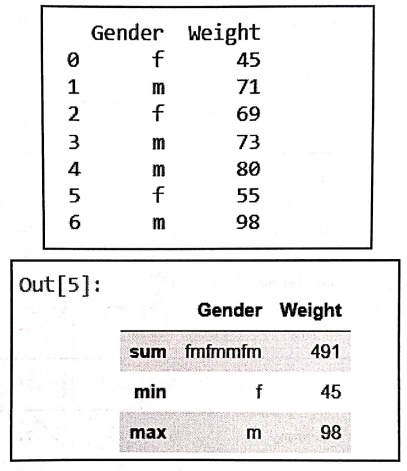
The agg() method allows to apply a
function or a list of function names to be executed. The agg() method is an
alias of the aggregate() method. The
agg() function is used to calculate
sum, min and max of each column in the data set.
•
For example ‒
import pandas as pd
data = {'Gender': ['f','m','f', 'm','m', 'f','m'], 'Weight':
[45,71,69,73,80,55,98]}
df = pd.DataFrame(data)
print(df)
df.agg(['sum','min','max'])
Output
Python for Data Science: Chapter 5: NumPy and Pandas Libraries : Tag: Computer Programming, Python, Data Science : Python library - Pandas: Summary Statistics
Python for Data Science: Chapter 5: NumPy and Pandas Libraries
Under Subject
Python for Data Science
AD25201 2nd Semester AIDS Dept | 2025 Regulation | 2nd Semester 2025 Regulation
Related Subjects

English Essentials II
EN25C02 2nd Semester | 2025 Regulation | 2nd Semester 2025 Regulation

Tamils and Technology தமிழர்களும் தொழில்நுட்பமும்
UC25H02 2nd Semester | 2025 Regulation | 2nd Semester 2025 Regulation
Linear Algebra
MA25C02 2nd Semester | 2025 Regulation

Applied Physics (CSIE) II
PH25C03 2nd Semester AIDS, CSE, IT, CSE(CY) Dept | 2025 Regulation | 2nd Semester 2025 Regulation

Digital Principles and Computer Organization
CS25C06 2nd Semester AIDS, CSE, IT, CSE(CY) Dept | 2025 Regulation | 2nd Semester 2025 Regulation

Basic Electrical and Electronics Engineering
EE25C01 2nd Semester | 2025 Regulation | 2nd Semester 2025 Regulation
Python for Data Science
AD25201 2nd Semester AIDS Dept | 2025 Regulation | 2nd Semester 2025 Regulation

Re-Engineering for Innovation
ME25C05 2nd Semester | 2025 Regulation | 2nd Semester 2025 Regulation
Python for Data Science - Laboratory
AD25201 2nd Semester AIDS Dept | 2025 Regulation | 2nd Semester 2025 Regulation