Applied Physics I: Chapter 7: Quantum Mechanics
Particle in a one dimensional potential box (infinite potential well)
Since the walls are of infinite potential, the particle does not penetrate out from the box.
PARTICLE IN A ONE
DIMENSIONAL POTENTIAL BOX (INFINITE POTENTIAL WELL)
Let
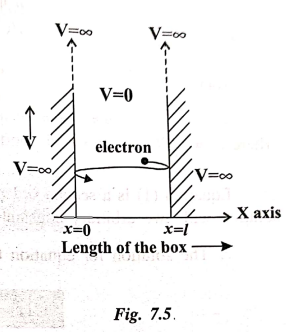
us consider a particle (electron) of mass 'm'
moving along x‒axis, enclosed in a one dimensional potential box (infinite
potential well) as shown in Fig. 7.5.
Since
the walls are of infinite potential, the particle does not penetrate out from
the
box.
Also, the particle is confined between the length ‘l’ of the box and has elastic collisions with the walls. Therefore, the potential energy of the electron inside the box is constant and can be taken as zero for simplicity.
∴ We can say that Outside the box and on the wall of the box, the potential
energy V of the electron is ∞.
Inside the box
the potential energy (V) of the electron is zero.
In
other words, we can write the boundary
conditions as
V(x)=0
when 0<x<l
V(x)
= ∞ when 0≥x≥l
Since
the particle cannot exist outside the box the wave function ᴪ=0 when 0≥x≥l.
To
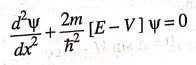
find the wave function of the particle within the box of length 'l', let us consider the schroedinger one
dimensional time independent wave equation (i.e.,)
Since
the potential energy inside the box is zero [(i.e) V=0], the particle has
kinetic energy alone and thus it is named as a free particle (or) free
electron.
∴ For a free particle
(electron), the Schroedinger wave equation is given by
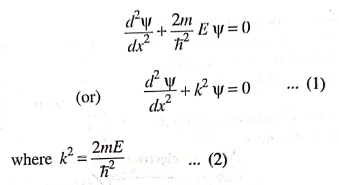
Equation
(1) is a second order differential equation, therefore, it should have solution
with two arbitrary constants.
∴ The solution for
equation (1) is given by
ᴪ(x)
= A sin kx + B cos kx ………….(3)
where
A and B are called as arbitrary constants, which can be found by applying the
boundary conditions.
(i.e.,)
V(x) = ∞ when x=0
and x=l
Boundary condition (i)
at x=0, potential energy V=∞, ∴
There is no chance for finding the particle at the walls of the box, .∴ ᴪ(x) = 0
∴
Equation (3) becomes
0 = A sin 0 + B cos 0
0 = 0 + B(1)
∴ B=0
Boundary condition (ii)
at x=1, potential energy V=∞, ∴ There is no chance for
finding the particle at the walls of the box, ∴ ᴪ(x) = 0
∴ Equation (3) becomes
0 = A sin kl
+ B cos kl
Since
B=0 (from 1st Boundary condition), we have
0
= A sin kl
Since
A ≠ 0; sin kl = 0
We
know sin nπ = 0
Comparing
these two equations, we can write kl=nπ
where
n is an integer.
(or)
k = nπ / l …………….(4)
Substituting
the value of B and k in equation (3) we can write the wave function associated
with the free electron confined in a one dimensional box as
ᴪn(x) = A sin (nπx/l) ……………..(5)
Energy of the particle (Electron)
We
know from equation (2)

Equating
equation (6) and equation (7), we can write
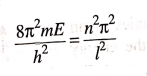
Energy
of the particle (electron) En = n2h2
/ 8ml2 …………..(8)
∴ From equations (8) and
(5) we can say that, for each value of 'n',
there is an energy level and the corresponding wave function.
Thus
we can say that, each value of En is known as Eigen value and the corresponding value of ᴪn is called
as Eigen function.
Energy levels of an electron
For
various values of 'n' we get various
energy values of the electron. The lowest energy value (or) ground state energy
value can be got by substituting n=1 in equation (8)
∴ When n=1 we get E1=
h2 / 8ml2
Similarly
we can get the other energy values
(i.e.,)
When n=2 we get E2= 4h2
/ 8ml2 ⇒ 4E1
(i.e.,)
When n=3 we get E3= 9h2
/ 8ml2 ⇒ 9E1
(i.e.,)
When n=4 we get E4= 16h2
/ 8ml2 ⇒ 16E1
∴ In general, we can
write the energy eigen function as
En= n2E1 ………………..(9)
It
is found from the energy levels E1, E2, E3
etc, the energy levels of an electron are Discrete.
This
is the great success which is achieved in quantum mechanics than classical
mechanics, in which the energy levels are found to be continuous.
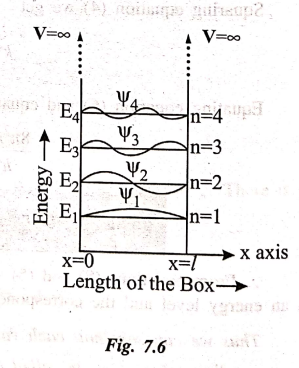
The
various energy eigen values and their corresponding eigen functions of an
electron enclosed in a one dimensional box is as shown in Fig. 7.6. Thus, we
have discrete energy values.
Note: The number of nodes and
antinodes in the wave with respect to the quantum number can be got from a
general formula (ie.,) if we have n
number of antinodes then (n+1) number of nodes will be there.
For example if n=3 then ᴪ3
has 3 antinodes and 4 nodes
(at x=0, x =l/3, x
=2l/3 and x=l)
Normalisation of the wave function
Normalisation:
It is the process by which the probability (P) of finding the particle (electron)
inside the box can be done.
We
know that the total probability (P) is equal to 1 means, then there is a
particle inside the box.
∴ For a one dimensional
potential box of length 'l', the
probability
P = 0∫1 |ᴪ|2 dx = 1 (Since the particle is present
inside the well between the length 0 to’l’
the limits are chosen between 0 to l
) ……..(10)
Substituting
equation (5) in equation (10), we get
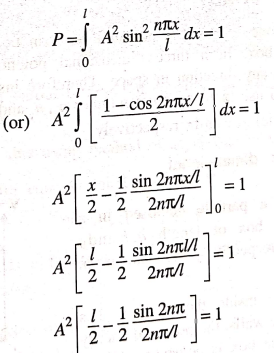
...(11)
We
know sin nπ = 0
sin
2nπ is also = 0
∴ Equation (11) can be
written as
A2l / 2 = 1
(or)
A2 = 2/l
(or)
A = √[2/l]
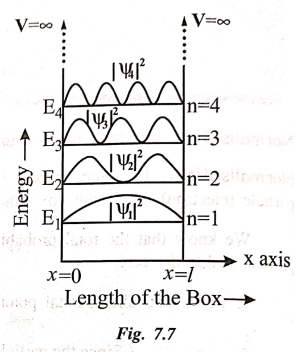
Substituting
the value of 'A' in equation (5),
The
normalised wave function can be written as

The
normalised wave function and their energy values are as shown in Fig. 7.7.
Applied Physics I: Chapter 7: Quantum Mechanics : Tag: Applied Physics : - Particle in a one dimensional potential box (infinite potential well)
Applied Physics I: Chapter 7: Quantum Mechanics
Under Subject
Applied Physics I
PH25C01 1st Semester | 2025 Regulation | 1st Semester 2025 Regulation
Related Subjects

English Essentials I
EN25C01 1st Semester | 2025 Regulation | 1st Semester 2025 Regulation

தமிழர் மரபு - Heritage of Tamils
UC25H01 1st Semester | 2025 Regulation | 1st Semester 2025 Regulation

Applied Calculus
MA25C01 Maths 1 M1 - 1st Semester | 2025 Regulation | 1st Semester 2025 Regulation
Applied Physics I
PH25C01 1st Semester | 2025 Regulation | 1st Semester 2025 Regulation

Applied Chemistry I
CY25C01 1st Semester | 2025 Regulation | 1st Semester 2025 Regulation

Makerspace
ME25C04 1st Semester | 2025 Regulation | 1st Semester 2025 Regulation

Computer Programming C
CS25C01 1st Semester | 2025 Regulation | 1st Semester 2025 Regulation

Computer Programming Python
CS25C02 1st Semester | 2025 Regulation | 1st Semester 2025 Regulation

Fundamentals of Electrical and Electronics Engineering
EE25C03 1st Semester | 2025 Regulation | 1st Semester 2025 Regulation

Introduction to Mechanical Engineering
ME25C03 1st Semester | 2025 Regulation | 1st Semester 2025 Regulation

Introduction to Civil Engineering
CE25C01 1st Semester Civil Department | 2025 Regulation | 1st Semester 2025 Regulation

Essentials of Computing
CS25C03 1st Semester - AID CSE IT Department | 2025 Regulation | 1st Semester 2025 Regulation

Applied Physics I Laboratory
PH25C01 1st Semester practical Laboratory Manual | 2025 Regulation | 1st Semester Laboratory 2025 Regulation

Applied Chemistry I Laboratory
CY25C01 1st Semester practical Laboratory Manual | 2025 Regulation | 1st Semester Laboratory 2025 Regulation

Computer Programming C Laboratory
CS25C01 1st Semester practical Laboratory Manual | 2025 Regulation | 1st Semester Laboratory 2025 Regulation

Computer Programming Python Laboratory
CS25C02 1st Semester practical Laboratory Manual | 2025 Regulation | 1st Semester Laboratory 2025 Regulation
Engineering Drawing
ME25C01 EEE Mech Dept | 2025 Regulation | 2nd Semester 2025 Regulation

Basic Electronics and Electrical Engineering
EE25C04 1st Semester ECE Dept | 2025 Regulation | 2nd Semester 2025 Regulation