Computer Programming C: UNIT III: Functions and Pointers
Recursion
C Programming
Recursion is a programming technique that allows the programmer to express operations in terms of themselves. In C, this takes the form of a function that calls itself.
RECURSION
INTRODUCTION
Recursion
is a programming technique that allows the programmer to express operations in
terms of themselves. In C, this takes the form of a function that calls itself.
A
useful way to think of recursive functions is to imagine them as a process
being performed where one of the instructions is to "repeat the
process". This makes it sound very similar to a loop because it repeats
the same code, and in some ways, it is similar to looping.
On
the other hand, recursion makes it easier to express ideas in which the result
of the recursive call is necessary to complete the task. Of course, it must be
possible for the "process" to sometimes be completed without the
recursive call.
Example:
One simple example is the idea of building a wall that is ten feet high, if I
want to build a ten foot high wall, then I will first build a 9 foot high wall,
and then add an extra foot of bricks. Conceptually, this is like saying the
"build wall" function takes a height and if that height is greater
than one, first calls itself to build a lower wall, and then adds one a foot of
bricks.
Recursion
is the process of calling the same function itself again and again until some
condition is satisfied. This process is used for repetitive computation in
which each action is satisfied in terms of a previous result.
In
order to write a recursive program, the user must satisfy the following.
•
The problem must be analysed and written in recursive form.
•
The problem must have the stopping condition.
Syntax:
function1()
{
function1();
}
In
the above function the function1() is called themselves continuously, so the
above function is in recursive manner.
There
are certain problems, that can be defined in terms of smaller problems of
similar types. Such problems are said to be recursive.
Example: Calculating the factorial
of an integer number.
Normally
n! = 1×2×3×...Xn (where 'n' is an integer). We can also express this by n!=n*(n‒1)!
This
is a recursive statement of the program, in which the desired action is
expressed in terms of previous results i.e., value of (n‒1)! Since 1! =1 is the
last expression, that provides the stopping condition.
n! for any non negative value of 'n' is
defined as
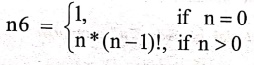
Here,
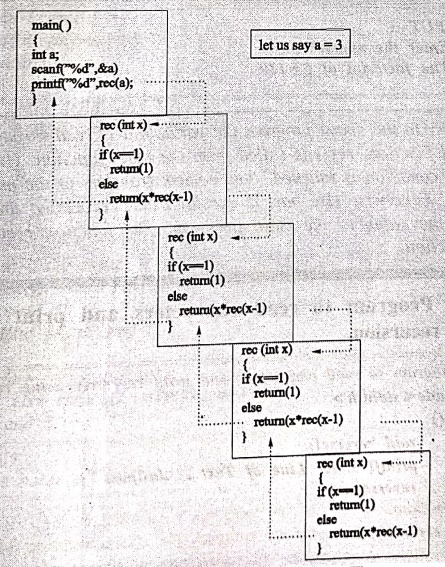
'n' recursively defined in terms of itself, hence 5! is calculated as follows:
5!
= 5*(5‒1)! = 5*4!
4!
= 4*(4‒1)! = 4*3!
3!
= 3*(3‒1)! = 3*2!
2!
= 2*(2‒1)! = 2*1!
1!
= 1*(1‒1)! = 1*1!
Example 1: Program to
calculate the factorial of an integer number.
/* Program to calculate the factorial of an integer number */
#include <stdio.h>
main()
{
int a; /*Local definition */
* Statements /
printf("Enter the number:");
scanf("%d",&a);
printf("The factorial of %d=%d", a, rec(a));
} /* main */
rec(int x) /* rec() is
a function it returns the value to main */
int f;
{
/* Statements */
if(x==1)
return(1);
else
f=x*rec(x‒1);
return(f);
} /* rec() */
OUTPUT
Enter the number 5
The factorial of 5=120
EXPLANATION: In
the above program the variable a is read through the keyboard. The user defined
function. rec() is called from the main function. Here the condition checked
x=1, if condition is satisfied, then control transfers to the main program and
prints the value. Otherwise else part is executed and calculated the factorial
value then it returns the value to the main program. The function rec() is
referred as a recursion function.
Example 2: Program to
read characters and print reversely using recursion.
/* Program to read characters and print reversely using
recursion */
#include <stdio.h>
main()
{
void reverse();
printf("Enter Line of Text . . .In");
reverse();
} /* main */
void reverse()
{
char c;
if ((c=getchar())!= '\n') emitido
reverse(); /* The function reverse() is a recursion function */
putchar(c);
} /* reverse() */
OUTPUT
Enter Line of Text . .
.munilak
kalinum
EXPLANATION:
The main program displays the prompt and then calls the reverse() function.
Then the recursive reverse() function reads a single character until end of
line (n) is encountered. Each function call reads a new character and pushed it
into the stack. Once the end‒of‒line is encountered, then the successive
characters are popped from the stack and displayed on a last‒in‒first‒out
basis, thus the characters are displayed in reverse order.
Example 3: Program to
demonstrate concept of recursion.
/* Program to demonstrate concept of recursion */
#include <stdio.h>
#include <conio.h>
int add(int pk,int pm);
void main()
{
/* Local definitions */
int k,i,m;
m=20;
k=70;
/* Statements */
clrscr();
i=add(k,m); /* call function */
printf("The value of addition is %d\n",i);
getch();
} /* main */
int add(int pk, int pm)
{
if(pm==0) return (pk);
else
return(1+add(pk,pm‒1));
} /* add */
OUTPUT
The value of addition
is 90
EXPLANATION:
In the program m is assigned 20 and k is assigned 70. The main function calls
the sub‒program add(). The subprogram add() executes its body and called
itself. Then performs the operation and prints the output.
TOWER OF HANOI
The
Tower of Hanoi is a children's playing game, played with three poles and a
number of different sized disks, each disk has a hole in center, allowing it to
be stacked around any of the poles. Initially the disks are stacked on the left
most pole in the order of decreasing size, i.e., the largest on the bottom and
the smallest on the top, as shown in figure given below.
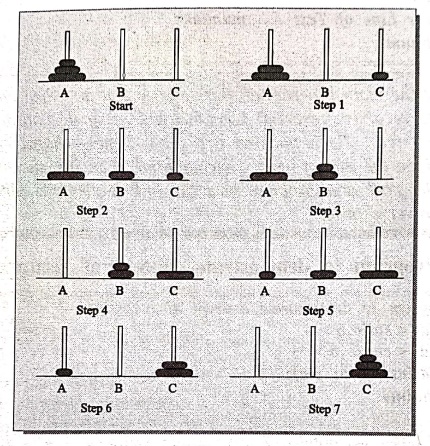
The
objective of this game is to transfer the disks from the left most pole to the
right most poles, without ever placing a larger disk on the top of the smaller
disk. Only one disk may be moved at a time and each disk must always be placed
around one of the poles.
The
general strategy of the Tower of Hanoi is to consider one of the poles to be
the origin, and the other to be the destination, the third pole will be used
for intermediate storage, this allows the disks to be moved without placing a
larger disk over the smaller one.
Assume
that there are 'n' disks numbered from smallest to largest as shown in the
figure. If the disks are initially stacked on the left pole, the problem of
moving all 'n' disks to the right pole can be stated in the following recursive
manner.
i)
Move the top n‒1 disks from the left pole to the center pole.
ii)
Move the nth disk (largest) to the right pole.
iii)
Move the n‒1 disks on the center pole to the right pole.
This
can be solved using the above manner for any value of 'n' greater then 0 (If
n=0 represents stopping condition)
Example: Program to
demonstrate tower of Hanoi.
/* Program using tower of Hanoi */
#include <stdio.h>
main()
{
void hanoi (int, char, char, char); /* Local definition */
/* Statements */
int n;
printf ("How many disk... \n");
scanf("%d", &n);
hanoi (n, 'L', 'R', 'C');
} /* main */
void hanoi (int n, char from, char to, char t)
{
if (n>0)
{
hanoi
(n‒1, from, temp, to);
printf
("Move disk %d from %c to %c\n", n, from, to);
hanoi
(n‒1, temp, to, from);
} /* if */
} /* hanoi */
OUTPUT
How many disk….. 3
Move disk 1 from L to
R
Move disk 2 from L to
C
Move disk 1 from R to
C
Move disk 3 from L to
R
Move disk 1 from C to
L
Move disk 2 from C to
R
Move disk 1 from L to
R
EXPLANATION:
In the above program the number of disk n is read and call the subprogram
hanoi() from the main function. The function hanoi() checks the condition if
(n>0) condition is true then the block of statements are executed and print
the poles and sides of the disk. In the program the function hanoi() is
referred as a recursion. Where L, R, C are the labels of the poles, i.e., left
(L), center (C) and Right (R) and L(From), R(To) and C(t) are the their sources
and destination.
Example: Program Binary Search
using recursive function.
#include <stdio.h>
#include <stdlib.h>
#define size 10
int binsearch (int[], int, int, int);
int main()
{
int num, i, key, position;
int low, high, list[size];
printf("\nEnter the total number of elements: ");
scanf("%d", &num);
printf("\nEnter the elements of list :");
for(i=0; i < num; i++)
{
scanf("%d", &list[i]);
}
low = 0;
high = num‒1;
printf("\nEnter element to be searched: ");
scanf("%d", &key);
position = binsearch(list, key, low, high);
if (position != ‒1)
printf("\nNumber present at %d", (position + 1));
else
printf("\n
The number is not present in the list");
return (0);
/*Binary Search function */
int binsearch(int a[], int x, int low, int high)
{
int mid;
if (low > high)
return ‒1;
mid = (low + high) / 2;
if (x == a[mid])
return (mid);
else if (x < a[mid])
binsearch(a, x,
low, mid ‒ 1);
else
binsearch(a, x,
mid + 1, high);
OUTPUT
Enter the total number
of elements: 5
Enter the elements of
list : 3 5 2 6 7
Enter element to be
searched :2
Number present at: 3
Enter the total number
of elements 5
Enter the elements of
list : 6 4 3 2 8
Enter element to be
searched : 9
The number is not
present in the list
Computer Programming C: UNIT III: Functions and Pointers : Tag: Computer Science : C Programming - Recursion
Computer Programming C: UNIT III: Functions and Pointers
Under Subject
Computer Programming C
CS25C01 1st Semester | 2025 Regulation | 1st Semester 2025 Regulation
Related Subjects

English Essentials I
EN25C01 1st Semester | 2025 Regulation | 1st Semester 2025 Regulation

தமிழர் மரபு - Heritage of Tamils
UC25H01 1st Semester | 2025 Regulation | 1st Semester 2025 Regulation
Applied Calculus
MA25C01 Maths 1 M1 - 1st Semester | 2025 Regulation | 1st Semester 2025 Regulation
Applied Physics I
PH25C01 1st Semester | 2025 Regulation | 1st Semester 2025 Regulation

Applied Chemistry I
CY25C01 1st Semester | 2025 Regulation | 1st Semester 2025 Regulation
Makerspace
ME25C04 1st Semester | 2025 Regulation | 1st Semester 2025 Regulation
Computer Programming C
CS25C01 1st Semester | 2025 Regulation | 1st Semester 2025 Regulation
Computer Programming Python
CS25C02 1st Semester | 2025 Regulation | 1st Semester 2025 Regulation
Fundamentals of Electrical and Electronics Engineering
EE25C03 1st Semester EEE Depart | 2025 Regulation | 1st Semester 2025 Regulation
Introduction to Mechanical Engineering
ME25C03 1st Semester Mechanical Dept | 2025 Regulation | 1st Semester 2025 Regulation

Introduction to Civil Engineering
CE25C01 1st Semester Civil, Agri Departments | 2025 Regulation | 1st Semester 2025 Regulation
Essentials of Computing
CS25C03 1st Semester - AIDS, CSE, CSE(CY), IT Department | 2025 Regulation | 1st Semester 2025 Regulation

Applied Physics I Laboratory
PH25C01 1st Semester practical Laboratory Manual | 2025 Regulation | 1st Semester Laboratory 2025 Regulation

Applied Chemistry I Laboratory
CY25C01 1st Semester practical Laboratory Manual | 2025 Regulation | 1st Semester Laboratory 2025 Regulation

Computer Programming C Laboratory
CS25C01 1st Semester EEE, ECE, CSE, CSE(CY), AIDS, IT practical Laboratory Manual | 2025 Regulation | 1st Semester Laboratory 2025 Regulation

Computer Programming Python Laboratory
CS25C02 1st Semester practical Laboratory Manual | 2025 Regulation | 1st Semester Laboratory 2025 Regulation
Engineering Drawing
ME25C01 EEE, Mech, Agri, EEE Depts | 2025 Regulation | 2nd Semester 2025 Regulation

Basic Electronics and Electrical Engineering
EE25C04 1st Semester ECE Dept | 2025 Regulation | 1st Semester 2025 Regulation
Essentials of Computing - Laboratory
CS25C03 1st Semester AIDS, CSE, CSE(CY), IT Depts | practical Laboratory Manual | 2025 Regulation | 1st Semester 2025 Regulation