Computer Programming C: UNIT III: Functions and Pointers
Function Prototypes
C Programming
The functions are classified into the following types depending on whether the arguments are present or not and whether a value is returned or not. These are also called function prototypes.
FUNCTION PROTOTYPES
INTRODUCTION
The
functions are classified into the following types depending on whether the
arguments are present or not and whether a value is returned or not. These are
also called function prototypes.
In
'C', while defining user‒defined function, it is a must to declare its
prototype. A prototype statement keeps the compiler to check the return type
and arguments types of the function.
A
function prototype declaration consists of the function's return type, name and
arguments list. It is always terminated with semicolon. If the programmer makes
mistake, the compiler flags an error message. The following. are the function
prototypes.
i)
Function with no arguments and no return value.
ii) Function with arguments and no
return value.
iii) Function with arguments and
with return value.
iv) Function with no arguments and
with return value.
1. Function with no arguments and no return values
In
this prototype, no data transfer takes place between the calling function and
the called function. i.e., the called program does not receive any data from
the calling program and does not send back any value to the calling program.
The
function is only executed and nothing is obtained. Such functions are used to
perform only operation, they act independently. They read data values and print
result in the same block.
Syntax:
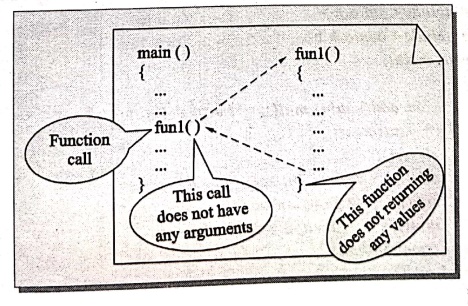
The
dotted line indicates that, there is only transfer of control but no data
transfer.
Example 1: Addition
of two numbers.
/* Program to addition of two numbers */
#include <stdio.h>
main()
{
void add(void);
add(); /* add is a
function with no arguments */
} /* main **/
void add()
{
int a, b, c ; /**
Local definitions */
/* Statements */
printf("Enter
two numbers...");
scanf("%d
%d",&a, &b);
c=a+b:
printf("Sum
is... %d",c);
} /* add */
OUTPUT
Enter two numbers... 10
20
Sum is... 30
EXPLANATION:
In the above program, user‒defined function add() is defined. The main function
calls the add() function. The user‒defined function add() executed the block of
statements and prints the output in same block. There is no argument sent from
main function and no values are returned from the add() function.
Example 2: Program to print
addition, subtraction and multiplication values using functions.
/* Program to print addition, subtraction and multiplication
values */
#include <stdio.h>
#include <conio.h>
void main()
{
void add(), sub(), mul(); /*Local definitions */
/* Statements */
clrscr();
add(); /*function call */
sub(); /* function call */
mul(); /*function call */
} /*main */
void add()
{
int a=10,b=5;
printf("The addition value is: %d\n", a+b);
} /*add */
void sub()
{
int a=10,b=5;
printf("The subtract value is : %d\n",a‒b);
} /*sub */
void mul()
{
int a=10,b=5;
printf("The multiplication value is : %d\n", a*b);
getch();
} /*mul */
OUTPUT:
The addition value is:
15
The subtract value is
: 5
The multiplication
value is: 50
EXPLANATION:
In the above program three user defined function add(), sub(), mul(). The main
function calls these three functions. These functions are called as per the
calling sequence and print the result as output.
2. Function with arguments and no return values
In
this prototype, data is transferred from calling function to called function.
i.e., The called program receives some data from the calling program and does
not send back any values to calling program. (One way communication). Such
functions are partly dependent on the calling function.
Syntax:
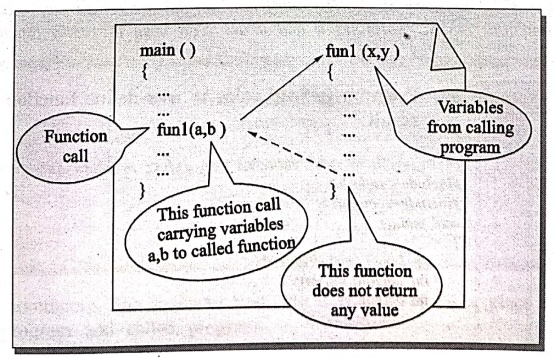
The
continuous line indicates data transfer and dotted line indicates transfer of
control.
Example 1: Addition
of two numbers.
/* Program for addition
of two numbers */
#include <stdio.h>
main()
{
void add(int,
int); /* Local definition */
int a,b;
printf("Enter
two values: ");
scanf("%d
%d", &a,&b);
add(a,b); /* add
is a function with arguments */
} /* main */
void add(int x, int y) /*
add is a function with no return values */
{
/* Local
definition */
int z;
/* Statements */
z=x+y;
printf("Sum
is..... %d", z);
} /* add */
OUTPUT
Enter two values: 10
20
Sum is..... 30
EXPLANATION:
In the program, the arguments a and b are passed to the add() function. Passed
arguments are executed in the calling function block and print the result in
the same block. The add() function did not return any values to the main
function, but the variables a and b are read from the main function.
Example 2: Program to send value to
user‒define function and display the result.
/* Program to send value to user‒define function and display the
result */
#include <stdio.h>
#include <conio.h>
void main()
{
/* Local definitions */
int date(int, int, int);
int dd,mm,yy;
/* Statements */
clrscr();
printf("Enter the Employee joining date .\n");
printf("Enter date,month,year : ");
scanf("%d %d %d", &dd, &mm, &yy);
date (dd,mm, yy); function call */
} /* main */
date(int x, int y, int z)
{
printf("Employee Joined date is : %d/%d/%d",x,y,z);
getch();
}
OUTPUT
Enter the Employee
joining date.
Enter date,month,
year: 11 12 1981
Employee Joined date
is: 11/12/1981
EXPLANATION:
In this program, three values are passed to date() function. The date() function
receives the arguments from main() function and prints the date in a format and
the date function did not return any values to the main function.
3. Function with arguments and with return value
In
this prototype, the data is transferred between the calling function and called
function. i.e., The called program receives some data from the calling program
and send back a value return to the calling program. (Two way data
communication).
Syntax:
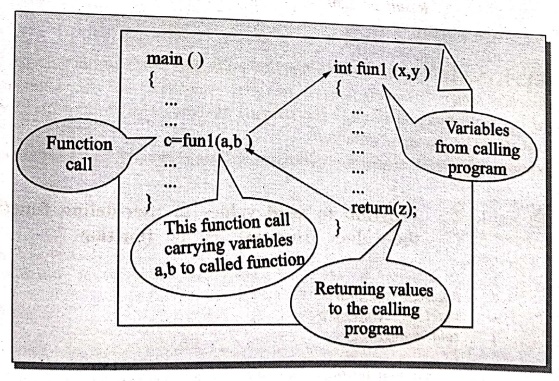
Here,
the continuous line indicates that, the data transfer takes place in between
calling program and called program.
Example 1: Addition of two numbers.
* Program for addition of two numbers */
#include <stdio.h>
main()
{
int add(int, int); /* Local definition */
int a,b,c;
/* Statements */
printf("Enter two numbers :");
scanf("%d %d", &a, &b);
c=add(a,b); /* add is a function with arguments */
printf("Result is ...%d", c);
} /* main */
int add(int x, int y) /* add is a function with return value to
main */
{
/* Local definition */
int z;
/* Statements */
z=x+y;
return(z);
} /* add */
OUTPUT
Enter two numbers: 10
20
Result is ...30
EXPLANATION:
The main() function calls and sends arguments to the user defined function
add(). The add() function performs calculation and the values are returned back
to the main function through the return() function. The reading and writing the
values are done in the main function.
Example 2: Program to
send values to user‒define function and receive the values from user‒define
function.
/* Program to send and receives the values from function */
#include <stdio.h>
#include <conio.h>
void main()
{
int mul(int, int), m, n,sum; /* Local definitions */
/* Statements */
clrscr();
printf("Enter the two numbers: ");
scanf("%d %d", &m,&n);
sum=mul(m,n); /* call function */
printf("Multiplication of entered values is: %d",
sum);
getch();
} /* main */
mul(int m, int n)
{
return(m*n);
} /* mul */
OUTPUT
Enter the two numbers:
30 4
Multiplication of
entered values is: 120
EXPLANATION:
In this program the function mul() receives three values from main function.
The mul() function calculates the multiplication of two values and return the
result to the main program.
4. Function with no arguments and with return value
In
this prototype, one way data communication takes place. i.e., the calling
program can not pass any arguments to the called program but, the called
program may send some return value to the calling program.
The
called function is independent. It reads values from the keyboard or generates
from initialization and returns the values. Here both the calling and called
functions are partly communicated with each other.
Syntax:
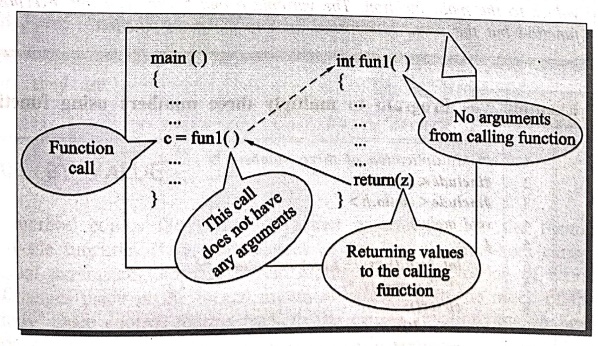
Example 1: Addition
of two numbers.
/* Function with no arguments and with return value */
#include <stdio.h>
main()
{
int add(); /* Local
definition */
c=add(); /* add is a function with no arguments */
printf("Results in ..%d", C);
} /* main */
int add()/* add is a function with return value */
{
/* Local definition */
int a,b,c;
/* Statements */
printf ("Enter two numbers: ");
scanf("%d %d", &a, &b);
c=a+b;
return (c);
} /* add */
OUTPUT
Enter two numbers: 10,
20
Result is …. 30
EXPLANATION:
In the above program, the main function did not send any arguments to the user
defined function add(). But the user defined function sending back some values
to the main function. The variable a and b are read and executed in add()
function but the result is returned back to the main function.
Example 2: Program to
multiply three numbers using function.
/* Multiplication of three numbers */
#include <stdio.h>
#include <conio.h>
void main()
{
int *mul(), *s; /* Local definitions */
/* Statements */
clrscr();
s=mul(); /* function call */
printf("Multiplication of three numbers is = %d",*s);
getch();
} /* main */
*mul()
{
int a,b,c,i;
printf("\n Enter the three values: ");
scanf("%d %d %d",&a,&b, &c);
i=a*b*c;
return(&i);
} /* mul */
OUTPUT
Enter the three
values: 4 8 2
Multiplication of
three numbers is = 64
EXPLANATION:
The function* mul() is declared as a pointer function i.e., the function
declared as pointer always returns the reference. The reference returned by the
function *mul() is assigned to a pointer *s The pointer *s prints the
multiplication value.
Computer Programming C: UNIT III: Functions and Pointers : Tag: Computer Science : C Programming - Function Prototypes
Computer Programming C: UNIT III: Functions and Pointers
Under Subject
Computer Programming C
CS25C01 1st Semester | 2025 Regulation | 1st Semester 2025 Regulation
Related Subjects

English Essentials I
EN25C01 1st Semester | 2025 Regulation | 1st Semester 2025 Regulation

தமிழர் மரபு - Heritage of Tamils
UC25H01 1st Semester | 2025 Regulation | 1st Semester 2025 Regulation
Applied Calculus
MA25C01 Maths 1 M1 - 1st Semester | 2025 Regulation | 1st Semester 2025 Regulation
Applied Physics I
PH25C01 1st Semester | 2025 Regulation | 1st Semester 2025 Regulation

Applied Chemistry I
CY25C01 1st Semester | 2025 Regulation | 1st Semester 2025 Regulation

Makerspace
ME25C04 1st Semester | 2025 Regulation | 1st Semester 2025 Regulation
Computer Programming C
CS25C01 1st Semester | 2025 Regulation | 1st Semester 2025 Regulation
Computer Programming Python
CS25C02 1st Semester | 2025 Regulation | 1st Semester 2025 Regulation
Fundamentals of Electrical and Electronics Engineering
EE25C03 1st Semester EEE Depart | 2025 Regulation | 1st Semester 2025 Regulation
Introduction to Mechanical Engineering
ME25C03 1st Semester Mechanical Dept | 2025 Regulation | 1st Semester 2025 Regulation

Introduction to Civil Engineering
CE25C01 1st Semester Civil, Agri Departments | 2025 Regulation | 1st Semester 2025 Regulation
Essentials of Computing
CS25C03 1st Semester - AIDS, CSE, CSE(CY), IT Department | 2025 Regulation | 1st Semester 2025 Regulation

Applied Physics I Laboratory
PH25C01 1st Semester practical Laboratory Manual | 2025 Regulation | 1st Semester Laboratory 2025 Regulation

Applied Chemistry I Laboratory
CY25C01 1st Semester practical Laboratory Manual | 2025 Regulation | 1st Semester Laboratory 2025 Regulation

Computer Programming C Laboratory
CS25C01 1st Semester EEE, ECE, CSE, CSE(CY), AIDS, IT practical Laboratory Manual | 2025 Regulation | 1st Semester Laboratory 2025 Regulation

Computer Programming Python Laboratory
CS25C02 1st Semester practical Laboratory Manual | 2025 Regulation | 1st Semester Laboratory 2025 Regulation
Engineering Drawing
ME25C01 EEE, Mech, Agri, EEE Depts | 2025 Regulation | 2nd Semester 2025 Regulation

Basic Electronics and Electrical Engineering
EE25C04 1st Semester ECE Dept | 2025 Regulation | 1st Semester 2025 Regulation
Essentials of Computing - Laboratory
CS25C03 1st Semester AIDS, CSE, CSE(CY), IT Depts | practical Laboratory Manual | 2025 Regulation | 1st Semester 2025 Regulation