Computer Programming C: UNIT III: Functions and Pointers
Pointers and Arrays
C Programming
The array elements can be accessed by two methods. • Standard array notation • Pointer arithmetic
POINTERS AND ARRAYS
The
array elements can be accessed by two methods.
•
Standard array notation
•
Pointer arithmetic
Array
notation is a form of relative addressing. The compiler treats the subscripts
as a relative offset from the beginning of the array. When a pointer variable
is set to the start of an array and is incremented to find the next element,
absolute addressing is being implemented. Therefore, using pointers have the
following advantages.
•
Accessing arrays through pointers is marginally faster than using array
notation.
•
Pointers give better control over array processing.
•
Pointers allow us to perform certain functions that are extremely difficult
with array notation.
Array
is a collection of similar data type elements stored under common name. When we
declare an array the consecutive memory locations are located to the array of
elements. The elements of an array can be efficiently accessed by using
pointers.
•
Array elements are always stored in consecutive memory locations according to
the size of the array.
•
The size of the data type with the pointer variables refers to, depends on the
data type pointed by the pointer.
•
A pointer when incremented, always points to a location after skipping the
number of bytes required for the data type pointed to by it.
Example:
int
a[5]={10,20,30,40,50}
Here,
a[5] means the array 'a' has 5 elements and of integer data type.
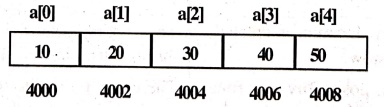
The
base address of the array start with 1th element of the array. The array is in
integer type, the integer will have 2 bytes and hence the address of the next
address element is incremented by 2.
Example:
int
a[5]={10,20,30,40,50}
int *b;
b=a;
Here,
'b' is a pointer variable which holds the base address of the array 'a' ie.
b=&a[0].
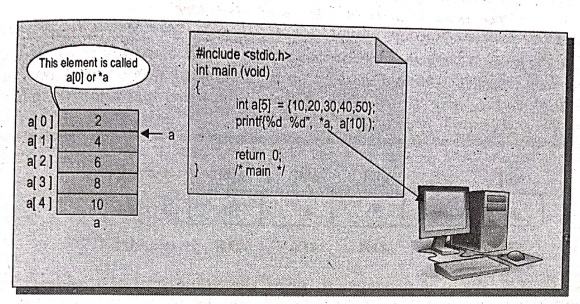
When
pointer variable is incremented by 1 then the related base address will be
incremented by address+2 because
pointer is of type integer. Hence the next address element by increase by 2
till the size of an array.
Example:
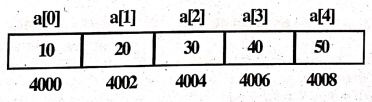
Example 1: Write a
program to print the value and address of the element.
/* Program to print the value and address of the element */
#include <stdio.h>
main()
{
/* Local definitions */
int a[5]={10,20,30,40,50}; /* a[5] has five elements of integer data
type "/
int b;
/* Statements */
for (b=0;b<5;b++)
{
printf ("The
value of a[%d]=%d",b,a[b]);
printf
("Address of a[%d]=%u",b,&a[b]);
} /* for */
} /* main */
OUTPUT
The value of a[0]=10
Address of a[0]=4000
The value of a[1]=20
Address of a[1]=4002
The value of a[2]=30
Address of a[2]=4004
The value of a[3]=40
Address of a[3]=4006
The value of a[4]=50
Address of a[4]=4008
EXPLANATION:
In the above program the integer variable a is declared as an array. The for
loop repeatedly executed the body up to four times starting from 0, each time
the loop prints the value of variable a assigned is to array and prints the
address of variable a as shown in output.
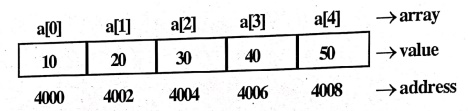
Example 2: Write a
program to print the value and the address of the element using pointer.
* Program to print the value and the address of the element
using pointer */
#include <stdio.h>
main()
{
int arr[5]={10,20,30,40,50}; /* arr[5] has five elements of
integer data type */
int i,*p_arr; /*
i,*p_arr is a pointer variables */
p_arr=arr;
for(i=0; i<=5;i++)
{
printf("Address=%u",
&arr[i]);
printf("Element=%d",
&arr[i]);
printf("%d",
*(arr+i));
printf("%d",p_arr[i]);
printf(“%d”,
*(p_arr+i));
} /* for */
} /* main */
OUTPUT
Address 4000 Element
10 10 10 10
Address 4002 Element
20 20 20 20
Address 4004 Element
30 30 30 30
Address 4006 Element
40 40 40 40
Address 4008 Element
50 50 50 50
EXPLANATION:
In the above program, the variable arr[] is declared as integer array, the
elements are displayed using different syntax. (1) &arr[i], (2) *(arr+i),
(3) p_ (4) *(p_arr+i).
1) &arr[i]
‒ This prints 0th address elements from the array.
2) *(arr+i)
‒ The arr+i is addition of a constant with the base address of an array. It
shows the address of element. The *(arr+i)
points to the elements of an array.
3) p_arr[i]
‒ Here 'p_arr' refers to the element
number and i refers to the base address. By varying p_arr and i the various elements of the array are displayed.
4)
*(p)arr+i) ‒ This statement is same
as 2.
Example 3: Write a
program to add the sum of the numbers using pointer.
/* Program to add the sum of number using pointer */
#include <stdio.h>
main()
{
/* Local definitions */
int b, total;
int a[5]; /* a[5] is an array elements */
int *c; /**c is a pointer variable */
/* Statements */
for (b=0;b<5;b++)
{
printf
("Enter the number %d", b+1);
scanf
("%d", &a[b]);
} /* for */
c=a,
for (b=0;b<5;b++)
{
printf
("%d", *c);
total = total +
*c;
с = c + 1;
} /* for */
printf ("\n Total = %d", total);
} /* main */
OUTPUT
Enter the number 10 20
30 40 50
Total = 150
EXPLANATION:
In the above program, the variable a is declared as an integer type array. c is
declared as a pointer variable. The for loop reads the 5 integer elements from
the keyboard. The array a is assigned to pointer variable c. The second for
loop gets each element of array through pointer variable c and adds to the
variable total. Finally the variable total is printed as output.
Example 5: Write a
program to sort a given number using pointer.
* Program to sort a given number using pointer */
#include <stdio.h>
main()
{
int j,k;
int arr[5]; /*arr[5] is a array elements */
int *a; /* *a is a
pointer variable */
a=arr;
for(j=0;j<5;j++)
{
printf("Enter
the number %d="j+1);
scanf("%d",
&arr[j]);
} /* for */
printf("\n Before sorting");
for(j=0;j<5;j++)
printf("%d\n",
arr[j]);
a=arr;
for(j=0;j<5;j++)
for(k=0;k<5‒j−1;k++)
If (*(arr+k) >
*(arr+k+1))
swap (arr+k, arr+k+1); /* function call */
printf ("After sorting");
for (j=0; j<5; j++)
printf
("%d\n", arr[j]);
} /* main */
swap (b,c)
int *b, *c; /* *b, *c is
a point variables */
{
int temp;
temp=*b;
*b=*c;
*c=temp;
} /* Swap */
OUTPUT
Enter the number=8
Enter the number=5
Enter the number=7
Enter the number=4
Enter the number=6
Before sorting 8 5 7 4 6
After sorting 4 5 6 7
8
EXPLANATION:
The variable arr is assigned to pointer variable a. The body of for loop j and
k checks the condition (*(arr+k)>*(arr+k+i). If the condition is true the
program control transfer to swap() function. The swap function interchanges the
value using third variable temp then control transfer to main program. Finally
using for loop j the sorted output is printed.
Computer Programming C: UNIT III: Functions and Pointers : Tag: Computer Science : C Programming - Pointers and Arrays
Computer Programming C: UNIT III: Functions and Pointers
Under Subject
Computer Programming C
CS25C01 1st Semester | 2025 Regulation | 1st Semester 2025 Regulation
Related Subjects

English Essentials I
EN25C01 1st Semester | 2025 Regulation | 1st Semester 2025 Regulation

தமிழர் மரபு - Heritage of Tamils
UC25H01 1st Semester | 2025 Regulation | 1st Semester 2025 Regulation
Applied Calculus
MA25C01 Maths 1 M1 - 1st Semester | 2025 Regulation | 1st Semester 2025 Regulation

Applied Physics I
PH25C01 1st Semester | 2025 Regulation | 1st Semester 2025 Regulation

Applied Chemistry I
CY25C01 1st Semester | 2025 Regulation | 1st Semester 2025 Regulation
Makerspace
ME25C04 1st Semester | 2025 Regulation | 1st Semester 2025 Regulation
Computer Programming C
CS25C01 1st Semester | 2025 Regulation | 1st Semester 2025 Regulation
Computer Programming Python
CS25C02 1st Semester | 2025 Regulation | 1st Semester 2025 Regulation
Fundamentals of Electrical and Electronics Engineering
EE25C03 1st Semester EEE Depart | 2025 Regulation | 1st Semester 2025 Regulation

Introduction to Mechanical Engineering
ME25C03 1st Semester Mechanical Dept | 2025 Regulation | 1st Semester 2025 Regulation

Introduction to Civil Engineering
CE25C01 1st Semester Civil, Agri Departments | 2025 Regulation | 1st Semester 2025 Regulation
Essentials of Computing
CS25C03 1st Semester - AIDS, CSE, CSE(CY), IT Department | 2025 Regulation | 1st Semester 2025 Regulation

Applied Physics I Laboratory
PH25C01 1st Semester practical Laboratory Manual | 2025 Regulation | 1st Semester Laboratory 2025 Regulation

Applied Chemistry I Laboratory
CY25C01 1st Semester practical Laboratory Manual | 2025 Regulation | 1st Semester Laboratory 2025 Regulation

Computer Programming C Laboratory
CS25C01 1st Semester EEE, ECE, CSE, CSE(CY), AIDS, IT practical Laboratory Manual | 2025 Regulation | 1st Semester Laboratory 2025 Regulation

Computer Programming Python Laboratory
CS25C02 1st Semester practical Laboratory Manual | 2025 Regulation | 1st Semester Laboratory 2025 Regulation
Engineering Drawing
ME25C01 EEE, Mech, Agri, EEE Depts | 2025 Regulation | 2nd Semester 2025 Regulation

Basic Electronics and Electrical Engineering
EE25C04 1st Semester ECE Dept | 2025 Regulation | 1st Semester 2025 Regulation
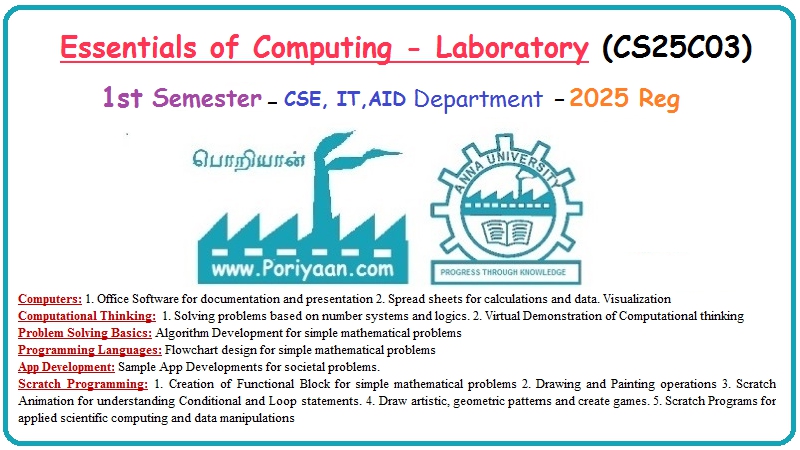
Essentials of Computing - Laboratory
CS25C03 1st Semester AIDS, CSE, CSE(CY), IT Depts | practical Laboratory Manual | 2025 Regulation | 1st Semester 2025 Regulation