Basic Electronics and Electrical Engineering: Chapter 8: Sensors and Transducers
Temperature Sensors
Temperature conveys the state of a mechanical system in terms of expansion or contraction of solids, liquids or gases, change in electrical resistance of conductors, semiconductors and thermoelectric emfs.
TEMPERATURE
SENSORS
Temperature conveys the
state of a mechanical system in terms of expansion or contraction of solids,
liquids or gases, change in electrical resistance of conductors, semiconductors
and thermoelectric emfs. Temperature sensors such as bimetallic strips,
thermocouples, thermistors are widely used in monitoring of manufacturing
processes such as casting, molding, metal cutting etc. The construction details
and principle of working of some of the temperature sensors are discussed in
following sections.
1. Bimetallic strips
Bimetallic strips are
used as thermal switch in controlling the temperature or heat in a
manufacturing process or system. It contains two different metal strips bonded
together.
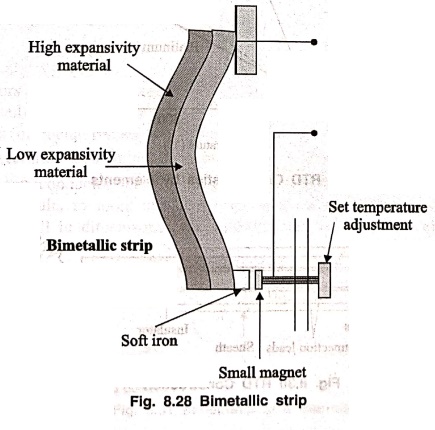
The metals have
different coefficients of expansion. On heating the strips bend into curved
strips with the metal with higher coefficient of expansion on the outside of
the curve. Figure shows a typical arrangement of a bimetallic strip used with a
setting‒up magnet. As the strips bend, the soft iron comes in closer proximity
of the small magnet and further touches. Then the electric circuit completes
and generates an alarm. In this way bimetallic strips help to protect the
desired application from heating above the pre‒set value of temperature.
2. Resistance temperature detectors (RTDs)
RTDs work on the
principle that the electric resistance of a metal changes due to change in its
temperature. On heating up metals, their resistance increases and follows a linear
relationship as shown in Figure 8.29 The correlation is
Rt = R0
(1+αT)

Where Rt is
the resistance at temperature T (°C) and R0 is the temperature at
0°C and α is the constant for the metal termed as temperature coefficient of
resistance. The sensor is usually made to have a resistance of 100Ω at 0°C.
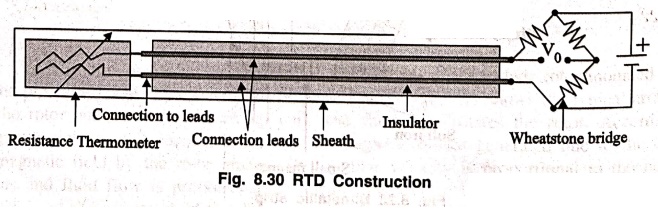
Fig. 940 shows the
construction of a RTD. It has a resistor element connected to a Wheatstone
bridge. The element and the connection leads are insulated and protected by a
sheath. A small amount of current is continuously passing though the coil. As
the temperature changes the resistance of the coil changes which is detected at
the Wheatstone bridge.
RTDs are used in the
form of thin films, wire wound or coil. They are generally made of metals such
as platinum, nickel or nickel‒copper alloys. Platinum wire held by a high‒
temperature glass adhesive in a ceramic tube is used to measure the temperature
in a metal furnace. Other applications are:
• Air conditioning and
refrigeration servicing
• Food Processing
• Stoves and grills
• Textile production
• Plastics processing
• Petrochemical
processing
• Micro electronics
• Air, gas and liquid
temperature measurement in pipes and tanks
• Exhaust gas
temperature measurement
Thermistors
Thermistors follow the
principle of decrease in resistance with increasing temperature. The material
used in thermistor is generally a semiconductor material such as a sintered
metal oxide (mixtures of metal oxides, chromium, cobalt, iron, manganese and
nickel) or doped polycrystalline ceramic containing barium titanate (BaTiO3)
and other compounds. As the temperature of semiconductor material increases the
number of electrons able to move about increases which results in more current
in the material and reduced resistance. Thermistors are rugged and small in
dimensions. They exhibit nonlinear response characteristics.

Thermistors are
available in the form of a bead (pressed disc), probe or chip. Fig 8.31 shows
the construction of a bead type thermistor. It has a small bead of dimension
from 0.5 mm to 5 mm coated with ceramic or glass material. The bead is
connected to an electric circuit through two leads. To protect from the
environment, the leads are contained in a stainless steel tube.
Applications of Thermistors
• To monitor the
coolant temperature and/or oil temperature inside the engine
• To monitor the
temperature of anincubator
• Thermistors are used
in modern digital thermostats
• To monitor the
temperature of battery packs while charging
• To monitor
temperature of hot ends of 3D printers
• To maintain correct
temperature in the food Handling and processing industry equipments
• To control the
operations of consumer appliances such as toasters, coffee makers,
refrigerators, freezers, hair dryers, etc.
Thermocouple
Thermocouple works on
the fact that when a junction of dissimilar metals heated, it produces an
electric potential related to temperature. As per Thomas Seebeck (1821), when
two wires composed of dissimilar metals are joined at both ends and one of the
ends is heated, then there is a continuous current which flows in the
thermoelectric circuit. Figure shows the schematic of thermocouple circuit.

The net open circuit
voltage (the Seebeck voltage) is a function of junction temperature and composition
of two metals. It is given by, ∆ VAB = α∆T
Where α, the Seebeck
coefficient, is the constant of proportionality.
Generally, Chromel (90%
nickel and 10% chromium)‒Alumel (95% nickel, 2% manganese, 2% aluminium and 1%
silicon) are used in the manufacture of a thermocouple.
Applications of Thermocouples
• To monitor
temperatures and chemistry throughout the steel making process
• Testing temperatures
associated with process plants e.g. chemical production and petroleum
refineries
• Testing of heating
appliance safety
• Temperature profiling
in ovens, furnaces and kilns
• Temperature
measurement of gas turbine and engine exhausts
• Monitoring of
temperatures throughout the production and smelting process in the steel, iron
and aluminum industry
Basic Electronics and Electrical Engineering: Chapter 8: Sensors and Transducers : Tag: Basic Engineering : - Temperature Sensors
Basic Electronics and Electrical Engineering: Chapter 8: Sensors and Transducers
Under Subject

Basic Electronics and Electrical Engineering
EE25C04 1st Semester ECE Dept | 2025 Regulation | 2nd Semester 2025 Regulation
Related Subjects

English Essentials I
EN25C01 1st Semester | 2025 Regulation | 1st Semester 2025 Regulation

தமிழர் மரபு - Heritage of Tamils
UC25H01 1st Semester | 2025 Regulation | 1st Semester 2025 Regulation

Applied Calculus
MA25C01 Maths 1 M1 - 1st Semester | 2025 Regulation | 1st Semester 2025 Regulation
Applied Physics I
PH25C01 1st Semester | 2025 Regulation | 1st Semester 2025 Regulation

Applied Chemistry I
CY25C01 1st Semester | 2025 Regulation | 1st Semester 2025 Regulation
Makerspace
ME25C04 1st Semester | 2025 Regulation | 1st Semester 2025 Regulation
Computer Programming C
CS25C01 1st Semester | 2025 Regulation | 1st Semester 2025 Regulation
Computer Programming Python
CS25C02 1st Semester | 2025 Regulation | 1st Semester 2025 Regulation
Fundamentals of Electrical and Electronics Engineering
EE25C03 1st Semester | 2025 Regulation | 1st Semester 2025 Regulation
Introduction to Mechanical Engineering
ME25C03 1st Semester | 2025 Regulation | 1st Semester 2025 Regulation

Introduction to Civil Engineering
CE25C01 1st Semester Civil Department | 2025 Regulation | 1st Semester 2025 Regulation
Essentials of Computing
CS25C03 1st Semester - AID CSE IT Department | 2025 Regulation | 1st Semester 2025 Regulation

Applied Physics I Laboratory
PH25C01 1st Semester practical Laboratory Manual | 2025 Regulation | 1st Semester Laboratory 2025 Regulation

Applied Chemistry I Laboratory
CY25C01 1st Semester practical Laboratory Manual | 2025 Regulation | 1st Semester Laboratory 2025 Regulation

Computer Programming C Laboratory
CS25C01 1st Semester practical Laboratory Manual | 2025 Regulation | 1st Semester Laboratory 2025 Regulation

Computer Programming Python Laboratory
CS25C02 1st Semester practical Laboratory Manual | 2025 Regulation | 1st Semester Laboratory 2025 Regulation
Engineering Drawing
ME25C01 EEE Mech Dept | 2025 Regulation | 2nd Semester 2025 Regulation
Basic Electronics and Electrical Engineering
EE25C04 1st Semester ECE Dept | 2025 Regulation | 2nd Semester 2025 Regulation