English Essentials II: Unit I: Oral Communication
Types of Oral Communication: Verbal and Nonverbal
I. Read the following text carefully and answer the questions II. Read the text on Non verbal Communication and answer the questions:
TYPES OF ORAL
COMMUNICATION: VERBAL AND NONVERBAL
I. Read
the following text carefully and answer the questions that follow:
Communication
is essentially a social affair. Man has evolved a host of different systems of
communications which render his social life possible - social life not in the
sense of living in packs for hunting or for making war, but in a sense unknown
to animals. Most prominent among all the systems of communication is, of
course, human speech and language. Human language is not to be equated with the
sign systems of animals, for man is not restricted to calling his young, or
suggesting mating, or shouting cries of danger; he can, with his remarkable
faculties of speech, give utterance to almost any thought. Like animals, we too
have our inborn instinctive cries of alarm, pain, etc., say Oh! Ah! We have
smiles; groans, and tears; we blush, shiver, yawn, and frown. A hen can set her
chicks scurrying up to her, by clucking - communication established by release
mechanism, but human language is vastly more than a complicated system of
clucking.
The
development of language reflects back upon thoughts; for with language thoughts
may become organized, new thoughts evolved. Self-awareness and the sense of
social responsibility have arisen as a result of organized thoughts. Systems of
ethics and law have been built up. Man has become self-conscious, responsible,
a social creature.
Speech
and writing are by no means our only system of communication. Social
interaction is greatly strengthened by habits of gesture - i.e. by the little
movements of the hands and face. With nods, smiles, frowns, hand-shakes and
other gestures, we can convey most subtle understanding. Also, we have economic
systems for trafficking not in ideas but in material goods and services; the
tokens of communication are bonds, letters, fax, electronic mail and so on. We
have conventions of dress, rules of the road, social formalities, and good
manners; we have rules of membership and function in business, institutions and
families. But life in the modern world is coming to depend more and more upon
"technical" means of communication, telephone and telegraph; radio
and printing. Without such technical aids the modern city-state could not exist
one week, for it is only by means of them that trade and business can proceed;
that goods and services can be distributed where needed; that railways can run on
a schedule; the law and order are maintained; that education is possible.
Communication has enabled the social unit to grow from the village to the town,
to the modern city-state, until today we see organized systems of mutual
dependence grown to cover whole hemispheres. Communication engineers have
altered the size and shape of the world.
TASK
1. Say whether the following
statements are True/False:
i)
Language is the only means of communication.
ii)
Human language is like language of animals.
iii)
Modern life is oriented towards technical means of communication.
iv)
Language has its origin on thoughts.
2. Answer the questions
briefly:
i)
Suggest a suitable title for the text.
ii)
Do you think that body language has any say in the communication process? How?
iii)
How is animal language different from human language?
iv)
Name the advancements that technology has brought to society.
3. Find the appropriate
words that give the following meanings:
i)
Inborn behaviour
ii)
Distinguished
iii)
Hard to describe /delicate
iv)
Transfer
v)
Rules and regulations
vi)
Move hurriedly
4. Give the antonyms of
the following words:
i)
dependence
ii)
restricted
iii)
complicated
iv)
organized
II. Read
the text on Non verbal Communication and answer the questions that follow:
NON VERBAL
COMMUNICATION
Man
is the mind and the mind is man. Language, the ability to communicate, is
arguably one of the greatest assets of the human mind. Civilisation is based on
the spread of ideas and could not exist without it. However, language is, not
the only form of communication the mind uses, i.e., the human mind does not
speak only with the tongue. Rather, the whole body speaks. The muscles, the
skin, the eyes and even the sweat glands... all communicate. For, while
language is the communication pathway of the conscious mind, these other
channels are largely the paths by which the unconscious expresses itself. The
origins of these lines of communication dates back to our pre-human ancestors;
back to before language developed. Communication through these channels - from
the unconscious to the unconscious-lacks the width and flexibility of language
but the fact that the unconscious does not lie can make this nonverbal
communication as important as speech. Many a time we speak volumes without even
ultering a word.
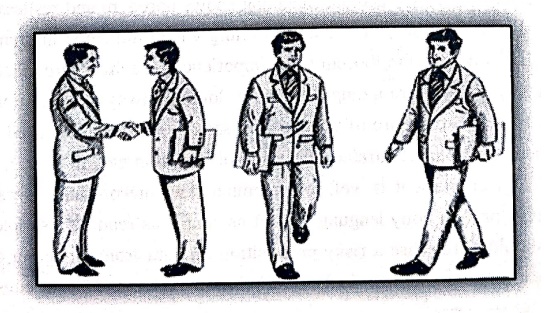
We
sometimes use body language to make up our mind about somebody we do not know.
We make a lightning judgement within the first ten seconds of meeting a person,
not even realising what we have done. When concealment or deception is being attempted,
body language is often more revealing as its signals arise in this subconscious
and can hence be interpreted accurately. But such interpretations lack depth.
The concept that isolated gestures can give a reading of a person's
characteristics is not true. Only a careful study of both verbal and nonverbal
signals will potentially allow us to accurately interpret a person's
personality and motivation. There are voluntary and involuntary gestures, which
tend to occur as parts of a group of gestures, accompanied by speech, posture,
body position, facial expression and voice modulation.
There
are many areas where a conscious reading of body language can be beneficial.
Sales and marketing staff find it particularly useful. Similarly an employer's
knowledge of body language can help him to read the unconscious clues provided
by candidates to decide whether it would be beneficial to employ them or not.
This requires a slightly deeper analysis and is more prone to error.
The
above are passive uses of body language. Body language can be used actively as
well. This requires even greater training and control. The conscious mind has
to be made to overcome the unconscious and take over control of the body
language signals. Candidates seeking employment can use body language to make
themselves appear more confident, powerful, trusting, etc... depending on what
the situation may require. This requires a thorough understanding of the
signals.
Giving
off negative signals could prevent a person from achieving their goal (e.g. a
successful presentation, proposing an idea in a meeting, discussing a task with
an employee, etc.). Some of the more negative signals to be avoided are:
fidgeting shows boredom and restlessness, the crossing of arms that indicates
unwillingness to listen; doodling which indicates inattentiveness; tapping
one's feet which shows distraction, boredom or impatience; touching your face
or playing with your hair can be a sign that you're hiding something; looking
away or hesitating before or while speaking indicates that you're unsure of
what you're saying; a fixed, unfocused stare shows your attention is elsewhere.
While concentrated effort and observation can, in time, help in interpreting
body language fairly accurately, it is well to remember that interpreting a
person's personality, attitudes and feelings through body language is not as
simple as reading a simple gesture or two. In particular one should never base
a risky proposition on data from a reading of body language alone as
communication is a package deal of verbal, non-verbal and vocal cues.
TASK
I. Say whether the
following statements are true or false. Correct the false ones.
1.
Language is the only form of communication.
2.
Non-verbal communication is always genuine because it comes from the
unconscious mind.
3.
One's whole personality can be accurately judged through his body language.
4.
Reading of body language helps one to be successful in business.
5.
It is possible to control our body language.
II. Match the signals
with the meanings they indicate:
tapping
one's feet – boredom
doodling
- hiding something
fidgeting
- not willing to listen
crossing
of arms - impatience
touching
one's face - inattentiveness
III. Match the
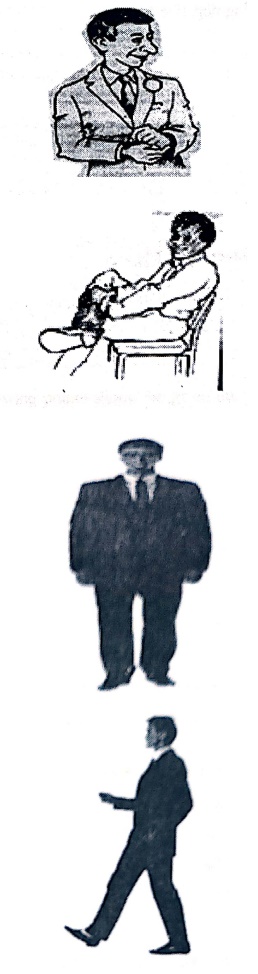
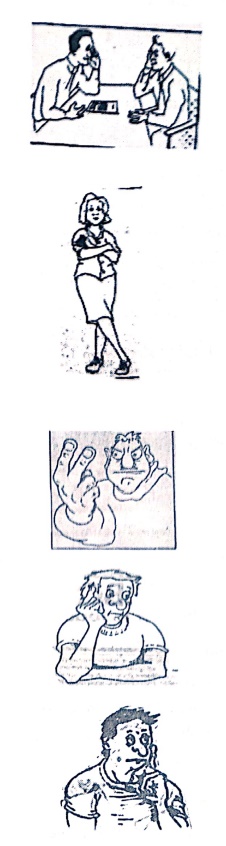
non-verbal cues in Column-B with the meanings given in Column-A.
A
1.
Copying the other person's gesture to gain acceptance
2.
Interested evaluation
3.
Partial arm barrier to achieve a secure feeling
4.
V for victory
5.
Having negative thoughts
6.
Decisive, masculine gait
7.
Tough minded and stubborn individual
8.
Defensive and cold
9.
Posture exuding self-confidence and level headedness
B
English Essentials II: Unit I: Oral Communication : Tag: English : - Types of Oral Communication: Verbal and Nonverbal
English Essentials II: Unit I: Oral Communication
Under Subject
English Essentials II
EN25C02 2nd Semester | 2025 Regulation | 2nd Semester 2025 Regulation
Related Subjects
English Essentials II
EN25C02 2nd Semester | 2025 Regulation | 2nd Semester 2025 Regulation
Tamils and Technology தமிழர்களும் தொழில்நுட்பமும்
UC25H02 2nd Semester | 2025 Regulation | 2nd Semester 2025 Regulation
Linear Algebra
MA25C02 2nd Semester | 2025 Regulation
Transforms and its Applications
MA25C03 2nd Semester EEE Dept | 2025 Regulation | 2nd Semester 2025 Regulation

Applied Physics (CE) II
PH25C02 2nd Semester Civil, Agri Depts | 2025 Regulation | 2nd Semester 2025 Regulation
Applied Physics (CSIE) II
PH25C03 2nd Semester AIDS, CSE, IT, CSE(CY) Dept | 2025 Regulation | 2nd Semester 2025 Regulation
Applied Physics (EE) II
PH25C04 2nd Semester EEE Dept | 2025 Regulation | 2nd Semester 2025 Regulation

Applied Physics (ME) II
PH25C05 2nd Semester Mechanical Dept | 2025 Regulation | 2nd Semester 2025 Regulation
Applied Chemistry (CE) II
CY25C02 2nd Semester Civil Dept | 2025 Regulation | 2nd Semester 2025 Regulation

Applied Chemistry (ME) II
CY25C03 2nd Semester Mechanical Dept | 2025 Regulation | 2nd Semester 2025 Regulation

Electron Devices
EC25C01 2nd Semester ECE Dept | 2025 Regulation | 2nd Semester 2025 Regulation
Digital Principles and Computer Organization
CS25C06 2nd Semester AIDS, CSE, IT, CSE(CY) Dept | 2025 Regulation | 2nd Semester 2025 Regulation

Basic Electrical and Electronics Engineering
EE25C01 2nd Semester | 2025 Regulation | 2nd Semester 2025 Regulation

Basic Civil and Mechanical Engineering
GE25C01 2nd Semester EEE Dept | 2025 Regulation | 2nd Semester 2025 Regulation
Data Structures using CPlusPlus
CS25C05 2nd Semester ECE Dept | 2025 Regulation | 2nd Semester 2025 Regulation
Engineering Drawing
ME25C01 EEE, Mech, Agri, EEE Depts | 2025 Regulation | 2nd Semester 2025 Regulation
Data Structures and Algorithms
CS25C04 2nd Semester EEE Dept | 2025 Regulation

Circuits and Network Analysis
EC25C02 2nd Semester ECE Dept | 2025 Regulation | 2nd Semester 2025 Regulation

Engineering Mechanics
ME25C02 2nd Semester Mech, Civil, Agri Depts | 2025 Regulation | 2nd Semester 2025 Regulation
Object Oriented Programming (OOPs)
CS25C07 2nd Semester CSE, CSE(CY) Depts | 2025 Regulation | 2nd Semester 2025 Regulation