Applied Calculus: UNIT IV: Multiple Integrals
Area enclosed by plane curves
Explanation, Formula, Equation, Example and Solved Problems - Multiple Integrals: Area enclosed by plane curves
AREA
ENCLOSED BY PLANE CURVES
Area in Cartesian System:
Let R be the plane
region, the area which is required. Let us divided the area into a large number
of elemental areas like PQRS (shaded) by drawing lines parallel to the y‒axis
at intervals of ∆x and line parallel to x axis at the intervals of ∆y above
figure

Area of the elemental
rectangle PQRS = ∆x. ∆y.
Required area A of the
region R is the sum of elemental area like PQRS.
viz., A = lim∆x→0,
∆y→0 (ΣΣ ∆x ∆y)
Area = ∫∫R
dxdy

The area A enclosed by
the curves y = f1(x) and y
= f2(x) and the ordinates
x = a and x = b is given by
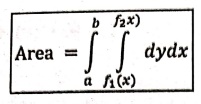
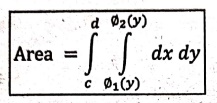
Similarly, the area
enclosed by x = ϕ1(y) and x = ϕ2(y) and y = c, y= d is
given by
Remark
1.
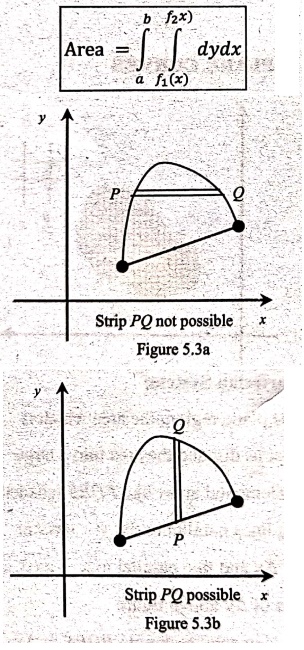
If the region is
similar to the region given in Figure 5.3a then the horizontal strip is not
possible so we take the vertical strip PQ as in Figure 5.3b In this case
Remark
2.
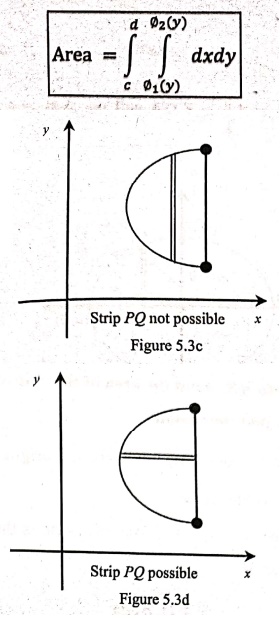
If the region is
similar to the region given in Figure 5.3c then the vertical strip is not
possible so we take the horizontal strip PQ as in Figure 5.3d In this case
Example
42. Find the area of the circle of radius a.
Solution:
Let us assume a circle
with center (0,0) and radius a
Equation of the circle
is x2 + y2 = a2
To plot the region:
x2
+ y2 = a2 is a circle with centre at
the orgin and radius 'a'
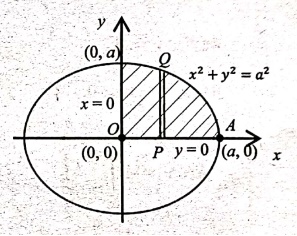
To evaluate the area:
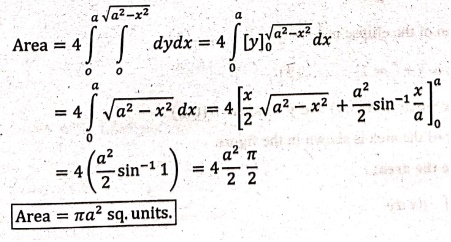
Area of the circle = 4
x Area of region in the first quadrant
= 4 ∫∫R dydx
Since the order of
integration is dydx, draw a vertical strip PQ
At P, y = 0;
At 0, x = 0;
At Q, y = √[a2 ‒ x2]
At A, x = a
Example
43. Find the area of the ellipse x2/a2 + y2/b2
= 1.
Solution:
To plot the region:
x2/a2 + y2/b2
= 1 is an ellipse with vertex at origin.
To evaluate the area:
Area of the ellipse = 4
× Area of region in the first quadrant
= 4 ∫∫R dydx
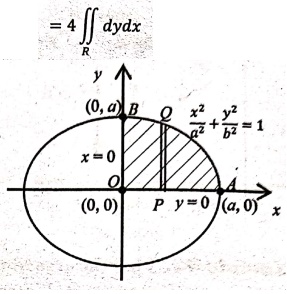
Since the order of
integration is dydx, draw a vertical strip PQ
At P, y = 0;
At Q, y = b/a √[a2 ‒ x2]
At O, x = 0;
At A, x = a
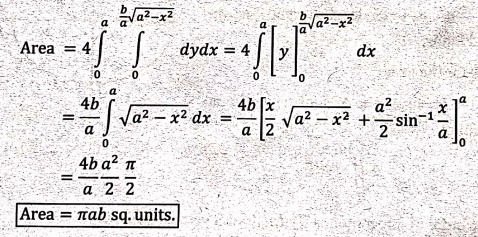
Area = πab sq.units.
Example
44. Find the smaller of the areas bounded by the ellipse 4x2 + 9y2
= 36 and the straight line 2x + 3y = 6.
Solution:
To plot the region:
The equation of the
ellipse is x2/9 + y2/4 = 1 ........ (1)
and the line is x/3 +
y/2= 1 ..:(2)
Both meet x‒axis at
A(3,0) and y‒axis at B(0,2)
The smaller of the area
is shown in the figure.
To evaluate the area:
Area = ∫∫ dx dy
Since the order of
integration is dx dy, draw horizontal strip PQO
Using horizontal
strips, the required area lies between

At P, x= 3/2(2− y),
At Q, x = 3/2√[4‒ y2],
At A, y = 0,
At B, y = 2
Required area is

Area = 3/2 (π‒2) sq.
units
Example
45. Find the area of the region bounded by the parabolas y2 = 4ax and x2
= 4ay.
Solution:
To plot the region:
y2
= 4ax is a parabola symmetrical about x‒axis and passing through the origin
x2
= 4ay is a parabola symmetrical about y‒axis and passing through the origin
The region of
integration is OAO (shaded region)
To find the points of
intersection:
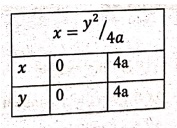
y2
= 4ax
x = y2
/ 4a ..... (1)
x2
= 4ay ……(2)
(2) (y2 / 4a)2 = 4ay Using
(1)
y4
/ 16a2 = 4ay
⇒
y2 = 64a3y.
y4‒64a3y = 0
y(y3 ‒ 64a3)=0
y= 0, y3 = 64a3
y = 4a
The points of
intersection are (0,0), (4a, 4a)
To evaluate the area:
Area = ∫∫R dydx
Since the order of
integration is dydx,
draw a vertical strip
PQ
At P, y = x2 / 4a
At Q, y = 2√α√x
At 0, x = 0;
At A, x = 4a
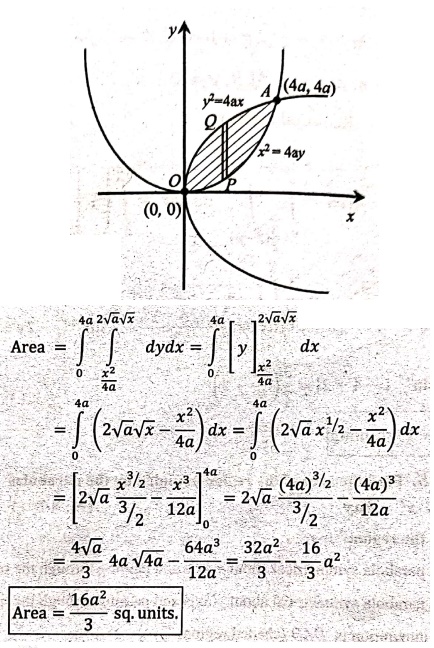
Area = 16a2 / 3 sq. units.
Example
46. Find the area between the curves y2
= 4x and x2 = 4y.
Solution:
To plot the region:
y2 = 4x is a parabola symmetrical
about x‒axis and passing through the origin
x2
= 4y is a parabola symmetrical about y‒axis and passing through the origin
The region of integration
is OAO (shaded region)
To find the points of
intersection:
y2=4x
x = y2 / 4 ………(1)
x2
= 4y …….. (2)
(2) => (y2/4)2
= 4y Using (1)
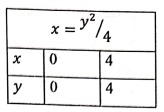
y4/16
= 4y
y4
=
64y
y4
– 64y =0
y(y3 – 64) =
0
y = 0, y3 = 64 ⇒ y = 4
The points of
intersection are (0,0), (4, 4)
To evaluate the area:
Area = ∫∫R dydx
Since the order of
integration is dydx,
draw a vertical strip
PQ
At P, y = x2/4
At Q, y = 2√x
At 0, x=0;
At A, x=4
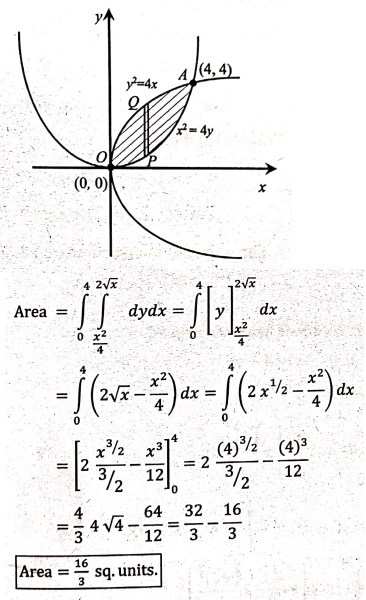
Area = 16/3 sq. units.
Example
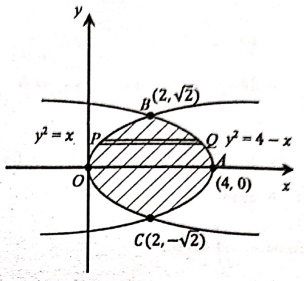
47. Find the area bounded by y2
= 4 ‒ x and y2 = x.
Solution:
To plot the region:
y2
= 4‒x = ‒(x‒4) is a parabola symmetrical about x‒axis (left side) with vertex
at (4, 0) and passing through the origin
y2
=
x is a parabola symmetrical about x‒axis and passing through the origin
The region of
integration is OBACO (shaded region)
To find the points of
intersection
y2
= 4‒x ………(1)
y2
= x ………(2)
From (1) and (2),
x = 4‒x ⇒ 2x= 4 ⇒ x=2
Put x = 2 in (2) ⇒ y2=2
⇒ y = ±√2
∴ The points of
intersection are (2, √2), (2, −√2)
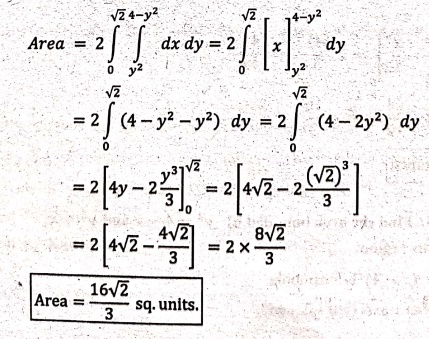
To evaluate the
integral:
Area = 2 × Area of OABO
= 2 ∫∫ dxdy
Since the order of
integration is dxdy, draw a horizontal strip PQ
At P, x = y2;
At Q, x = 4‒y2
At O, y = 0;
At B, y = √2
Example
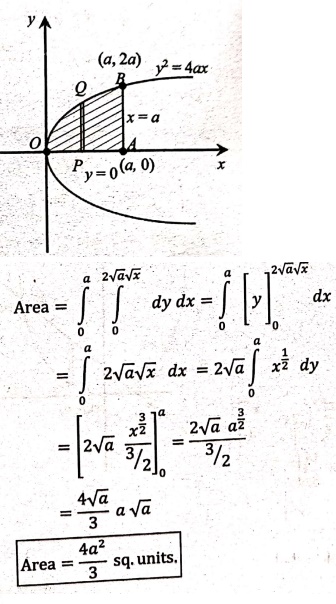
48. Find the area enclosed by the parabola y2
= 4ax, the x‒axis and the latus rectum of the parabola.
Solution:
To plot the region:
y2
= 4ax is a parabola symmetrical about x‒axis with vertex at origin.
The equation of latus
rectum is x = a, a line perpendicular to x‒axis.
To find the points of
intersection
y2
= 4ax ……..(1)
Equation of latus
rectum is x = a
Put x = a in (1) ⇒ y2 = 4a2
⇒ y = 2a
[Take only positive
value since the region is first quadrant.]
The point of
intersection is (a, 2a)
The region of
integration is OABO (shaded region)
To evaluate the area:
Area = ∫∫R
dydx
Since the order of
integration is dydx, draw a vertical strip PQ
At P, y = 0;
At Q, y = 2√a√x
At O, x = 0;
At A, x = a
Example
49. Find the area of the region R enclosed by the parabola y = x2 and the line y=x+2.
Solution: We
need to describe the region between the graph of the parabola y = x2 and the straight line y =
x + 2
To find the points of
intersection
y = x2 ... (1)
y = x + 2 ... (2)
From (1) and (2),
x2=x+2
⇒ x2‒x‒2=0
(x‒2)(x+1)=0 ⇒ x=2,‒1
Put x = 2 in (2) ⇒ y = 4
Put x = ‒1 in (2) ⇒ y = 1
∴
The points of intersection are (2,4), (−1,1)
The area is given by
A = ∫∫R dy
dx
Since the order of
integration is dydx, draw vertical strip PQ
At P, y = x2;
At Q, y=x+2
At A, x= ‒1;
At B, x = 2

Example
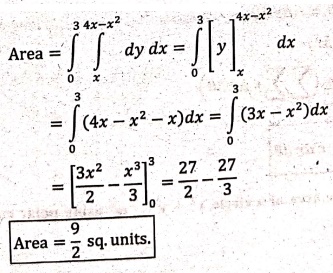
51. Find by double integration, the area lying between the parabola y = 4x‒x2 and the line y = x.
Solution:
To plot the region:
y = x …….(1) a straight line intersect the XOY plane
y = 4x‒x2 …………(2)
= ‒( x2‒4x)
y = ‒[ (x‒2)2‒4 ]
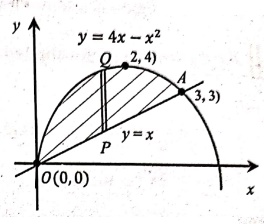
(x‒4) = (x‒2)2 is a parabola with
vertex (2, 4) which is symmetrical about y‒axis (downwards) and passing through
the origin
The region of
integration is the shaded region OAO. To find the point of intersection from
(1) and (2)
x = 4x − x2
x2
‒ 3x = 0 ⇒
x(x − 3) = 0 ⇒
x = 0 or x = 3
The points of
intersections are (0, 0) and (3, 3)
To evaluate the area:
Area = ∫∫R dydx
Since the order of
integration is dydx, draw a vertical strip PQ.
At P, y = x;
At Q, y = 4x‒x2
At O, x = 0;
At A, x = 3
Example
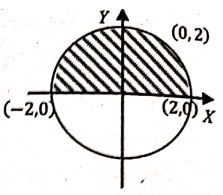
52. Evaluate ∫∫R dx dy where R is the shaded region in the figure.
Solution:
Given region is a semi‒circular
part of the circle x2 + y2 = 4.
∫∫R dx dy =
Area of the shaded region (Semi – circle)
= ½ Area of the circle (x2 + y2
= 4) = ½ π (4)
Area = 2π sq. units
AREA IN POLAR SYSTEM
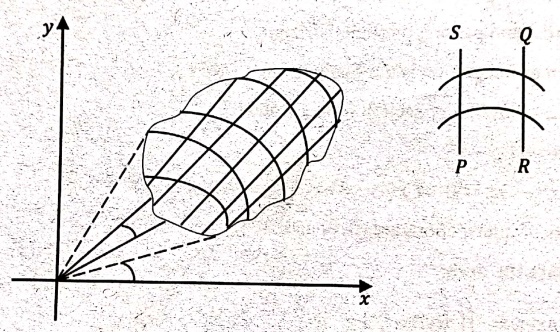
We divided the area A
of the given region R into a large number of elemental curvilinear rectangular
areas like PQRS (shaded) by drawing radial lines and concentric circular arcs,
where P and R have a polar coordinates (r, θ) and (r+ Δr, θ + Δθ) above figure
Area of the element
PQRS = r Δr Δθ
(PS = r Δθ and PQ = Δr)
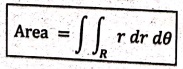
Required area A = lim∆r→0,
∆θ→0 ( ΣΣ r Δr Δθ)
Area = ∫∫R r
dr dθ
Example
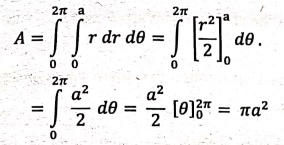
53. Find the area of a circle x2+
y2 = a2 using polar coordinates in double integrals.
Solution:
Example
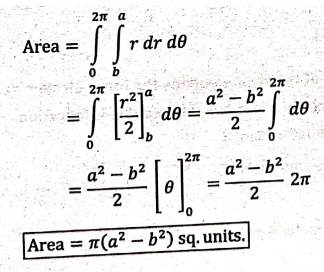
54. Find the area between the two circles x2
+ y2 = a2 and x2 + y2
= b2 where a > b.
Solution:
To plot the region:
The region of integration
is the annular region between x2
+ y2 = a2 and x2 + y2
= b2

Since the region is
circular,
we use polar co‒ordinates.
x = r cosθ, y = r sinθ
x2
+ y2 = r2
dx dy = r dr dθ
To evaluate the area:
x2
+ y2 = a2 ⇒ r2 = a2
⇒
r
= a
x2
+ y2 = b2 ⇒ r2 = b2
⇒
r
= b
r
varies from r = a to r = b
Since the region lies
in all the four quadrants,
θ varies from θ = 0 to θ = 2π
Area = π(a2 ‒ b2) sq. units.
Example
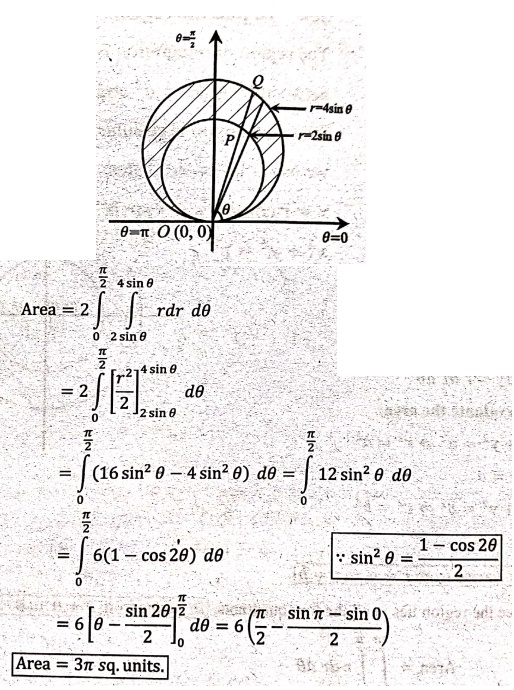
55. Find the area between the circles r = 2 sinθ and r = 4 sinθ.
Solution:
To plot the region
r = 2 sinθ is a circle with diameter 2 passing
through the origin and symmetrical about θ = π/2
r = 4 sinθ is a circle with diameter 4 passing
through the origin and symmetrical about θ = π/2
∴
Total area = 2 (Area of region in the first quadrant)
To evaluate the area:
Limits of r: At P, r = 2 sinθ; At Q, r = 4 sinθ
Limits of θ: θ = 0 to θ
= π/2
Example
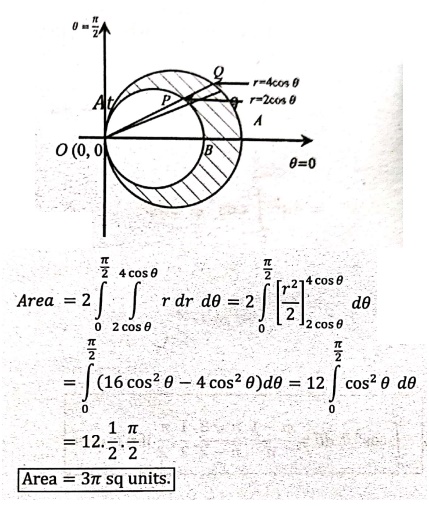
56. Find the area of the region outside the inner circle r = 2 cos θ and inside
the outer circle r = 4 cos θ by double integration.
Solution:
r = 2 cosθ is the circle with diameter 2 passing
through the origin and symmetrical about the initial line θ = 0.
r = 4 cosθ is the
circle with diameter 4 passing through the origin and symmetrical about the initial
line θ=0.
To evaluate the area:
Area = 2 × Area of the
region above the initial line.
= 2 ∫∫OABO r
dr dθ
Limits of r: At P, r =
2 cos θ,
Limits of θ: θ = 0,
Area = 3π sq units.
Example
57. Find the area of the cardioid r = a(1
+ cosθ).
Solution:
To plot the region:
r = a(1 + cosθ) is a cardioid passes through the
origin and symmetrical about the initial line.
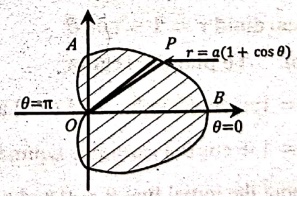
To evaluate the area:
∴ Area = 2 × Area of the
region above the initial line.
= 2 ∫∫OABO r
dr dθ
Limits of r: At 0, r =
0 to r = a(1 + cos θ)
Since the region lies
in the first and second quadrant, θ varies from θ = 0 to θ = π

I = 3/2 πa2
sq. units.
Example
58. Find the area outside to the circle r = 1 and inside to the cardioid r = 1+
cosθ
Solution:
To plot the region:
r
= 1, a circle with centre (0,0) and radius 1
r = 1+ cosθ a cardioid,
symmetrical about the initial line θ = 0 and passes through the origin (0,0)
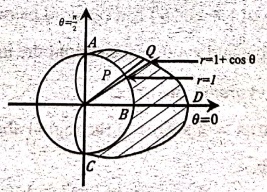
The region of
integration is ABCDA. (shaded region).
The region is symmetric
about the line θ = 0.
To evaluate the area:
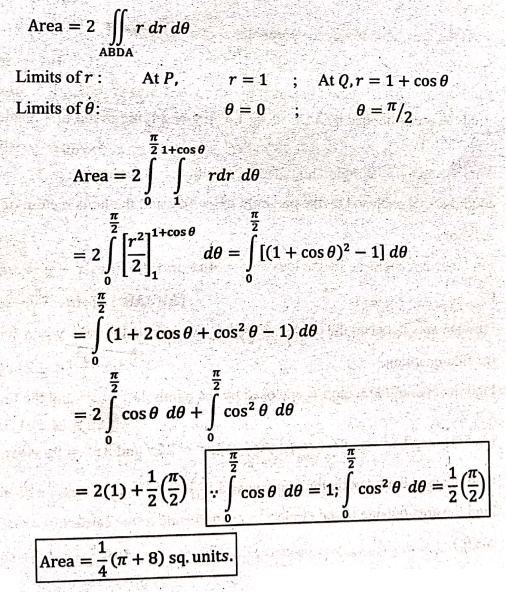
Area = 2 × Area of the
region above the initial line
= 2 ∫∫ABDA r
dr dθ
The point of
intersection of the circle r = 1 and r = 1 + cosθ are obtained as
1 = 1 + cosθ
cos θ = 0
θ = ± π/2
Since the region ABDA
lies in the first quadrant and touches the x‒axis & y‒axis,
θ varies from θ = 0 to θ = π/2
EXERCISE
26. Find the area
enclosed by y = x2 and x =
y2. Ans: 16/3
27. Find the area of
the circle x2 + y2 = 16. Ans: 16π
28. Find the area of
the ellipse x2/16 + y2/9 = 1. Ans: 12π
29. Find the area of
the region bounded by x = 0, y = 0 and x + y = a. Ans: 1/2 a2
30. Find the area of
the region enclosed by the curves y = x and y = x2. Ans: 1/6
sq.units.
31. Find by double
integration, the area between the parabola y2
= 4ax and the line y = x. Ans: 8a2 / 3 sq.units.
32. Find the area
bounded by the parabolas y = x2
and the straight line 2x − y + 3=0. Ans:
32/3 sq.units.
33. Find the area of
the region bounded by y = x ‒ 1 and y2
= 2x + 6. Ans: 18 sq.units
34. Find the area
bounded by x2 + y2 = 4, x + y = 2 lying in
the first quadrant. Ans: π‒2
35. Find the area of
the region bounded by x = 0, y = 0 and x + y = 1. Ans: 1/2.
36. Find the area
enclosed by the parabola x2
= 4ay and the latus rectum of the parabola.
Ans: 4a2 / 3
37. Find the area
enclosed by the curve y2 =
4ax and the lines x + y = 3a, y = 0. Ans:
10a2 / 3 sq.units
38. Find the area
between the circle x2 + y2 = a2 and the line x + y = a lying in the first quadrant. Ans: a2/4 (π‒2) sq. units
39. Find the area of
the region R enclosed by the parabola y = x2
and the line y = x + 2. Ans: 9/2
40. Find the area
between the two parabolas 3y2
= 25x and 5x2 = 9y. Ans: 5 sq. units
41. Find the area
bounded by the hypocycloid (x/a)2/3 +(y/b)2/3 = 1. Ans: 3/8 πab sq. units
42. Find the area
outside to the circle r = a and inside to the cardioid r = a( 1+cos θ ). Ans: a2(π+8) sq. units.
Applied Calculus: UNIT IV: Multiple Integrals : Tag: Applied Calculus : - Area enclosed by plane curves
Applied Calculus: UNIT IV: Multiple Integrals
Under Subject

Applied Calculus
MA25C01 Maths 1 M1 - 1st Semester | 2025 Regulation | 1st Semester 2025 Regulation
Related Subjects

English Essentials I
EN25C01 1st Semester | 2025 Regulation | 1st Semester 2025 Regulation

தமிழர் மரபு - Heritage of Tamils
UC25H01 1st Semester | 2025 Regulation | 1st Semester 2025 Regulation
Applied Calculus
MA25C01 Maths 1 M1 - 1st Semester | 2025 Regulation | 1st Semester 2025 Regulation

Applied Physics I
PH25C01 1st Semester | 2025 Regulation | 1st Semester 2025 Regulation

Applied Chemistry I
CY25C01 1st Semester | 2025 Regulation | 1st Semester 2025 Regulation

Makerspace
ME25C04 1st Semester | 2025 Regulation | 1st Semester 2025 Regulation

Computer Programming C
CS25C01 1st Semester | 2025 Regulation | 1st Semester 2025 Regulation

Computer Programming Python
CS25C02 1st Semester | 2025 Regulation | 1st Semester 2025 Regulation

Fundamentals of Electrical and Electronics Engineering
EE25C03 1st Semester | 2025 Regulation | 1st Semester 2025 Regulation

Introduction to Mechanical Engineering
ME25C03 1st Semester | 2025 Regulation | 1st Semester 2025 Regulation

Introduction to Civil Engineering
CE25C01 1st Semester Civil Department | 2025 Regulation | 1st Semester 2025 Regulation

Essentials of Computing
CS25C03 1st Semester - AID CSE IT Department | 2025 Regulation | 1st Semester 2025 Regulation

Applied Physics I Laboratory
PH25C01 1st Semester practical Laboratory Manual | 2025 Regulation | 1st Semester Laboratory 2025 Regulation

Applied Chemistry I Laboratory
CY25C01 1st Semester practical Laboratory Manual | 2025 Regulation | 1st Semester Laboratory 2025 Regulation

Computer Programming C Laboratory
CS25C01 1st Semester practical Laboratory Manual | 2025 Regulation | 1st Semester Laboratory 2025 Regulation

Computer Programming Python Laboratory
CS25C02 1st Semester practical Laboratory Manual | 2025 Regulation | 1st Semester Laboratory 2025 Regulation

Engineering Drawing
ME25C01 EEE Mech Dept | 2025 Regulation | 2nd Semester 2025 Regulation

Basic Electronics and Electrical Engineering
EE25C04 1st Semester ECE Dept | 2025 Regulation | 2nd Semester 2025 Regulation