Applied Calculus: UNIT IV: Multiple Integrals
Triple Integrals: Cartesian coordinates into spherical polar coordinates
Explanation, Formula, Equation, Example and Solved Problems - Multiple Integrals: Triple Integrals: Cartesian coordinates into spherical polar coordinates
CARTESIAN
TO SPHERICAL POLAR COORDINATES
Let us first define
spherical polar coordinates of a point in space and derive the relations
between Cartesian and spherical polar coordinates for above figure

Let P be the point
whose Cartesian coordinate are (x, y, z).
Let PM be drawn ⟂ r to the xOy plane. Let
MN parallel to y = axis. Let = r, the angle made by OP with the positive z‒axis
= θ and angle made by OM with x‒axix = Ø.
The triplet (r, θ, Ø) are
called the spherical polar coordinate of P.
Since OMP = 90°, MP = z
= r cosθ, OM = r sinθ, ON = x = r sinθcosØ and NM = y = r sinθsinØ
Thus the
transformations from three dimensional Cartesian to spherical polar coordinates
are
x = r sinθ cosØ
y = r sinθ sin Ø.
z = r cosθ
Also x2 + y2+z2
= r2,
In this case,
J = ∂(x,y,z) / ∂(r,θ,z)
= r2 sin 0
Hence dx dy dz = r2
sinθ dr dθ dz
and ∫∫∫V f(x, y, z) dx dy dz = ∫∫∫V
g(r,θ,z) r2 sinθ dr dθ dz
Note:
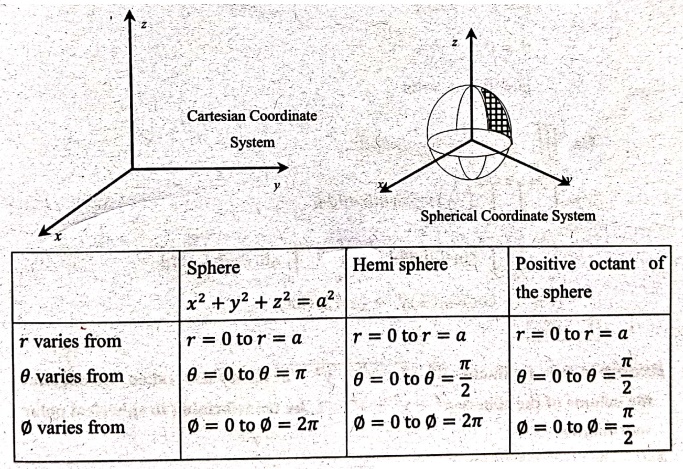
Whenever ∫∫∫ f(x, y, z) dx dy dz is
to be evaluated throughout the volume of a sphere, hemisphere or octant of a
sphere, it will be advantageous to use spherical polar coordinates.
Example
82. Change the spherical polar coordinates and hence evaluate ∫∫∫V dxdydz
/ x2+y2+z2 , where V is the volume of the sphere x2 + y2 + z2
= a2.
Solution:
The given integral is
I = ∫∫∫V dxdydz
/ x2+y2+z2
To convert from
Cartesian to spherical polar coordinates system, we have the following
transformation
x = r sinθ cosϕ
y = r sinθ sinϕ
z = r cosθ
dxdydz = r2
sinθ drdθdϕ
Also x2 + y2+z2
= r2.
The region is entire
volume of the sphere x2 + y2 + z2 = a2.
Therefore the limits
are
r=0 ; r=a
θ = 0 ; θ = π
ϕ = 0 ; ϕ = 2π

I = 4πα
Example
83. Evaluate ∫∫∫ √[1‒x2 ‒ y2 ‒ z2] dx dy dz, taken throughout the volume of the sphere x2 + y2+z2
= 1, by transforming to spherical polar coordinates.
Solution:
The given integral is
I = ∫∫∫ √[1‒x2 ‒ y2 ‒ z2]
dx dy dz
To convert from
Cartesian to spherical polar coordinates system, we have the following
transformation
x = r sinθ cosϕ
y = r sinθ sinϕ
z = r cosθ
dxdydz= r2
sinθ drdθdϕ
Also x2 + y2 + z2
= r2.
The region is entire
volume of the sphere x2 + y2 + z2 = 1.
Therefore the limits
are
r=0 ; r=1
θ=0 ; θ = π
ϕ=0 ; ϕ = 2π

Put r = sint in the
innermost integral
dr = cost dt
r = 0 ⇒ sint = 0 ⇒ t=0
r = 1 ⇒ sint = 0 ⇒ t = π/2

Example
84. Evaluate  , by transforming to spherical polar coordinates.
Solution:
The boundaries of the
region of integration are z = 0, z = √[a2‒x2 ‒ y2] or x2
+ y2+z2 = a2,
y = 0, y = √[a2 ‒ x2] or x2 + y2
= a2, x = 0 and x = a.
From the boundaries, we note that the region of integration is the volume of
the positive octant of the sphere x2
+ y2 + z2 = a2.
To convert from
Cartesian to spherical polar coordinates system, we have the following
transformation
x = r sinθ cosϕ
y = r sinθ sinϕ
z = r cos θ
dxdydz = r2
sinθ drdθdϕ
Also x2 + y2 + z2
= r2.
The region is volume of
the positive octant of the sphere x2
+ y2 + z2 = a2.
Therefore the limits
are
r=0 ; r = a
θ = 0 ; θ = π/2
ϕ = 0 ; ϕ = π/2

Example
85. Evaluate  using spherical polar coordinates.
Solution:
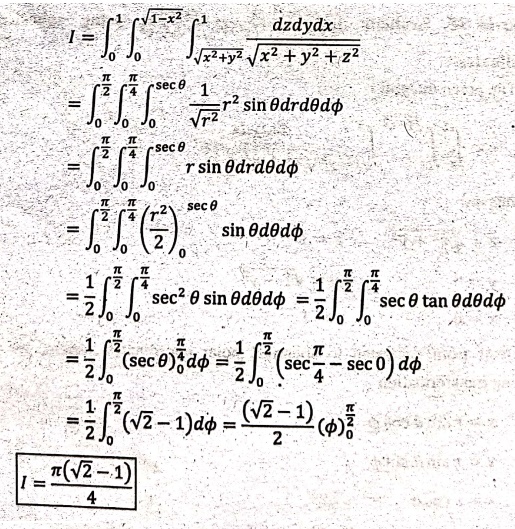
The given integral is
The limits are
z = √[x2
+ y2] ; z = 1
y=0 ; y
= √[1‒x2]
x=0 ; x
= 1
To convert from
Cartesian to spherical polar coordinates system, we have the following
transformation
x = r sinθ cosϕ
y = r sinθ sinϕ
z = r cosθ
dxdydz = r2
sinθ drdθdϕ
Also x2 + y2 + z2
= r2.
We have z = 1
r cosθ = 1
r = 1 / cosθ = secθ
We have z = √[x2 + y2] ⇒
r
cosθ = √[ (r sinθ cosϕ )2 + (r sinθ sinϕ)2]
⇒
r
cosθ = √[ (r sinθ)2 [cos2ϕ + sin2ϕ] ]
⇒
r
cosθ = r sinθ ⇒
tanθ = 1⇒ θ = π/4
Since both lower limits
of x and y are zero, ϕ = 0 to ϕ = π/2
Therefore the limits
are
r = 0 ; r = secθ
θ = 0 ; θ = π/4
ϕ = 0 ; ϕ = π/2
Example
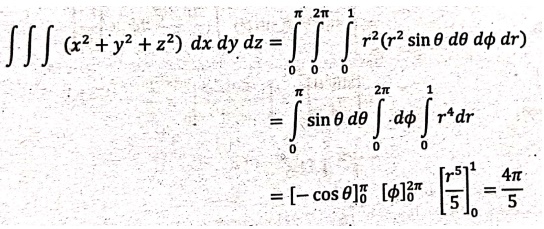
86. Evaluate the integral ∫∫∫ (x2
+ y2 + z2) dx dy dz taken over the
volume enclosed by the sphere x2
+ y2 + z2 =1.
Solution:
Since the region is a
sphere, we use spherical polar co‒ordinates.
The spherical polar co‒ordinates
is
x = r sinθ cosϕ
y = r sinθ sinϕ
z = r cosθ
x2
+ y2+z2 = r2
dxdydz = r2
sinθ drdθdϕ
For the entire sphere x2 + y2+z2
= 1
Limits are
r=0 to r = 1
θ=0 to θ = π
ϕ = 0 to ϕ = 2π
Evaluate
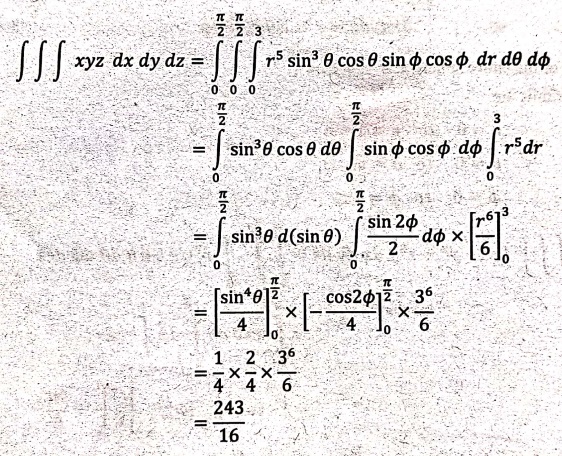
the integration ∫∫∫ xyz dx dy dz taken throughout the volume for which x, y, z ≥
0 and x2 + y2 + z2 ≤ 9.
Solution:
Since the region is a
sphere, we use spherical polar co‒ordinates.
The spherical polar co‒ordinates
is
x = r sinθ cosϕ
y = r sinθ sinϕ
z = r cosθ
x2
+ y2+z2 = r2
dxdydz = r2
sinθ drdθdϕ
For first octant of the
sphere x2 + y2+z2 = 9
Limits are
r = 0 to r = 3
θ = 0 to θ = π/2
ϕ = 0 to ϕ = π/2
EXERCISE
77. Evaluate the
integrals by changing to cylindrical co‒ordinates
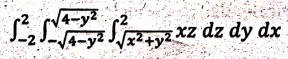
Ans:
0
78. Evaluate the
integrals by changing to cylindrical co‒ordinates.

Ans:
4√2‒5 / 15
79. Evaluate ∫∫∫V
(x2 + y2)dV, V lies between the spheres x2 + y2 + z2
= 4 and x2+ y2+z2 = 9. Ans:
1688π / 15.
80. Evaluate the
integral ∫∫∫ (x2 + y2+z2) dx dy dz taken over the volume closed of the sphere x2 + y2+ z2
= a2 transforming into
spherical.co‒ ordinates.
Ans:
4π/5 a5
81. Evaluate the
integration ∫∫∫ xyz dz dy dx through the spherical octant for which x2 + y2+z2
≤ a2. Ans: a6/48
Applied Calculus: UNIT IV: Multiple Integrals : Tag: Applied Calculus : - Triple Integrals: Cartesian coordinates into spherical polar coordinates
Applied Calculus: UNIT IV: Multiple Integrals
Under Subject

Applied Calculus
MA25C01 Maths 1 M1 - 1st Semester | 2025 Regulation | 1st Semester 2025 Regulation
Related Subjects

English Essentials I
EN25C01 1st Semester | 2025 Regulation | 1st Semester 2025 Regulation

தமிழர் மரபு - Heritage of Tamils
UC25H01 1st Semester | 2025 Regulation | 1st Semester 2025 Regulation
Applied Calculus
MA25C01 Maths 1 M1 - 1st Semester | 2025 Regulation | 1st Semester 2025 Regulation

Applied Physics I
PH25C01 1st Semester | 2025 Regulation | 1st Semester 2025 Regulation

Applied Chemistry I
CY25C01 1st Semester | 2025 Regulation | 1st Semester 2025 Regulation

Makerspace
ME25C04 1st Semester | 2025 Regulation | 1st Semester 2025 Regulation
Computer Programming C
CS25C01 1st Semester | 2025 Regulation | 1st Semester 2025 Regulation

Computer Programming Python
CS25C02 1st Semester | 2025 Regulation | 1st Semester 2025 Regulation

Fundamentals of Electrical and Electronics Engineering
EE25C03 1st Semester | 2025 Regulation | 1st Semester 2025 Regulation

Introduction to Mechanical Engineering
ME25C03 1st Semester | 2025 Regulation | 1st Semester 2025 Regulation

Introduction to Civil Engineering
CE25C01 1st Semester Civil Department | 2025 Regulation | 1st Semester 2025 Regulation
Essentials of Computing
CS25C03 1st Semester - AID CSE IT Department | 2025 Regulation | 1st Semester 2025 Regulation

Applied Physics I Laboratory
PH25C01 1st Semester practical Laboratory Manual | 2025 Regulation | 1st Semester Laboratory 2025 Regulation

Applied Chemistry I Laboratory
CY25C01 1st Semester practical Laboratory Manual | 2025 Regulation | 1st Semester Laboratory 2025 Regulation

Computer Programming C Laboratory
CS25C01 1st Semester practical Laboratory Manual | 2025 Regulation | 1st Semester Laboratory 2025 Regulation

Computer Programming Python Laboratory
CS25C02 1st Semester practical Laboratory Manual | 2025 Regulation | 1st Semester Laboratory 2025 Regulation
Engineering Drawing
ME25C01 EEE Mech Dept | 2025 Regulation | 2nd Semester 2025 Regulation

Basic Electronics and Electrical Engineering
EE25C04 1st Semester ECE Dept | 2025 Regulation | 2nd Semester 2025 Regulation