Applied Calculus: UNIT IV: Multiple Integrals
Change of variables in double integrals
Explanation, Formula, Equation, Example and Solved Problems - Multiple Integrals: Change of variables in double integrals: Changing Cartesian coordinates into polar coordinates
CHANGE
OF VARIABLES IN DOUBLE INTEGRALS
Sometimes, the
evaluation of a double integral may become simpler by change of variables. The
change of variables may be from
✓
Cartesian to Cartesian coordinates.
✓ Cartesian
to Polar coordinates.
CARTESIAN COORDINATES INTO POLAR COORDINATES
Sometimes, the
evaluation of a double integral may become simpler by change of variables.
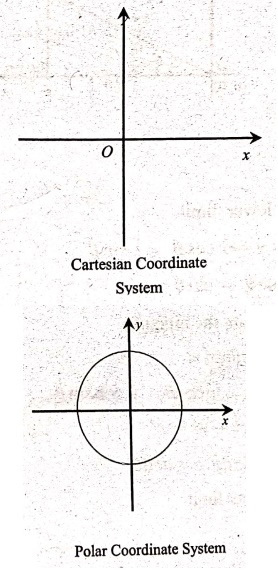
Changing from Cartesian coordinates to polar coordinates. i.e., Changing from
(x, y) to (r, θ), the variables are related by
x= r cos θ
y= r sin θ
x2
+ y2 = r2
dxdy = |J| drdθ = r drdθ

Note:
Whenever
∫∫ f(x, y)dxdy is evaluated
throughout the area of a circle, upper half of a circle, quadrant of a circle,
it is advantageous to use polar coordinates.
Example
59. Change into polar coordinates, 0∫10∫x
f(x, y) dydx.
Solution:
The polar form is
x = r cos θ, y = r sin 0
x2
+ y2 = r2
dxdy = r drdθ
Inner upper limit is
y = x ⇒ r sin θ = r cos θ
sin θ = cos θ
tan θ = 1; θ = π/4
θ varies from θ = 0 to θ = π/4
Outer upper limit x = 1
r
cos 0 = 1
⇒
r = 1 / cosθ
r
varies from r = 0 to r = 1/cosθ

Example
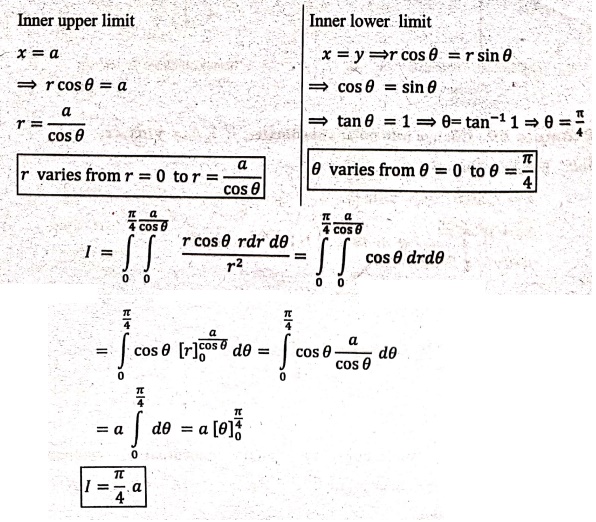
60. By changing to polar coordinates evaluate 0∫ay∫a
( x / x2+y2 )
dxdy.
Solution:
To plot the region
The region of
integration is bounded by x=y,
x = a, y = 0, y = a.

To evaluate the integral:
The polar form is
x = r cos θ, y = r sin θ
x2
+ y2 = r2
dxdy = r drdθ
Example
61. Evaluate by changing to polar coordinate the integral 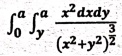 .
.
Solution:
To plot the region:
The region of
integration is bounded by x = y, x = a, y = 0, y = a.

The polar form is
x = r cos θ, y = r sin θ
x2
+ y2 = r2, dxdy
= r drdθ
To evaluate the area:

Example
62. By converting to polar coordinates evaluate = 0∫∞0∫∞
e‒(x2+y2) dxdy, hence find 0∫∞e‒x2 dx.
Solution:
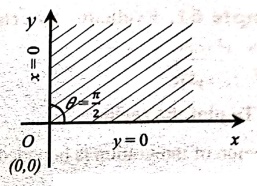
To plot the region:
The region is bounded
by x = 0, x = ∞, y = 0, y = ∞
To evaluate the
integration:
The polar form is
x = r cos θ, y = r sin θ
x2
+ y2 = r2
dxdy = r drdθ
Since both the lower limits
are 0 and region is entire first quadrant,
θ varies from θ = 0 to θ = π/2
Both the upper limits
are ∞,
r
varies from r = 0 to r = ∞

Example
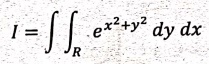
63. Using polar coordinates, evaluate ∫∫R ex2+y2
dy dx, where R is the semicircular region bounded by the x‒axis and the curve y
= √[1 ‒ x2].
Solution:
To plot the region:
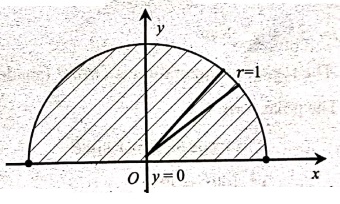
The region R is the
semicircular region bounded by x‒axis (y = 0) and the circle x2 + y2 = 1.
The polar form is
x = r cosθ, y = r sinθ
x2
+ y2 = r2, dydx
= r drdθ
To find the limit:
Given, x2 + y2 = 1
⇒
r2 = 1
⇒
r
= 1
r
varies from r = 0 to r = 1
Region is in first and
second quadrant,
θ varies from θ=0 to θ = π
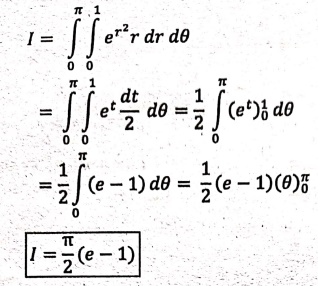
Put r2 = t
2r dr = dt
r dr = dt/2
When r = 0 ⇒ t = 0
When r = 1⇒ t=1
Example
64. Change into polar coordinates, 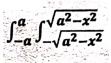 dydx and evaluate.
Solution:
To plot the region:
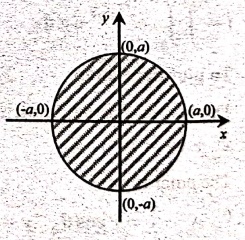
The region is bounded
by x = ‒a, x = a
‚y
= −√[a2 ‒ x2], y = √[a2 ‒ x2 ]
ie., x2+ y2 = a2
The region of integration
is OABO (shaded region)
The polar form is
x=rcosθ, y = r sinθ
x2
+ y2 = r2
dxdy = r drdθ
Inner upper limit is y
= √[a2‒x2]
i.e.,x2 + y2 = a2
r2 = a2 ⇒ r = a
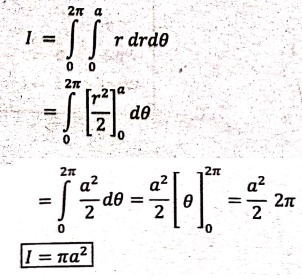
r varies from r = 0 tor = a
Since both the lower
limits are negative, the region is entire circle x2 + y2
= a2
θ varies from θ = 0 to 2π
I = πα2
Example
65. By Converting into polar co‒ordinates evaluate 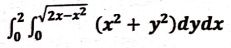
Solution:
To plot the region:
Since inner limit is a
function of x, first integrate with respect to y, then x
The region of
integration is bounded by
y = 0, y = √[2x‒x2] i.e. x2 + y2
‒ 2x = 0, x = 0, x = 2.
x = 0 is y‒axis
x2
+ y2 ‒ 2x = 0 is a circle
with center (1,0) and radius = 1
x = 0 is y‒axis, x = 2
is a straight line perpendicular to x‒axis

To evaluate the
integral:
The polar form is
x = r cosθ, y = r sinθ
x2
+ y2 = r2
dxdy = r drdθ
x2 − 2x+1 + y2 = 1
i.e. (x‒1)2+ y2 = 12
center (1,0) and radius 1
Since the region is a
semi circle lies in first quadrant,
θ varies from θ=0 to θ=π/2
y= √[2x‒x2]
⇒
y2 = 2x − x2
⇒ x2 + y2 − 2x = 0
r2 ‒ 2r cosθ
= 0
r(r ‒ 2cosθ) = 0
r =
0 or r = 2 cosθ
varies from r = 0 to r
= 2 cosθ

I = 3π / 4
Example
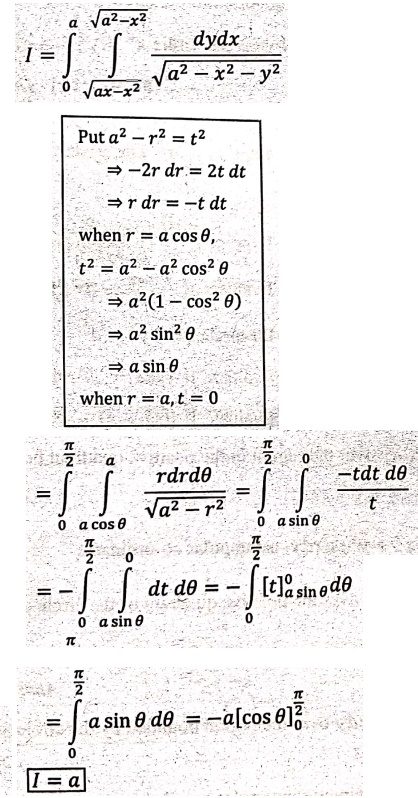
66. Transform the double the double integral in polar coordinates 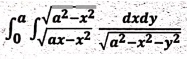 and
then evaluate it.
and
then evaluate it.
Solution:
The limit of the inner
integral containing x term, first integrate with respect to y then x.
To plot the region:
The region of
integration is bounded by y = √[ax ‒ x2],
y = √[a2 − x2],
x = 0, x = a.
i.e.,x2+y2‒ax = 0 & x2
+ y2 = a2
x2
+ y2 ‒ ax = 0
⇒
(x – a/2)2 + (y − 0)2 = (a/2)2
i.e., the circle with
centre at (a/2,0) and radius a/2
x2+y2 = a2 is a circle with centre (0,0) and radius a.

The region of integration
is between the two circles which lies in the first quadrant.
To evaluate the
integral:
The polar form is
x = r cosθ, y = r sinθ
x2
+ y2 = r2
dxdy = r drdθ
Since the region lies
in first quadrant which touches both x and y axes,
θ varies from θ = 0 to θ = π/2
x2
+ y2 − ax = 0 ⇒ r2 ‒ ar
cosθ = 0
r(r ‒ a cosθ) = 0
r = 0 or r = a cosθ
Take r = a cosθ
x2
+ y2 = a2 ⇒ r2 = a2 ⇒ r = a
r varies from r =
a cosθ tor = a
EXERCISE
43. Using polar
coordinates, evaluate ∫∫R e(x2+y2) dydx, where R is the semi-circular
region bounded by the x‒axis and the curve y = √[1‒x2]. Ans: π/2 (e‒1)
44. Evaluate the
following by changing to polar coordinates

45. Evaluate 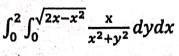 by changing to polar coordinates. Ans:
π/2
by changing to polar coordinates. Ans:
π/2
46. Express 0∫∞0∫∞
f(x, y) dxdy in polar co‒ordinates. Ans: 0∫π/20∫∞
f(r, θ)r drdθ.
47. Express 0∫ay∫a (x2dxdy)
/ (√[x2+y2]) in polar co‒ordinates
and then evaluates it. Ans: a3/3
log(√2 + 1)
48. Evaluate ∫∫ (x+y) /
(x2+y2+a2)
dxdy over the portion of the first quadrant lying inside the circle x2 + y2 = a2.
Ans: 2a (1 ‒ π/4)
49. Evaluate ∫∫ xy dxdy
over the positive quadrant of the circle x2
+ y2 = 1. Ans: 1/8.
50. Evaluate ∫∫ √[a2‒x2‒y2]
dx dy over the semi‒circle x2+
y2 = ax in the positive
quadrant. Ans: [a3(3π‒4) ] / 18
51. Evaluate ∫∫ (x + y)
dx dy over the region in the positive quadrant bounded by the circle x2 ‒ 2ax + y2 = 0. Ans: (3π‒4)a3 / 48
52. Evaluate ‒a∫a0∫√(a2‒x2)
(x2+
y2) dxdy, using polar co‒ordinates.
Ans: πa4 / 4
53. Evaluate ∫∫ √ [ (1‒x2‒y2) / (1+x2+y2 )] dx dy over the positive
quadrant of the circle x2+
y2
1. Ans: π/2 ( π/4 ‒ 1/2)
54. Evaluate ∫∫ sin π(x2 + y2)dxdy over the region bounded by the circle x2 + y2 = 1. Ans: 2
55. Evaluate ∫∫ (x2y2 ) / (x2+y2) dxdy by changing into
polar coordinates over annular region between the circles x2+y2
= 16 and x2 + y2 = 4. Ans: I = 15π
56. Transform the
integral into the polar coordinates and hence evaluate 0∫a0∫√[a2‒x2]
√[x2 + y2] dydx. Ans: πa3 / 6
57. Transforming to
polar co‒ordinates, evaluate the integral 0∫a0∫√[a2‒x2]
(x2y+ y3) dxdy. Ans: a5 / 5
Applied Calculus: UNIT IV: Multiple Integrals : Tag: Applied Calculus : - Change of variables in double integrals
Applied Calculus: UNIT IV: Multiple Integrals
Under Subject

Applied Calculus
MA25C01 Maths 1 M1 - 1st Semester | 2025 Regulation | 1st Semester 2025 Regulation
Related Subjects

English Essentials I
EN25C01 1st Semester | 2025 Regulation | 1st Semester 2025 Regulation

தமிழர் மரபு - Heritage of Tamils
UC25H01 1st Semester | 2025 Regulation | 1st Semester 2025 Regulation
Applied Calculus
MA25C01 Maths 1 M1 - 1st Semester | 2025 Regulation | 1st Semester 2025 Regulation

Applied Physics I
PH25C01 1st Semester | 2025 Regulation | 1st Semester 2025 Regulation

Applied Chemistry I
CY25C01 1st Semester | 2025 Regulation | 1st Semester 2025 Regulation

Makerspace
ME25C04 1st Semester | 2025 Regulation | 1st Semester 2025 Regulation
Computer Programming C
CS25C01 1st Semester | 2025 Regulation | 1st Semester 2025 Regulation

Computer Programming Python
CS25C02 1st Semester | 2025 Regulation | 1st Semester 2025 Regulation

Fundamentals of Electrical and Electronics Engineering
EE25C03 1st Semester | 2025 Regulation | 1st Semester 2025 Regulation

Introduction to Mechanical Engineering
ME25C03 1st Semester | 2025 Regulation | 1st Semester 2025 Regulation

Introduction to Civil Engineering
CE25C01 1st Semester Civil Department | 2025 Regulation | 1st Semester 2025 Regulation
Essentials of Computing
CS25C03 1st Semester - AID CSE IT Department | 2025 Regulation | 1st Semester 2025 Regulation

Applied Physics I Laboratory
PH25C01 1st Semester practical Laboratory Manual | 2025 Regulation | 1st Semester Laboratory 2025 Regulation

Applied Chemistry I Laboratory
CY25C01 1st Semester practical Laboratory Manual | 2025 Regulation | 1st Semester Laboratory 2025 Regulation

Computer Programming C Laboratory
CS25C01 1st Semester practical Laboratory Manual | 2025 Regulation | 1st Semester Laboratory 2025 Regulation

Computer Programming Python Laboratory
CS25C02 1st Semester practical Laboratory Manual | 2025 Regulation | 1st Semester Laboratory 2025 Regulation
Engineering Drawing
ME25C01 EEE Mech Dept | 2025 Regulation | 2nd Semester 2025 Regulation

Basic Electronics and Electrical Engineering
EE25C04 1st Semester ECE Dept | 2025 Regulation | 2nd Semester 2025 Regulation