Applied Calculus: UNIT IV: Multiple Integrals
Iterated Integrals
Explanation, Formula, Equation, Example and Solved Problems - Iterated Integrals (Multiple Integrals)
ITERATED
INTEGRALS
The method of
evaluation of double integrals depend upon the nature of the curves binding the
region R. Let the region R be bounded by the curves x = x1, x = x2, y = y1 and y =
y2 is shown in Figure 5.2.
Case
(i)
When x1, x2 are
functions of y and y1, y2
are constants. (The variable x has
variable limits, y has constant limits) Let AC and BD be the curves x1
= φ1(y) and x2
= φ2(y).
Here the double
integral is evaluated first with respect to x (treating y as a constant
temporarily). The resulting expression is a function of y which is integrated
with respect to y between the limits y = y1 and y = y2.
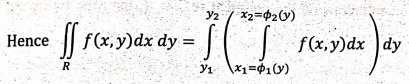
The integration being
carried from the inner to the outer rectangle. Geometrically the integral in
the inner rectangle indicates that the integration is performed along the
horizontal strip PQ (keeping y constant) while the outer rectangle corresponds
to the sliding of strip PQ from AC to BD thus covering the entire region ABDC
of integration.
Case
(ii)
When y1, y2 are
functions of x and x1, x2
are constants (the variable y has variable limits and x has constant limits
shown in Figure 5.3. Let AB and CD be the curves y1 = φ1(x)
and y2 = φ2(x).
Here the double
integration is evaluated first with respect to y (treating x as a constant
temporarily). The resulting expression is a function of x is integrated with
respect to x between the limits x = x1 and x = x2.
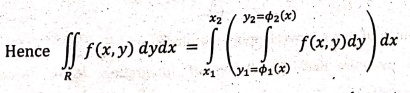
The integration being
carried from the inner to the outer rectangle. Geometrically, the integral in
the inner rectangle indicates that the integration is performed along the
vertical strip PQ (keeping x constant) while the outer rectangle correspondence
to the sliding of the strip from AB to CD thus covering the entire region ABDC
of the integration.
Case
(iii) When x1, x2, y1 and y2 are constants. Here the region of integration is a
rectangle ABDC. It is immaterial whether we integrate first with respect to x
and then with respect to y or first to y and then with respect to x. Hence the
order of integration is immaterial provided the limits of integration are
changed accordingly,

Properties of Double Integrals
Like single integrals,
double integrals of continuous functions have algebraic properties that are
useful in computations and applications.
If f(x, y) and g(x, y) are continuous on the bounded region R, then
the following properties hold.
1. Constant Multiple:

2. Sum and Difference:

3. Domination:

4. Additivity:

if R is the union of
two nonoverlapping regions R1 and R2.
Property 4 assumes that
the region of integration R is decomposed into nonoverlapping regions R1
and R2 with boundaries consisting of a finite number of line
segments or smooth curves. Figure 15.17 illustrates an example of this
property.
The idea behind these
properties is that integrals behave like sums. If the function f(x, y) is replaced by its constant
multiple cf(x, y), then a Riemann sum
for f
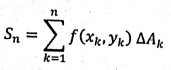
is replaced by a
Riemann sum for cf
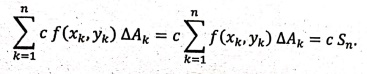
Taking limits as n → ∞ shows
that c limn→∞ Sn = c ∫∫R f(x,y) dA and limn→∞ cSn = ∫∫R cf dA are equal. It follows that the
Constant Multiple Property carries over from sums to double integrals.
The other properties
are also easy to verify for Riemann sums, and carry over to double integrals
for the same reason. While this discussion gives the idea, an actual proof that
these properties hold requires a more careful analysis of how Riemann sums
converge.
FUBINI'S THEOREM
If is continuous on the
rectangle
R = [(x,y) |a≤x≤b, c≤y≤d}, then

More generally, this is
true if we assume that f is bounded
on R, f is discontinuous only on a
finite number of smooth curves, and the iterated integrals exist.
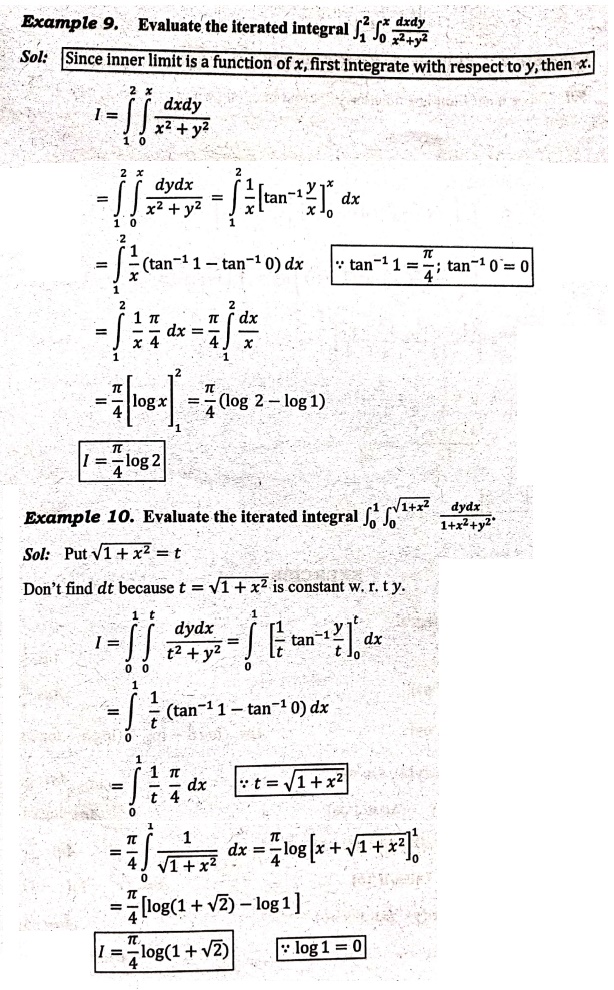
Example
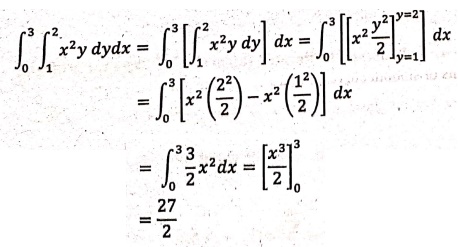
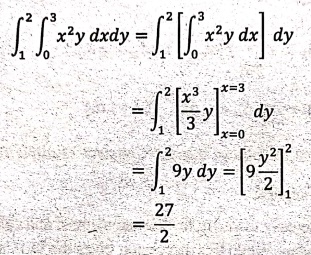
1. Evaluate the iterated integrals.
(a) 0∫31∫2 x2y dydx
(b) 1∫20∫3
x2y dxdy
Solution:
(a) Here we first
integrate with respect to y:
(b) Here we first
integrate with respect to x:
Example
2. Evaluate the iterated integral 1∫21∫3
xy2 dxdy.
Solution:
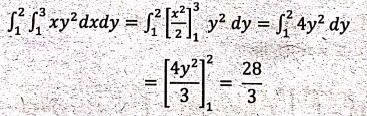
= 28/3
Example
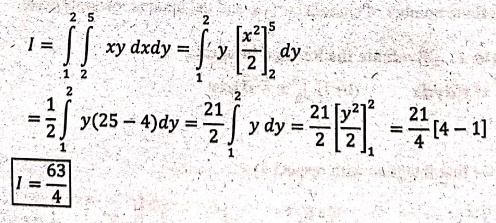
3. Evaluate the iterated integral 1∫22∫5
[xy] dxdy
Solution:
Example
4. Evaluate the iterated integral 0∫10∫2 xy(x
+ y) dxdy
Solution:
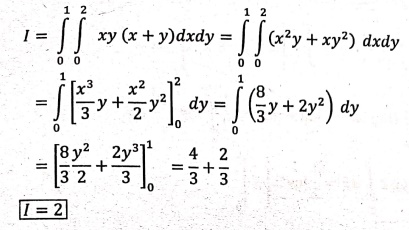
I=2
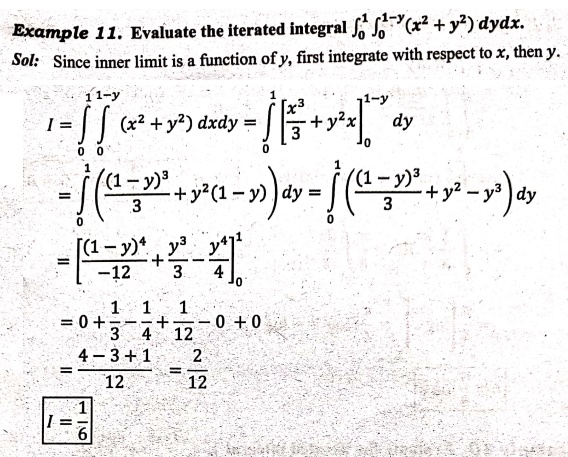
Example
5. Evaluate the iterated integral 1∫20∫x2
x dydx
Solution:
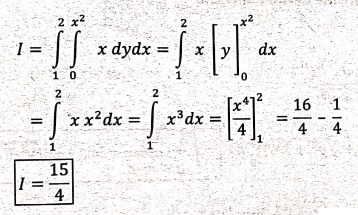
Example
6. Evaluate the iterated integral 0∫a0∫√[a2‒x2]
dydx
Solution:
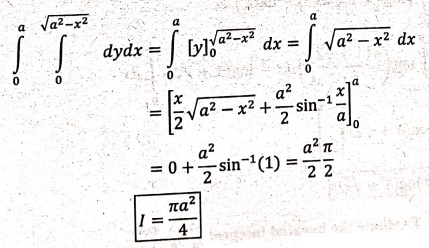
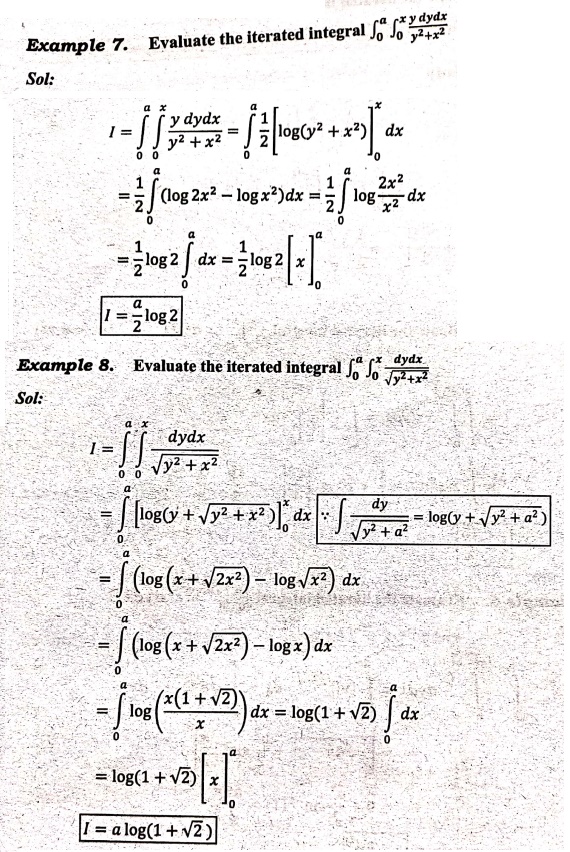
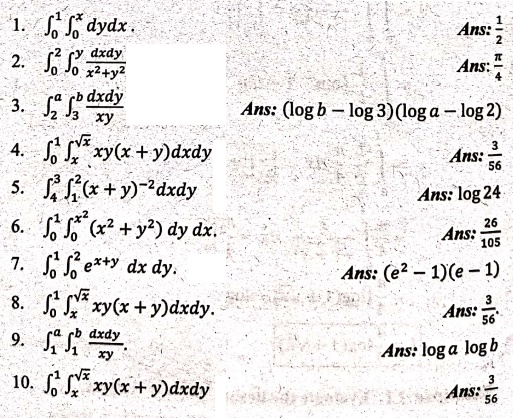
EXERCISE
Evaluate
the iterated integral
Applied Calculus: UNIT IV: Multiple Integrals : Tag: Applied Calculus : - Iterated Integrals
Applied Calculus: UNIT IV: Multiple Integrals
Under Subject
Applied Calculus
MA25C01 Maths 1 M1 - 1st Semester | 2025 Regulation | 1st Semester 2025 Regulation
Related Subjects

English Essentials I
EN25C01 1st Semester | 2025 Regulation | 1st Semester 2025 Regulation

தமிழர் மரபு - Heritage of Tamils
UC25H01 1st Semester | 2025 Regulation | 1st Semester 2025 Regulation
Applied Calculus
MA25C01 Maths 1 M1 - 1st Semester | 2025 Regulation | 1st Semester 2025 Regulation
Applied Physics I
PH25C01 1st Semester | 2025 Regulation | 1st Semester 2025 Regulation

Applied Chemistry I
CY25C01 1st Semester | 2025 Regulation | 1st Semester 2025 Regulation

Makerspace
ME25C04 1st Semester | 2025 Regulation | 1st Semester 2025 Regulation
Computer Programming C
CS25C01 1st Semester | 2025 Regulation | 1st Semester 2025 Regulation
Computer Programming Python
CS25C02 1st Semester | 2025 Regulation | 1st Semester 2025 Regulation

Fundamentals of Electrical and Electronics Engineering
EE25C03 1st Semester | 2025 Regulation | 1st Semester 2025 Regulation
Introduction to Mechanical Engineering
ME25C03 1st Semester | 2025 Regulation | 1st Semester 2025 Regulation

Introduction to Civil Engineering
CE25C01 1st Semester Civil Department | 2025 Regulation | 1st Semester 2025 Regulation
Essentials of Computing
CS25C03 1st Semester - AID CSE IT Department | 2025 Regulation | 1st Semester 2025 Regulation

Applied Physics I Laboratory
PH25C01 1st Semester practical Laboratory Manual | 2025 Regulation | 1st Semester Laboratory 2025 Regulation

Applied Chemistry I Laboratory
CY25C01 1st Semester practical Laboratory Manual | 2025 Regulation | 1st Semester Laboratory 2025 Regulation

Computer Programming C Laboratory
CS25C01 1st Semester practical Laboratory Manual | 2025 Regulation | 1st Semester Laboratory 2025 Regulation

Computer Programming Python Laboratory
CS25C02 1st Semester practical Laboratory Manual | 2025 Regulation | 1st Semester Laboratory 2025 Regulation
Engineering Drawing
ME25C01 EEE Mech Dept | 2025 Regulation | 2nd Semester 2025 Regulation

Basic Electronics and Electrical Engineering
EE25C04 1st Semester ECE Dept | 2025 Regulation | 2nd Semester 2025 Regulation