Applied Calculus: UNIT IV: Multiple Integrals
Triple Integrals: Volume of Solids
Explanation, Formula, Equation, Example and Solved Problems - Multiple Integrals: Triple Integrals: Volume of Solids
VOLUME OF SOLIDS
Definition:
The volume V of three
dimensional region is given by V = ∫∫∫V dzdydx. If the region is
bounded by
z = f1(x,y), z = f2(x, y), y = Ø1(x),
y = Ø2(x) and x = a, x = b then

The order of
integration can be changed with a suitable change in the limits of integration.
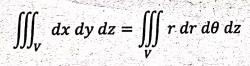
In cylindrical polar
coordinate system, the volume of a region of space V is given by
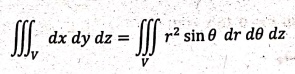
In spherical polar
coordinate system, the volume of a region of space V is given by
Example
87. Find the volume of the region bounded by x = 0, y = 0, z = 0, x/a + y/b + z/c
= 1.
Solution:
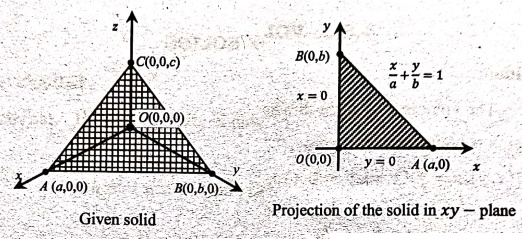
To plot the region:
Given region is bounded
by the planes x = 0, y = 0, z = 0 and x/a + y/b + z/c = 1.
x/a + y/b + z/c = 1 is
plane which intersect the coordinate axes at (a, 0,0), (0, b, 0), (0,0, c)
To evaluate the volume:
Volume V = ∫∫∫ dz dy dx
To find the limits:
Given x/a + y/b + z/c =
1 .......(1)
⇒
z = c ( 1 – x/a – y/b)
z varies from z = 0 to z = c(1 – x/a – y/b)
Put z = 0(1), the
projection of the solid in the xy - plane is the region bounded by x = 0, y = 0
and x/a + y/b = 1 .......(2)
y = b(1 ‒ x/a)
y varies from y = 0 to y = b (1 ‒ x/a)
Put y = 0 in (2), we
get x/a = 1
x = a
x varies from x = 0 to
x = a
Volume V = ∫∫∫V
dz dy dx
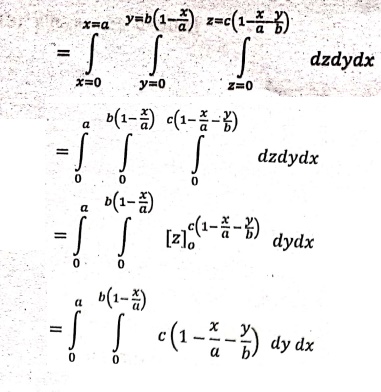
Put, t = 1‒x/a ; don’t
find dt because 1‒x/a is a constant with respect to y
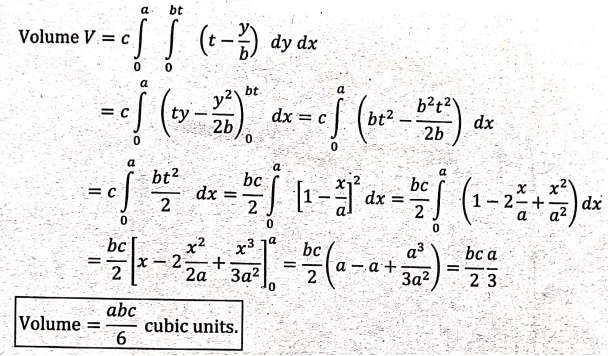
Volume = abc/6 cubic
units.
Example
88. Find the volume of the sphere of radius 'a'.
Solution:
To plot the region:
Equation of a sphere of
radius 'a' is x2 + y2 + z2 = a2 …….(1)
To evaluate the volume:
Volume V = 8 × Volume
of the solid lies in the first octant
= 8 × ∫∫∫V dz
dy dx
To find the limits:
(1) ⇒
z2 = a2 ‒ x2
‒ y2
z = √[a2
‒ x2 ‒ y2] (Since the region is
first octant)
z varies from z = 0 to z = √[a2 ‒ x2 ‒ y2]
Put z = 0 in (1), the
projection of the solid in the xy‒plane is the circle
x2
+ y2 = a2 ... (2)
⇒
y = √[a2 ‒ x2]
y varies from y = 0 to y = √[a2‒ x2]
Put y = 0 in (2), we
get x2 = a2 ⇒ x= a
x varies from x = 0 to
x = a

V = 4/3 πа3
cubic units.
Note:
We can find the volume of the sphere using spherical polar coordinates system
Example
89. Find the volume of the sphere of radius 'a' using spherical polar
coordinates system
Solution:
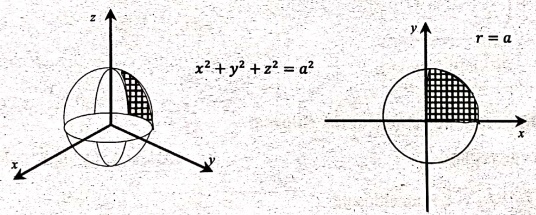
To plot the region:
Equation of a sphere of
radius 'a' is x2 + y2 + z2 = a2 …..
(1)
To evaluate the volume:
Volume V = 8 × Volume
of the solid lies in the first octant
= 8 × ∫∫∫V dz
dy dx
To convert from
Cartesian to spherical polar coordinates system, we have the following
transformation
x = r sinθ cosϕ
y = r sinθ sinϕ
z = r cosθ
dxdydz = r2
sinθdrdθdϕ
Also x2 + y2 + z2
= r2
The region is the
volume of the first octants sphere x2
+ y2 + z2 = a2.
Therefore the limits
are
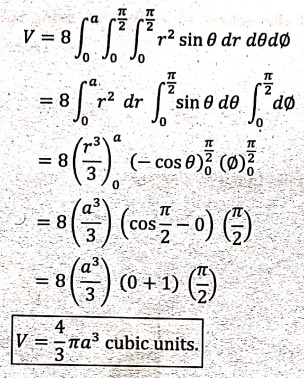
r = 0; r = a
θ = 0; θ = π/2
ϕ = 0; ϕ = π/2
Volume of sphere
Example
90. Find the volume of the ellipsoid 
Solution:
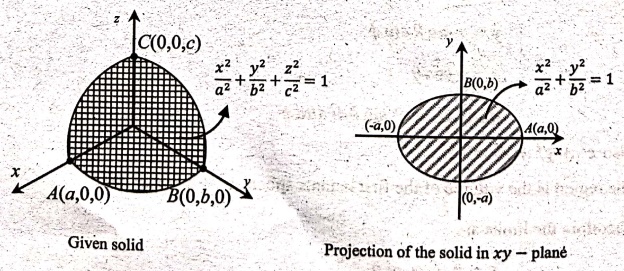
To plot the region:
is
an ellipsoid.
To evaluate the volume:
Volume V = 8 × Volume
of the solid lies in the first octant
= 8 ∫∫∫V
dzdydx
To find the limits:
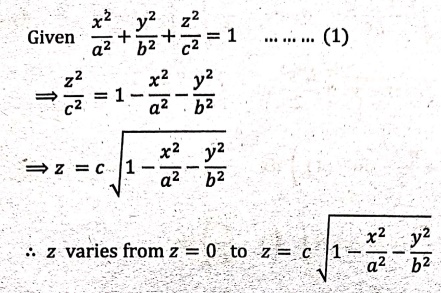
Put z = 0 in (1), the
projection of the solid in the xy - plane is the ellipse

Example
91. Find the volume common to the cylinders x2
+ y2 = a2 and x2 + z2
= a2.
Solution:
To plot the region:
x2
+ z2 = a2 and x2 + y2
= a2 are cylinders which
are symmetrical about y - axis and z ‒ axis respectively.
The section of the
cylinder x2+z2 = a2 is the circle x2
+ y2 = a2 in the xy - plane. In the
figure only one‒eight (in particular octant) of the required volume is shown.
To evaluate the volume:
Volume V = 8 × Volume
of the solid lies in the first octant
= 8 ∫∫∫V
dzdydx
To find the limits:
We have x2 + z2 = a2
z2
= a2 ‒ x2 ⇒ z = √[a2 = x2]
..z varies from
z = 0 to z = √[a2 ‒ x2]
The projection of the
solid in the xy planeis x2
+ y2 = a2 ... (1)
which is a circle in
the xy ‒ plane.
⇒
y2
= a2 ‒ x2 ⇒ y = √[a2 ‒ x2]
. y varies from y = 0
to y=√[a2 ‒ x2]
Put y = 0 in (1)
x2
= a2 ⇒ x = a
.x varies from x = 0 to
x = a

Example
92. Find the volume bounded by the cylinder x2
+ y2 = 4, y+z = 4, z = 0.
Solution:
To plot the region:
x2
+ y2 = 4 ... (1) is a cylinder which are symmetrical
about z-axis.
y + z = 4 ... (2) is a plane intersecting y and z axes.
z = 0 is xoy plane. The
common volume is given in the following figure

To evaluate the volume:
Volume V = ∫∫∫V
dz dy dx
Since the region is
cylindrical, we use cylindrical polar coordinates system.
We have the following
transformation
x = r cosθ, y = r sinθ,
z = z
dx dy dz = r dr dθ dz.
Also x2 + y2 = r2.
To evaluate the volume:
Volume V = ∫∫∫V
dz dy dx
To find the limits:
Given z = 0 and y + z =
4
z = 4‒y = 4‒r sinθ
z varies from z = 0 to z = 4 ‒ 4 ‒ rsinθ
x2
+ y2 = 4
r2 = 4 ⇒ r=2
r varies from r = 0 to r=2
In a cylinder, 0 ≤ θ ≤
2π
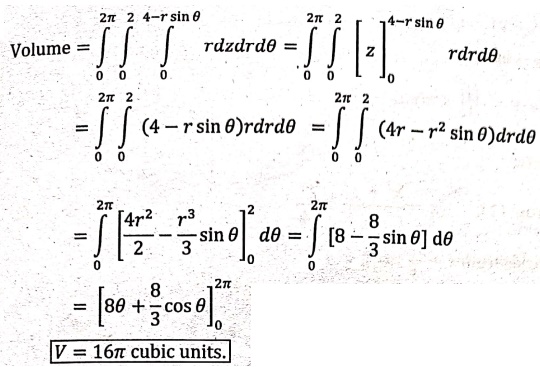
V = 16π cubic units.
Example
93. Find the volume of the paraboloid of revolution x2 + y2
= 4z cut off by the plane z = 4.
Solution:
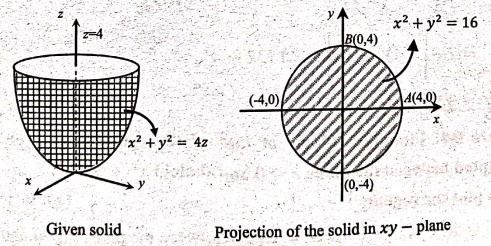
To plot the region:
Given x2 + y2 = 4z
……..(1) is a paraboloid which is cut by the plane z = 4 shaded region.
Put z = 4 in (1), we get x2
+ y2 = 16
The section of the
paraboloid by the plane z = 4 is the circle x2
+ y2 = 16 ... (2)
The projection of the
given solid on the xy‒plane is the circle x2+
y2 = 16.
Since the region is
cylindrical, we use cylindrical polar coordinates system.
We have the following
transformation
x = r cosθ, y = r sinθ,
z = z
dx dy dz = r dr dθ dz.
Also x2+y2 = r2,
To evaluate the volume:
Volume V = ∫∫∫V
dz dy dx
To find the limits:
Now from (1),
z
= x2+ y2 / 4
z = r2/4
z varies from z = r2/4 to z = 4
(2) ⇒ r2 = 16 ⇒ r = 4
r
varies from r = 0 to y=4
In a cylinder, 0 ≤ θ ≤
2π.
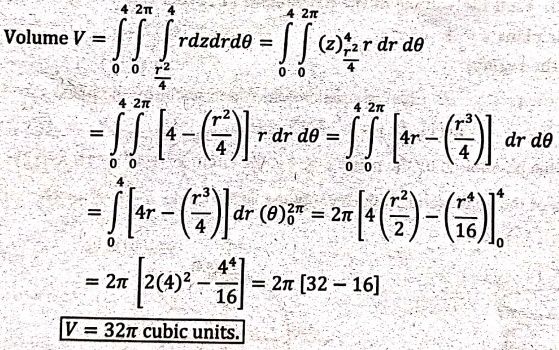
V = 32π cubic units.
Example
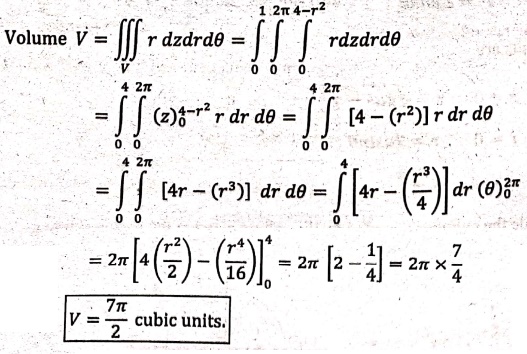
94. Find the volume of the portion of the cylinder x2+ y2
= 1 intercepted between the plane z = 0 and the paraboloid x2 + y2
= 4‒z.
Solution:
To plot the region:
The region is the
cylinder x2 + y2 = 1 intercepted between
the plane z = 0 and the paraboloid x2
+ y2 = 4‒z

Since the region is
cylindrical, we use cylindrical polar coordinates system.
We have the following
transformation
x = r cosθ, y = r sinθ, z= z
dx dy dz = r dr dθ dz.
Also x2+ y2= r2.
x2
+ y2 = 1
r2 = 1.
⇒
0 ≤ r ≤ 1.
In a cylinder, 0 ≤ θ ≤
2π.
Given z = 4 ‒ x2 ‒ y2
= 4‒(x2 + y2)
= 4‒r2
z varies from z = 0 to z = 4 ‒ r2
To evaluate the volume:
Example
95. Find the volume of a solid bounded by the spherical surface x2 + y2 + z2
= 4a2 and the cylinder x2 + y2 ‒ 2ay = 0.
Solution:
Cylindrical co‒ordinates
x = r cosθ
y = r sinθ
z = z
x2
+ y2 = r2
dz dy dx = r dz dr dθ
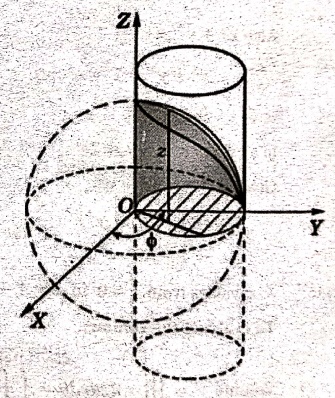
The equation of the
sphere and the cylinder
x2
+ y2 + z2 = 4a2
r2 + z2 = 4a2
z2
= 4a2 ‒ r2
z = √[4a2 ‒ r2]
and the cylinder x2 + y2 ‒ 2ay = 0
x2
+ y2 = 2ay
r2 = 2ar sinθ
r = 2a sinθ
Therefore the limits
are
z=0; z = √[4a2 ‒ r2]
r = 0; r = 2a sinθ
θ = 0; θ = π/2
The volume inside the
cylinder bounded by the sphere is twice the volume shown shaded in the Figure
for which z varies from 0 to √[(a2
‒ r2)],
Hence, the required volume is given by
Volume = ∫∫∫ dz dy dx

Example
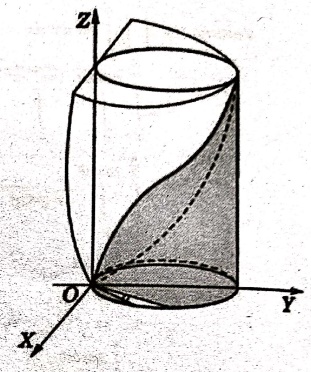
96. Find the volume bounded by the paraboloid x2 + y2
= az, the cylinder x2 + y2 = 2ay and the plane z = 0.
Solution:
The required volume is
founded by integrating z = x2+y2 / a, over the circle x2+y2 = 2ay
Changing to polar
coordinates in the xy‒plane, we have x = r cosθ, y = r sinθ
x2
+ y2 = r2
dx dy = rdr dθ
We have the circle.
x2
+ y2 = 2ay
r2 = 2ar sinθ
r = 2a sinθ
z = x2+ y2 / a
⇒
z
= r2/a
and the polar equation
of the circle is r = 2a sinθ.
To cover this circle, r
varies from 0 to 2a and θ varies from θ = 0 to π.
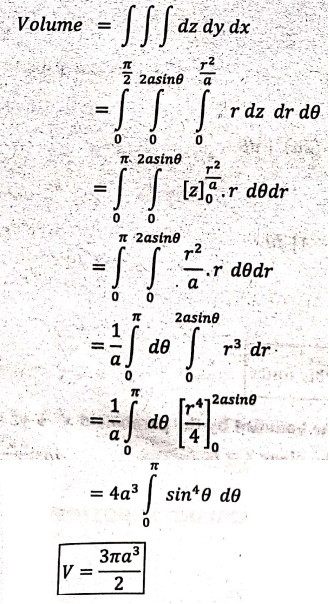
Hence the required volume
is
EXERCISE
82. Find the volume of
the region bounded by x = 0, y = 0, z=0, x + y + z = 1
Ans:
1/6
83. Find the volume of
the region bounded by x = 0, y = 0, z = 0, x + 2y + 3z = 6.
Ans:
6 cubic units
84. Find the volume of
the sphere of radius 'a' which lies in the first octant.
Ans:
πa3/6
85. Find the volume of
the spherical x2 + y2 + z2 = 32 by using triple integration.
Ans:
36π
86. Find the volume of
the ellipsoid x2/a2 + y2/b2 +
z2/c2 = 1 which lies in the
first octant.
Ans:
πabc / 6
87. Find the volume of
the ellipsoid x2/4 + y2/9 + z2/16 = 1.
Ans:
32π
88. Find the volume
bounded by the cylinder x2
+ y2 = 4 and the planes y
+ z = 3 and z = 0.
Ans:12π
89. Find the volume of
the cylinder x2 + y2 = a2, z = 0 & z= h.
Ans:
πa2h
90. Find the volume of
the region bounded by z = x2
+ y2, z=0, x = ‒a, x = a and
y = ‒a and y = a.
Ans:
8a4 /3 cubic units.
91. Find the volume of
the paraboloid of revolution x2
+ y2 = z cut off by the
plane z = 4.
Ans:
2π cubic units
92. Find the volume of
the region bounded by the surfaces y2
= 4ax and x2 = 4ay and the
plane z = 0 z = 3.
Ans:
Volume = 16 a2 cubic units
93. Calculate the
volume of the solid bounded by the planes x = 0, y = 0, 2x + 3y+4z = 12 and z =
0.
Ans:
12
94. Find the volume of
the portion of the sphere x2
+ y2 + z2 = a2 lying inside the cylinder x2 + y2
= ay.
Ans: 2a3/9 [3π ‒ 4]
Applied Calculus: UNIT IV: Multiple Integrals : Tag: Applied Calculus : - Triple Integrals: Volume of Solids
Applied Calculus: UNIT IV: Multiple Integrals
Under Subject
Applied Calculus
MA25C01 Maths 1 M1 - 1st Semester | 2025 Regulation | 1st Semester 2025 Regulation
Related Subjects

English Essentials I
EN25C01 1st Semester | 2025 Regulation | 1st Semester 2025 Regulation

தமிழர் மரபு - Heritage of Tamils
UC25H01 1st Semester | 2025 Regulation | 1st Semester 2025 Regulation
Applied Calculus
MA25C01 Maths 1 M1 - 1st Semester | 2025 Regulation | 1st Semester 2025 Regulation
Applied Physics I
PH25C01 1st Semester | 2025 Regulation | 1st Semester 2025 Regulation

Applied Chemistry I
CY25C01 1st Semester | 2025 Regulation | 1st Semester 2025 Regulation
Makerspace
ME25C04 1st Semester | 2025 Regulation | 1st Semester 2025 Regulation
Computer Programming C
CS25C01 1st Semester | 2025 Regulation | 1st Semester 2025 Regulation

Computer Programming Python
CS25C02 1st Semester | 2025 Regulation | 1st Semester 2025 Regulation
Fundamentals of Electrical and Electronics Engineering
EE25C03 1st Semester | 2025 Regulation | 1st Semester 2025 Regulation

Introduction to Mechanical Engineering
ME25C03 1st Semester | 2025 Regulation | 1st Semester 2025 Regulation

Introduction to Civil Engineering
CE25C01 1st Semester Civil Department | 2025 Regulation | 1st Semester 2025 Regulation
Essentials of Computing
CS25C03 1st Semester - AID CSE IT Department | 2025 Regulation | 1st Semester 2025 Regulation

Applied Physics I Laboratory
PH25C01 1st Semester practical Laboratory Manual | 2025 Regulation | 1st Semester Laboratory 2025 Regulation

Applied Chemistry I Laboratory
CY25C01 1st Semester practical Laboratory Manual | 2025 Regulation | 1st Semester Laboratory 2025 Regulation

Computer Programming C Laboratory
CS25C01 1st Semester practical Laboratory Manual | 2025 Regulation | 1st Semester Laboratory 2025 Regulation

Computer Programming Python Laboratory
CS25C02 1st Semester practical Laboratory Manual | 2025 Regulation | 1st Semester Laboratory 2025 Regulation
Engineering Drawing
ME25C01 EEE Mech Dept | 2025 Regulation | 2nd Semester 2025 Regulation

Basic Electronics and Electrical Engineering
EE25C04 1st Semester ECE Dept | 2025 Regulation | 2nd Semester 2025 Regulation