Data Structures using C PlusPlus: Chapter 9: Searching, Sorting and Complexity Analysis
Binary Search
Data Structures using C++ Program
Questions: 1. With example explain the binary search technique. 2. Write C++ code to implement linear search with suitable example. 3. Write C++ code to implement binary search with suitable example. 4. Explain in detail about linear search algorithm with an example. 5. Describe binary search in detail. 6. Explain linear search in detail. 7. Explain the binary search with sample program. 8. Write the algorithm to perform binary search on an array and demonstrate with an example.
Binary
Search
• Basic concept :
Binary search is a searching algorithm in which the list of elements is divided
into two sublists and key element is compared with middle element. If match is
found then the location of that element is returned. Otherwise, we search into
either of the halves depending upon the result produced through the match.
•
The prerequisite for this searching technique is that the list should be
sorted.
Example:
•
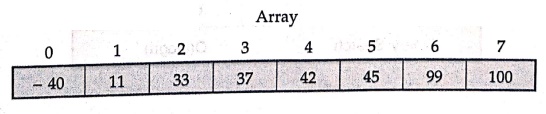
As mentioned earlier the necessity of this method is that all the elements
should be sorted. So let us take an array of sorted elements.
Step 1:
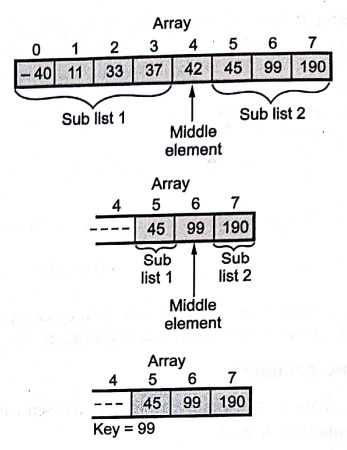
Now the key element which is to be searched is 99
key = 99.
Step 2 :
Find the middle element of the array. Compare it with the key
if
middle  key
key
i.e.
if 42 99
if
42 < 99 search the sublist 2
Now
handle only sublist 2. Again divide it, find mid of sublist 2
if
middle key
i.e.
if 99 99
if
middle key
i.e.
if 99 99
So
match is found at 7th position of array i.e. at array [6]
Thus
by binary search method we can find the element 99 present in the given list at
array [6]th location.
Algorithm for binary search using recursive definition :
1.
if(low > high)
2.
return;
3.
mid = (low + high)/2;
4.
if(x= =a[mid])
5.
return (mid);
6.
if(x < a[mid])
7.
search for x in a[low] to a[mid‒1];
8.
else
9.
search for x in a[mid + 1] to a[high];
Searching method ‒ Time complexity
Linear
Search ‒ O(n)
Binary
Search ‒ O(nlogn)
Advantages of binary searching
1.
It is an efficient technique.
Disadvantages of binary searching
1.
It requires specific ordering before the applying the method.
2.
It is complex to implement.
Time complexity
Let,
the recurrence relation be,
T(n) = T (n/2 ) + c
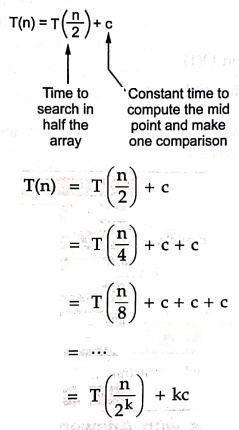
T (n/2 ) ‒ Time to search in half the array
c ‒ Constant time to compute the mid point and
make one comparison
T(n)
= T (n/2 ) + c
=
T(n/4) + c + c
= T(n/8) + c + c + c
= …
= T(n/2k) + c
Let
us assume n /2k = 1
n = 2k
k = long2
n
Equation
(9.9.1) becomes,
T(n)
= T(n/n) + c.log2n
= T (1)+c‒log2n
As
T(1) = 1 (Base case, compares only 1 element)
T(n) = O(log n)
In
binary search,
Best case :
O(1)
Average case :
O(log n)
Worst case :
O(log n)
Space complexity :
For
iterative implementation O(1)
For
recursive implementation O(log n) (stack space)
Review Questions
1. With example
explain the binary search technique.
2. Write C++ code to
implement linear search with suitable example.
3. Write C++ code to
implement binary search with suitable example.
4. Explain in detail
about linear search algorithm with an example.
5. Describe binary
search in detail.
6. Explain linear
search in detail.
7. Explain the binary
search with sample program.
8. Write the algorithm
to perform binary search on an array and demonstrate with an example.
Data Structures using C PlusPlus: Chapter 9: Searching, Sorting and Complexity Analysis : Tag: Data Structure, C++ Programing : Data Structures using C++ Program - Binary Search
Data Structures using C PlusPlus: Chapter 9: Searching, Sorting and Complexity Analysis
Under Subject
Data Structures using CPlusPlus
CS25C05 2nd Semester ECE Dept | 2025 Regulation | 2nd Semester 2025 Regulation
Related Subjects
English Essentials II
EN25C02 2nd Semester | 2025 Regulation | 2nd Semester 2025 Regulation

Tamils and Technology தமிழர்களும் தொழில்நுட்பமும்
UC25H02 2nd Semester | 2025 Regulation | 2nd Semester 2025 Regulation
Linear Algebra
MA25C02 2nd Semester | 2025 Regulation

Electron Devices
EC25C01 2nd Semester ECE Dept | 2025 Regulation | 2nd Semester 2025 Regulation
Data Structures using CPlusPlus
CS25C05 2nd Semester ECE Dept | 2025 Regulation | 2nd Semester 2025 Regulation

Circuits and Network Analysis
EC25C02 2nd Semester ECE Dept | 2025 Regulation | 2nd Semester 2025 Regulation

Re-Engineering for Innovation
ME25C05 2nd Semester | 2025 Regulation | 2nd Semester 2025 Regulation
Engineering Drawing - Laboratory
ME25C01 2nd Semester | 2025 Regulation | 2nd Semester 2025 Regulation
Data Structures using CPlusPlus - Laboratory
CS25C05 2nd Semester ECE Dept | 2025 Regulation | 2nd Semester 2025 Regulation
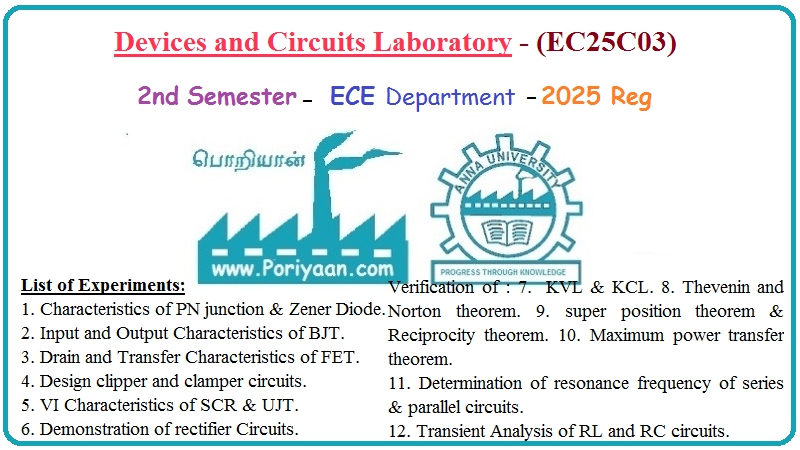
Devices and Circuits Laboratory
EC25C03 2nd Semester ECE Dept | 2025 Regulation | 2nd Semester 2025 Regulation