Data Structures using C PlusPlus: Chapter 9: Searching, Sorting and Complexity Analysis
Searching, Sorting and Complexity Analysis: Two Marks Important Questions and Answers
Data Structures using C++ Program
Data Structures using C++ Program: Chapter 9: Searching, Sorting and Complexity Analysis : Anna University Part A Two Marks Important Questions and Answers
Data Structures using C ++
Chapter 9: Searching, Sorting and Complexity Analysis
Two Marks Questions with Answers
1. What
is the time complexity of binary search and quick sort ?
Answer:
The
time complexity of binary search is O(logn) and the best case and average case
time complexity of quick sort is O(logn) the worst case time complexity is O(n2).
2. What
do you mean by sorting? Mention its types.
Answer:
The
sorting is a method of arranging the data in some systematic order. The data
can be arranged in ascending order or descending order.
There
are two types of sorting ‒
1. Internal sorting :
The internal sorting is a method which is applied on the data stored on the
main memory. Various techniques of internal sorting method are ‒
a)
Bubble sort
b)
Insertion sort
c)
Shell sort
d)
Heap sort
e)
Merge sort
f)
Quick sort
2. External sorting :
In this sorting method the data resides on external or secondary storage
devices such as hard disk, floppy disk etc.
3. What
is external sorting?
Answer:
External
sorting is a sorting method in which the data resides on external or secondary
storage devices such as floppy disks, hard disks etc. The external sorting is a
complex sorting method. The data stored on secondary memory is part by part
loaded into the main memory and then the sorting is done on main memory itself.
The sorted data can be stored in the intermediate files. Thus many files can be
generated. And finally all the sorted intermediate files are merged in a single
file. Thus a huge amount of data is sorted using this technique.
4. Sort
the following using merge sort: 15,25,70,07,11,65,81,57.
Answer:
Consider,
15, 25, 70, 07, 11, 65, 81, 57. These elements are stored in an array.

We
will go on dividing an array.
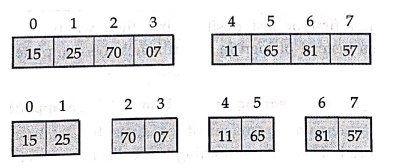
Now
if we divide the above sublists we will get a single element in each sublist.
Further division is not possible hence we will stop dividing and start merging.
Now we will sort the elements in each sublist.
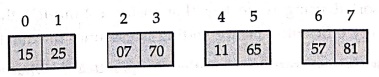
Now
merge two sublists
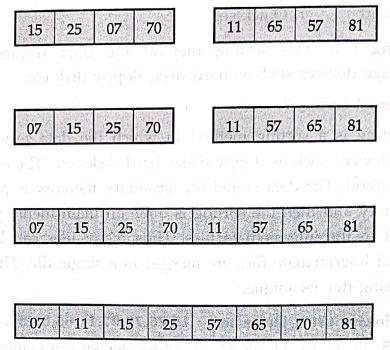
is
a sorted list.
5. State
the algorithmic technique used in merge sort.
Answer:
Divide
and conquer is an algorithmic strategy used to perform merge sort.
6. What
is worst case complexity of quick sort?
Answer:
If
the pivot element is chosen as the smallest or largest element from an array
then it occupies either first or last position and then we have to sort the
list with respect to pivot. Thus instead of logn in (n − 1) levels the complete
list time complexity O(n2).
7. What
is sorting? How is sorting essential for database applications ?
Answer:
Sorting
is a systematic arrangement of data. In database applications, huge amount of
data is stored. This data is nothing but collection of records. For example in
employee database ‒ the information like employee name, ID, salary, Department,
Date of joining is stored. Various operations that can be performed in the
database are insertion of record, deletion of record, searching of particular
record and modification of specific record.
If
the records are sorted using some key (For instance Emp‒ID) then these
operations can be performed very efficiently. Hence sorting is essential for
database applications.
8. Which
is the fastest sorting algorithm in practice? What is the average and worst
running time of it?
Answer:
The
fastest sorting algorithm in practice is quick sort. The average case time
complexity is O(logn) and the worst running time of it is O(n2).
9. Differentiate
between stable and unstable sort.
Answer:
In
stable sorting if the same value elements are present in the list then the
order of the elements remain the same even after the sorting. But in the
unstable sorting the order of the similar value elements get changed.
10. What
is the worst case and best case number of comparisons in linear search?
Answer:
In
linear search if the entire list of elements need to be searched for locating
the key element then the worst case number of comparisons are O(n) where n
denotes the total number of elements in the list. During the best case the
elements which is to be searched is present almost at the initial place. Hence
very few comparisons are required in best case. The best case number of
comparisons are O(1).
11. List
the four types of sorting techniques
Answer:
The
four types of sorting techniques are ‒
1.
Bubble sort
2.
Quick Sort
3.
Insertion sort
4.
Merge Sort
12. State
why quick sort is more efficient than merge sort ?
Answer:
Merge
sort requires auxiliary memory to perform sorting while the quick sort is a in‒place
sorting method. The merge sort is more towards the processing of elements and
quick sort is more towards storing of elements. These features make the quick
sort more efficient than the merge sort.
13. How
to perform union operation ?
Answer:
The
union operation is a operation in which the elements from one set are combined
with the elements of the another set. The repetition of element is avoided.
Following
C++ implements this operation.
#define MAX 10
class UnionClass
{
private:
int a[MAX],b[MAX];
int i,term1,term2;
public:
void getData()
{
cout<<"\n
How many elements are there in First set?";
cin>>term1;
cout<<"\n
Enter the elements in First set\n";
for(i=0;i<term1;i++)
cin>>a[i];
cout<<"\n
How many elements are there in Second set? ";
cin>>term2;
cout<<"\n
Enter the elements in Second set\n";
for(i=0;i<term2;i++)
cin>>b[i];
}
void Union()
{
int c[MAX];
int i,j,k,n,flag;
k=0;flag=0;
for(i=0;i<term1;i++)
{
c[k++]=a[i];
}
for(j=0;j<term2;j++)
{
flag=0;
for(i=0;i<term1;i++)
{
if(a[i]= =b[j])
flag=1;
}
if(flag= =0)
c[k++]=b[j];
}
n=k;
cout<<"\n
The A union B={";
for(k=0;k<n;k++)
cout<<"
"<<c[k];
cout<<"}";
}
};
void main()
{
UnionClass obj;
obj.getData();
obj.Union();
}
Output
How many elements are
there in First set? 3
Enter the elements in
First set
1 2 3
How many elements are
there in Second set? 5
Enter the elements in
Second set
2 2 3 3 4
The A union B={ 1 2 3
4}
14. What
is the time complexity of quick sort and binary search?
Answer:
The
time complexity of quick sort and binary search is O(nlogn)
15. Why
stability of sorting is important?
Answer:
Stability
of sorting is important for following reasons ‒
1.
It helps to sort the records properly when multiple keys for sorting are used.
2.
It determines the worst case performance of the sorting algorithm.
16. When
will the worst case occur in linear search ?
Answer:
When
the item is at the last position in the array or if the desired element is not
present in the array, it is a worst case.
17. For
rearranging the library books in a shelf in proper order at the end of each
day, which sorting technique will be the ideal choice?
Answer: Insertion
sort.
18. way a
card game player arranges his cards as he picks them one by one is an example
of ‒
Answer: Insertion
sort.
19. Name
the sorting technique in which array to be sorted is partitioned again and
again in such a way that all the elements that are less than partitioning
element appear just before it and all the greater elements will appear after
it.
Answer: Quick
sort.
20. What
is meant by sorting?
The
sorting is a method of arranging the data in some systematic order. The data
can be arranged in ascending order or descending order.
21. What
is time complexity?
Answer:
Time
complexity is amount of time required by an algorithm to execute. The time
complexity is denoted using the asymptotic notations such as Big oh, Big omega
and Big theta notation.
22. How
an array elements are sorted using merge sort ?
Answer:
In
merge sort, the array elements are repeatedly divided in groups and these
groups are then merged together and finally two sub‒groups are merged together
to form a single sorted list.
23. List
of advantages of quick sort ?
Answer:
Advantages
of quick sort are:
1.
Quick sort is inplace sorting algorithm. Hence it needs no temporary memory.
2.
It is faster than other sorting algorithms
3.
It can be modified to parallel quick sort algorithm, due to use of divide and
conquer approach.
4.
It is well suited for modern computer architecture.
24. Which
search is faster and why?
Answer:
•
Binary search is faster than linear search algorithm. The time complexity of
binary search is O(logn).
•
It is faster because, the list is divided into two sublists by keeping on
middle element. Each time the middle element of the compared with the key
element. Due to this strategy, entire list need not have to be searched for
searching the key element.
25. What
is the time complexity of linear search?
Answer:
The
time complexity of linear search is O(n)
26. Name
the sorting technique which use the divide and conquer strategy?
Answer:
The
sorting techniques that use divide and conquer strategy are:
1)
Quick sort
2)
Merge sort
27. What
are the drawbacks of insertion sort ?
Answer:
1.
It has a high time complexity of O(n2) in the worst and average
cases, making it slow for large datasets.
2.
It requires many comparisons and shifts, which reduces performance on big input
sizes.
28. Give
an algorithm to search an element in an array using linear search.
•
Linear search does not expect specific ordering of the data. Infact the data is
arranged in the list. At every iteration the record will be compared with the
help of the key. In this case sometimes all the elements get compared with the
key value. Although this is an simple searching technique some unnecessary
comparisons has to be performed. This method does not give the satisfactory
solution for the system for large number of elements.
•
The time complexity of this algorithm is O(n). The time complexity will
increase linearly with the value of n. For higher value of n the linear search
is not the satisfactory solution.
Data Structures using C PlusPlus: Chapter 9: Searching, Sorting and Complexity Analysis : Tag: Data Structure, C++ Programing : Data Structures using C++ Program - Searching, Sorting and Complexity Analysis: Two Marks Important Questions and Answers
Data Structures using C PlusPlus: Chapter 9: Searching, Sorting and Complexity Analysis
Under Subject
Data Structures using CPlusPlus
CS25C05 2nd Semester ECE Dept | 2025 Regulation | 2nd Semester 2025 Regulation
Related Subjects

English Essentials II
EN25C02 2nd Semester | 2025 Regulation | 2nd Semester 2025 Regulation

Tamils and Technology தமிழர்களும் தொழில்நுட்பமும்
UC25H02 2nd Semester | 2025 Regulation | 2nd Semester 2025 Regulation

Linear Algebra
MA25C02 2nd Semester | 2025 Regulation

Electron Devices
EC25C01 2nd Semester ECE Dept | 2025 Regulation | 2nd Semester 2025 Regulation
Data Structures using CPlusPlus
CS25C05 2nd Semester ECE Dept | 2025 Regulation | 2nd Semester 2025 Regulation

Circuits and Network Analysis
EC25C02 2nd Semester ECE Dept | 2025 Regulation | 2nd Semester 2025 Regulation

Re-Engineering for Innovation
ME25C05 2nd Semester | 2025 Regulation | 2nd Semester 2025 Regulation
Engineering Drawing - Laboratory
ME25C01 2nd Semester | 2025 Regulation | 2nd Semester 2025 Regulation
Data Structures using CPlusPlus - Laboratory
CS25C05 2nd Semester ECE Dept | 2025 Regulation | 2nd Semester 2025 Regulation
Devices and Circuits Laboratory
EC25C03 2nd Semester ECE Dept | 2025 Regulation | 2nd Semester 2025 Regulation