Data Structures using C PlusPlus: Chapter 9: Searching, Sorting and Complexity Analysis
Sorting Algorithm: Quick Sort
Example, Algorithm, Analysis, C++ Program
Questions: 1. Write C++ code to implement quick sort with suitable example. 2. Give short notes of quick sort with suitable example. 3. Explain quick sort in detail. 4. Write a C++ program to implement quick sort.
Sorting Algorithms
•
Various sorting algorithms which we will study in this chapter are ‒
1.
Insertion sort
2.
Merge sort
3.
Quick sort
4.
Heap sort
Sorting
Algorithm: Quick Sort
•
Quick sort is a sorting algorithm that uses the divide and conquer strategy. In
this method division is dynamically carried out. The three steps of quick sort
are as follows:
1) Divide :
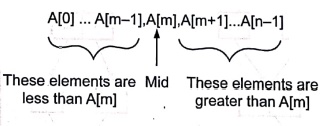
Split the array into two sub arrays that each element in the left sub array is
less than or equal the middle element and each element in the right sub array
is greater than the middle element. The splitting of the array into two sub
arrays is based on pivot element. All the elements that are less than pivot
should be in left sub array and all the elements that are more than pivot
should be in right sub array.
2) Conquer :
Recursively sort the two sub arrays.
3) Combine :
Combine all the sorted elements in a group to form a list of sorted elements.
•
Consider an array A[i] where i is ranging from 0 to n ‒1 then we can formulize
the division of array elements as
•
Let us understand this algorithm with the help of some example.
Analysis
•
When pivot is chosen such that the array gets divided at the mid then it gives
the best case time complexity. The best case time complexity of quick sort is O(nlog 2n).
•
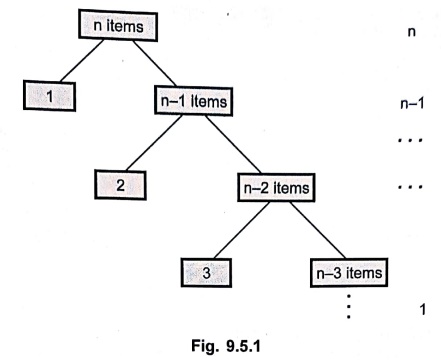
The worst case for quick sort occurs when the pivot is minimum or maximum of
all the elements in the list. This can be graphically represented as ‒
•
This ultimately results in O(n2)
time complexity. When array elements are randomly distributed then it
results in average case time complexity, and it is O(nlog2n).
C++ program
/**************************************************************
Program to sort the elements in ascending order using Quick Sort
***************************************************************/
#include<iostream>
#include<cstdlib>
using namespace std;
#define SIZE 10
class Quick
{
private:
int arr[SIZE];
public:
int get _data(int);
void
quicksort(int,int);
int
partition(int,int);
void swap(int,int);
void display(int);
};
/*
This function is to input the elements
*/
int Quick::get_data(int n)
{
int i;
cout<<"\n
Enter Total numbers to sort : ";
cin>>n;
for(i=0;i<n;i++)
{
cout<<"\nEnter
Element";
cin>>arr[i];
}
return n;
}
/*
This fuction is to sort the elements in a sublist
*/
void Quick::quicksort(int p,int q)
{
int i; if(p<q)
{
j‒partition(p,q+1);//setting pivot element
quicksort(p,j‒1);//splitting
of list
quicksort(j+1,q);//splitting
of list
}
}
/*
This function is to partition a list and decide the pivot
element
*/
int Quick::partition(int m,int p)
{
int pivot = arr[m];
int i=m,j=p;
do
{
do
{
do
i++;
}while(arr[i]
<pivot);
do
{
j‒ ‒;
while(arr[j]>pivot);
if(i<j)
swap(i,j);
}while(i<j);
arr[m] = arr[j];
arr[j]=pivot;
return j;
}
void Quick::swap(int i,int j)
{
int P;
p=arr[i];
arr[i] = arr[j];
arr[j] = p;
}
void Quick::display(int n)
{
for(int
i=0;i<n;i++)
cout<<"
"<<arr[i];
}
void main()
{
Quick obj://for
integer elements
int n,i;
clrscr();
cout<<"\n\t\t
Quick Sort Method \n";
n=obj.get data(n);
obj.quicksort(0,n‒1);
cout<<"\n\n\t
Sorted Array Is: \n";
obj.display(n);
getch();
}
Output
Quick Sort Method
Enter Total numbers to
sort: 5
Enter Element 30
Enter Element 50
Enter Element 10
Enter Element 20
Enter Element 40
Sorted Array Is:
10 20 30 40 50
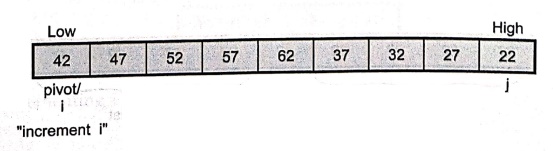
Example : 1
Explain the algorithm
of quick sort by sorting the following set of numbers as an example:
42 47 52 57 62 37 32 27 22.
Solution:
Step 1:
Step 2:

As
Array[i] > Array[pivot], i will not be incremented. As Array [j] <
Array[pivot], j will not be decremented. Just swap Array[i] and Array[j].
increment i, decrement j
Step 3:

As
Array[i] > Array[pivot], i will not be incremented. As Array[j] <
Array[pivot], j will not be decremented.
Just swap Array[i] and Array[j]. Then
increment i and decrement j.
Step 4:

Swap
Array[i] and Array [j]
Step 5 :

Swap
Array[i] and Array[j]
Step 6 :

As
j <i, swap Array[Low] and Array[j]
Step 7 :
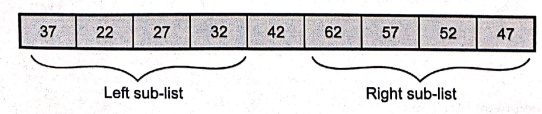
Step 8:
Now
two sublist can be sorted independantly.
While
Array[i] < Array[pivot] keep on incrementing i as i = j, swap Array[j] and Array[pivot]
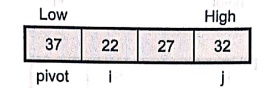
Step 9 :
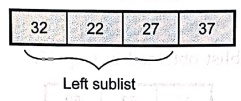
Step 10 :
Sort
the left sublist obtained in step 9.

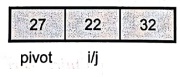
Step 11 :
We
will sort left sublist obtained in step 9.
Swap
Array[pivot] and Array[j]
Step 12 :
The
left sublist obtained in step 7 is now sorted.

We
will sort right sublist
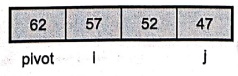
Go
on incrementing i if Array[i] < Array[pivot]
Step 13 :
Swap
Array[pivot] and Array[j]
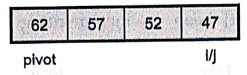
Step 14 :
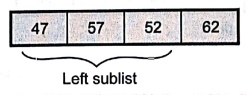
Step 15 :
Now
we will sort the left sublist obtained in step 13.
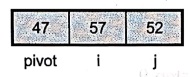
Now
swap Array[i] and Array[j].
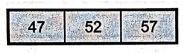
Thus
we get a sorted sublist.
Step 16 :
If
we combine all the sublist we get following list ‒

This
is a sorted list.
Example : 2
Sort the following
values using Quick sort and estimate its time and space complexity: 65 70 75 80
85 60 55 50 45. Illustrate each step of the sorting process.
Solution :
Pass 1
(55,
50, 45) 60 (65 70 75 80 85)
Pass 2
45
(55, 50) (65, 70, 75, 80, 85)
Pass 3
45,
50, 55 (65, 70, 75, 80, 85)
Pass 4
45
50 55 65 (70 75 80 85)
Pass 5
45
50 55 65 70 (75 80 85)
Pass 6
45
50 55 65 70 75 (80 85)
Pass 7
45
50 55 65 70 75 80 (85)
Pass 8
45
50 55 65 70 75 80
Example : 3
Discuss the quick sort
algorithm and apply the same for the following numbers, 90, 77, 60, 99, 55, 88,
66.
Solution:
Quick sort Algorithm ‒ Refer
section 9.5.
Consider
the elements in an array
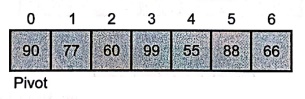
The
first element is considered to be pivot element.
Step 1:
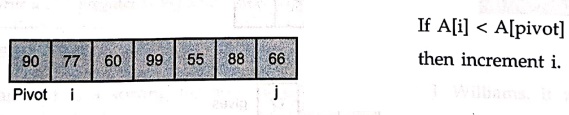
Similarly
if A[j] > A[pivot] decrement j.
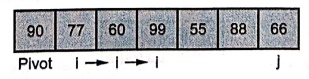
As
i can not be incremented or j can not be decremented. Hence swap A[i] and A[j].
Then continue to increment i and decrement j. When j crosses i, swap A[j] and
A[pivot].
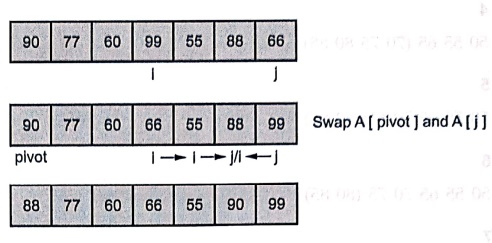
Step 2:
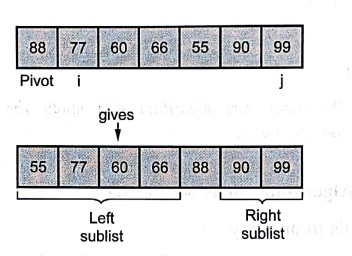
Step 3 :
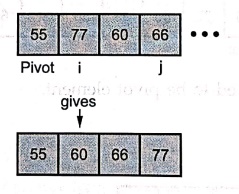
Step 4 :
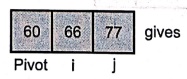
Step 5 :
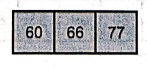
Step 6 :
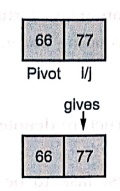
Step 7 :
Consider
the Right sub‒list obtained in step 2.
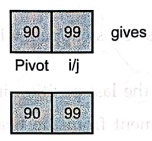
Step 8:
Obtaining
the sublists from all the previous steps we get the final sorted list as

Review Questions
1. Write C++ code to
implement quick sort with suitable example.
2. Give short notes of
quick sort with suitable example.
3. Explain quick sort
in detail.
4. Write a C++ program
to implement quick sort.
Data Structures using C PlusPlus: Chapter 9: Searching, Sorting and Complexity Analysis : Tag: Data Structure, C++ Programing : Example, Algorithm, Analysis, C++ Program - Sorting Algorithm: Quick Sort
Data Structures using C PlusPlus: Chapter 9: Searching, Sorting and Complexity Analysis
Under Subject
Data Structures using CPlusPlus
CS25C05 2nd Semester ECE Dept | 2025 Regulation | 2nd Semester 2025 Regulation
Related Subjects

English Essentials II
EN25C02 2nd Semester | 2025 Regulation | 2nd Semester 2025 Regulation

Tamils and Technology தமிழர்களும் தொழில்நுட்பமும்
UC25H02 2nd Semester | 2025 Regulation | 2nd Semester 2025 Regulation

Linear Algebra
MA25C02 2nd Semester | 2025 Regulation

Electron Devices
EC25C01 2nd Semester ECE Dept | 2025 Regulation | 2nd Semester 2025 Regulation
Data Structures using CPlusPlus
CS25C05 2nd Semester ECE Dept | 2025 Regulation | 2nd Semester 2025 Regulation

Circuits and Network Analysis
EC25C02 2nd Semester ECE Dept | 2025 Regulation | 2nd Semester 2025 Regulation

Re-Engineering for Innovation
ME25C05 2nd Semester | 2025 Regulation | 2nd Semester 2025 Regulation

Engineering Drawing - Laboratory
ME25C01 2nd Semester | 2025 Regulation | 2nd Semester 2025 Regulation
Data Structures using CPlusPlus - Laboratory
CS25C05 2nd Semester ECE Dept | 2025 Regulation | 2nd Semester 2025 Regulation
Devices and Circuits Laboratory
EC25C03 2nd Semester ECE Dept | 2025 Regulation | 2nd Semester 2025 Regulation