Data Structures using C PlusPlus: Chapter 9: Searching, Sorting and Complexity Analysis
Sorting Algorithm: Insertion Sort
Example, Algorithm, Analysis, Advantages, C++ Program
Question: Explain insertion sort with its time complexity.
Sorting Algorithms
•
Various sorting algorithms which we will study in this chapter are ‒
1.
Insertion sort
2.
Merge sort
3.
Quick sort
4.
Heap sort
Sorting
Algorithm: Insertion Sort
Insertion
sort builds the final sorted list one element at a time.
•
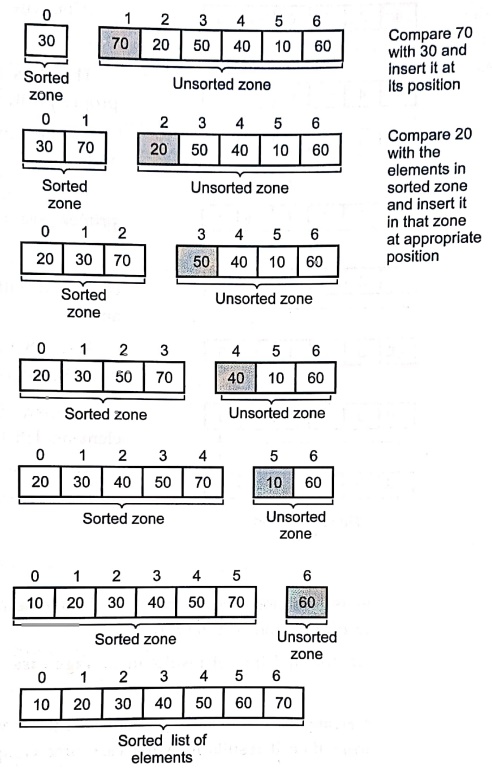
It takes each element from the input and inserts it into its correct position
in the already‒sorted part of the list.
•
In this method the elements are inserted at their appropriate place. Hence is
the bere name insertion sort. Let us
understand this method with the help of some example –
For example
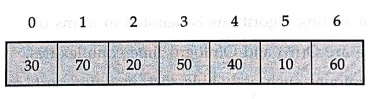
Consider
a list of elements as,
The
process starts with first element.
Algorithm
1.
Store the list of unsorted elements in an array
2.
Set a marker for the sorted zone after the first number in the list
3.
Repeat steps 4 through 6 unit the unsorted zone is empty
4.
Select the first unsorted number
5.
Swap this number to the left unit it arrives at the correct sorted position
6.
Advance the marker to the right one position
7.
Stop
Example : 1
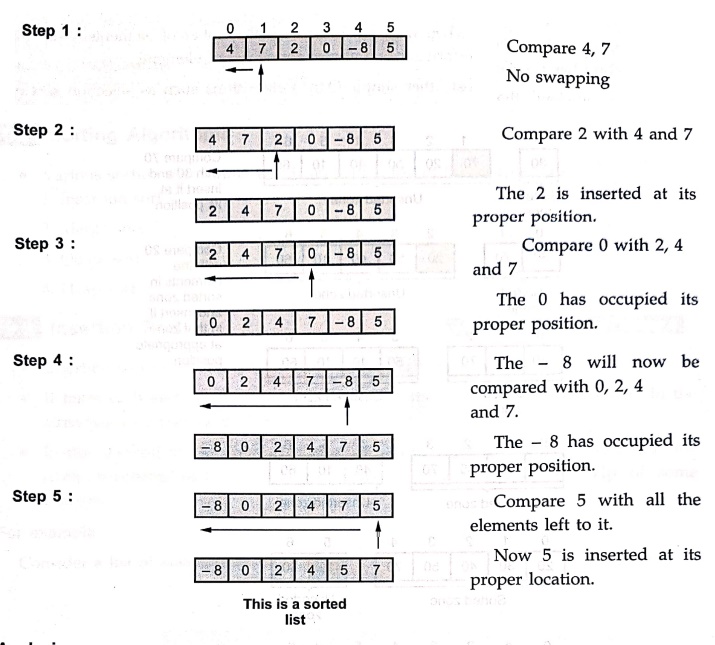
Sort the sequence 4, 7,
2, 0, ‒8, 5 using insertion sort.
Solution :
Consider
that the elements are stored in an array as follows:
Analysis
•
When an array of elements is almost sorted then it is best case complexity. The best case time complexity of insertion
sort is O(n).
•
If an array is randomly distributed then it results in average case time complexity which is O(n 2).
•
If the list of elements is arranged in descending order and if we want to sort
the elements in ascending order then it results in worst case time complexity which is O(n2).
Advantages of insertion sort
1.
Simple to implement.
2.
This method is efficient when we want to sort small number of elements. And
this method has excellent performance on almost sorted list of elements.
3.
More efficient than most other simple O(n2) algorithms such as
selection sort or bubble sort.
4.
This is a stable (does not change the relative order of equal elements).
5.
It is called in‒place sorting algorithm (only requires a constant amount O(1)
of extra memory space). The in‒place sorting algorithm is an algorithm in which
the input is overwritten by output and to execute the sorting method it does
not require any more additional space.
•
Let us now see the implementation of this method using C++.
/**************************************************************
Implementation of insertion sort
***************************************************************/
#include<iostream>
using namespace std;
class Sort
{
private:
int A[10];
int n;
public:
void get _data();
void Insert _sort();
void display();
};
void Sort::Insert _sort().
{
int i,j,temp;
for(i=1;i<=n‒1;i++)
{
temp‒A[i];
j=i‒1;
while((j>=0)&&(A[j]>temp))
{
A[i+1]=A[i];
j=j‒1;
}
A[j+1]=temp;
}
}
void Sort::get_data()
}
cout<<"\n How many elements are there?";
cin>>n;
cout<<"\n Enter the elements\n";
for(int i=0;i<n;i++)
cin>>A[i];
}
void Sort::display()
{
cout<<"\n
The sorted list of elements is...\n";
for(int
i=0;i<n;i++)
cout<<"\n "<<A[i];
}
void main()
{
Sort obj;
clrscr();
cout<<"\n\t\t
Insertion Sort";
obj.get_data();
obj.Insert_sort();
obj.display();
getch();
}
Output
Insertion Sort
How many elements are
there?7
Enter the elements
3
1
2
5
4
7
6
The sorted list of
elements is...
1
2
3
4
5
6
7
Logic explanation
•
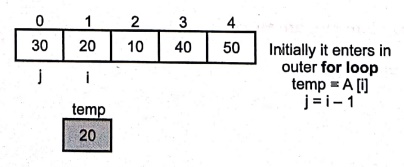
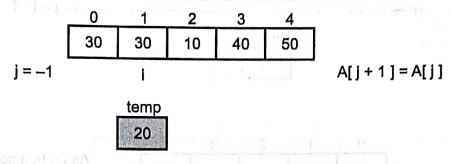
For understanding the logic of above C++ program consider a list of unsorted elements
as,
•
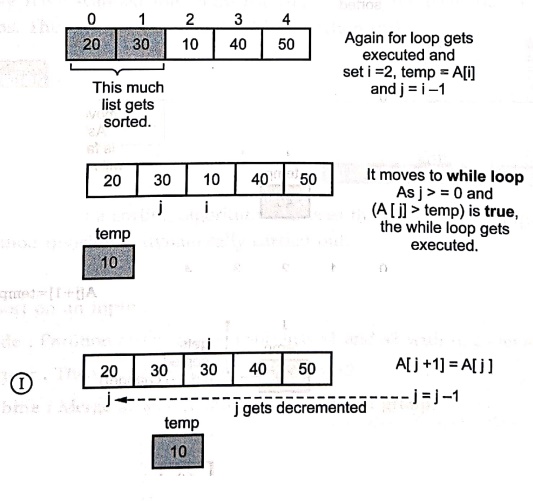
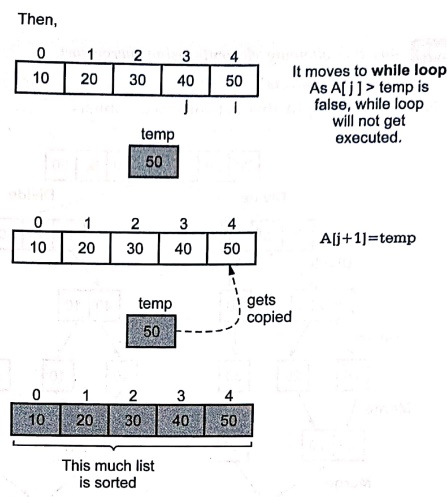
Then the control moves to while loop.
As j >= 0 and A[j] > temp is True,
the while loop will be executed.
•
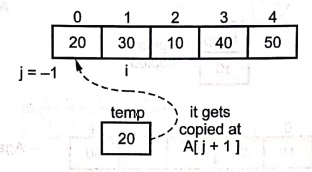
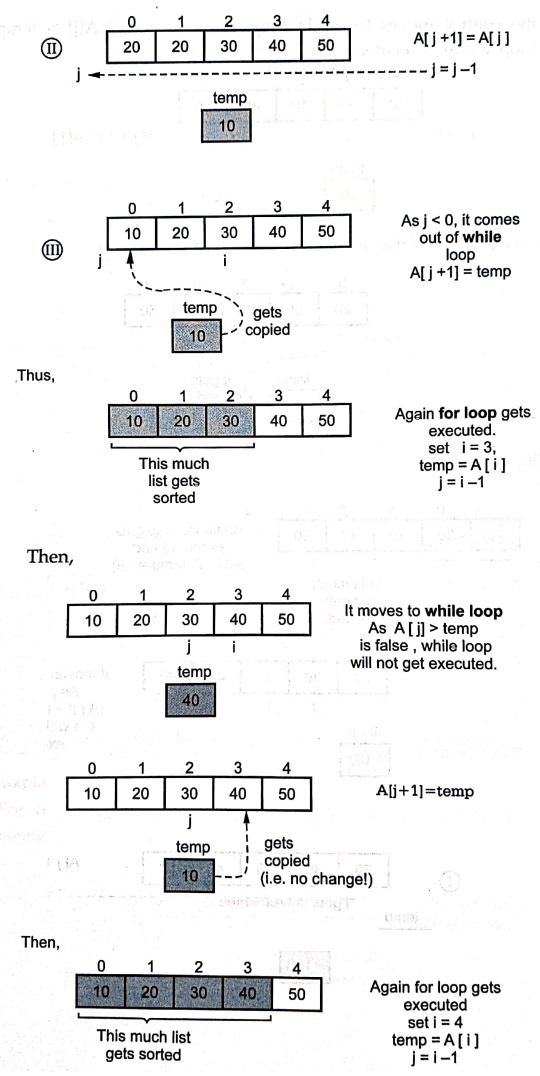
Now since j >= 0 is false, control comes out of while loop.
•
Then list becomes,
•
Thus we have scanned the entire list and inserted the elements at corresponding
locations. Thus we get the sorted list by insertion sort.
Review Question
1. Explain insertion
sort with its time complexity.
Data Structures using C PlusPlus: Chapter 9: Searching, Sorting and Complexity Analysis : Tag: Data Structure, C++ Programing : Example, Algorithm, Analysis, Advantages, C++ Program - Sorting Algorithm: Insertion Sort
Data Structures using C PlusPlus: Chapter 9: Searching, Sorting and Complexity Analysis
Under Subject
Data Structures using CPlusPlus
CS25C05 2nd Semester ECE Dept | 2025 Regulation | 2nd Semester 2025 Regulation
Related Subjects

English Essentials II
EN25C02 2nd Semester | 2025 Regulation | 2nd Semester 2025 Regulation

Tamils and Technology தமிழர்களும் தொழில்நுட்பமும்
UC25H02 2nd Semester | 2025 Regulation | 2nd Semester 2025 Regulation
Linear Algebra
MA25C02 2nd Semester | 2025 Regulation

Electron Devices
EC25C01 2nd Semester ECE Dept | 2025 Regulation | 2nd Semester 2025 Regulation
Data Structures using CPlusPlus
CS25C05 2nd Semester ECE Dept | 2025 Regulation | 2nd Semester 2025 Regulation

Circuits and Network Analysis
EC25C02 2nd Semester ECE Dept | 2025 Regulation | 2nd Semester 2025 Regulation

Re-Engineering for Innovation
ME25C05 2nd Semester | 2025 Regulation | 2nd Semester 2025 Regulation
Engineering Drawing - Laboratory
ME25C01 2nd Semester | 2025 Regulation | 2nd Semester 2025 Regulation
Data Structures using CPlusPlus - Laboratory
CS25C05 2nd Semester ECE Dept | 2025 Regulation | 2nd Semester 2025 Regulation
Devices and Circuits Laboratory
EC25C03 2nd Semester ECE Dept | 2025 Regulation | 2nd Semester 2025 Regulation