Data Structures using C PlusPlus: Chapter 9: Searching, Sorting and Complexity Analysis
Linear Search
Data Structures using C++ Program
Linear search does not expect specific ordering of the data. Infact the data is arranged in the list.
Linear
Search
•
Linear search does not expect specific ordering of the data. Infact the data is
arranged in the list. At every iteration the record will be compared with the
help of the key. In this case sometimes all the elements get compared with the
key value. Although this is an simple searching technique some unnecessary
comparisons has to be performed. This method does not give the satisfactory
solution for the system for large number of elements.
•
The time complexity of this algorithm is O(n). The time complexity will
increase linearly with the value of n. For higher value of n the linear search
is not the satisfactory solution.
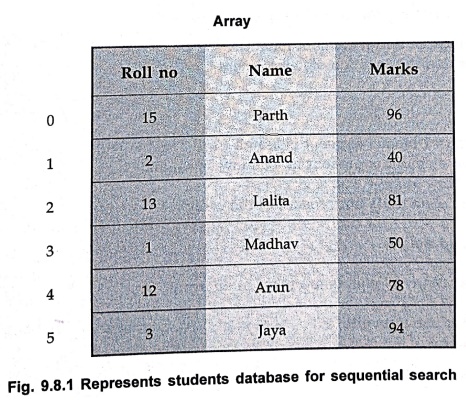
•
From the above Fig. 9.8.1 the array is maintained to store the students record.
The record is not sorted at all. If we want to search the student's record
whose roll number is 12 then with the key‒roll number we will see the every
record whether it is of roll number = 12. We can obtain such a record at Array
[4] location.
•
Let us now implement the sequential search using C++ program
C++ program
/*********************************************************************
Program for implementing the sequential search
**********************************************************************/
#include<iostream>
using namespace std;
class Search
{
private:
int a[10],n,key;
public:
void get_data();
void Seq _Search(int);
};
void Search::Seq_Search(int key)
{
int flag=0,mark;
for(int
i=0;i<n;i++)
{ //searching element
from beginning of array
if(a[i]= =key)
{
flag=1;//setting
the flag if element found
mark=i;//marking
the location of key element
break;
}
}
if(flag= =1)//flag=1 means element is found
cout<<"\n
The element is present at location: "<<mark+1;
else
cout<<"\n
The element is not present in the array";
}
void Search::get_data()
{
cout<<"\n
How Many Elements are there in an array?";
cin>>n;
cout<<"\n
Enter the elements ";
for(int
i=0;i<n;i++)
cin>>a[i];
}
void main()
{
int k;
Search obj;
clrscr();
obj.get_data();
cout<<"\n\t
Enter the element which is to be searched";
cin>>k;
obj.Seq_Search(k);
getch( );
}
Output
How Many Elements are
there in an array? 7
Enter the elements 10
20 30 40 50 60 70
Enter the element
which is to be searched 50
The element is present
at location: 5
Time complexity
This
is a method in which we scan each element of the list one by one until target
element is found.
Best case :
When the element is present at first position. Hence time complexity is O(1).
Worst case :
When the element is at the last position or not present at all. Hence time
complexity is O(n).
Average case :
On average, half of the elements are checked. The time complexity is O (n/2) which simplifies to O(n).
Space complexity :
O(1), as no extra space used.
Data Structures using C PlusPlus: Chapter 9: Searching, Sorting and Complexity Analysis : Tag: Data Structure, C++ Programing : Data Structures using C++ Program - Linear Search
Data Structures using C PlusPlus: Chapter 9: Searching, Sorting and Complexity Analysis
Under Subject
Data Structures using CPlusPlus
CS25C05 2nd Semester ECE Dept | 2025 Regulation | 2nd Semester 2025 Regulation
Related Subjects

English Essentials II
EN25C02 2nd Semester | 2025 Regulation | 2nd Semester 2025 Regulation

Tamils and Technology தமிழர்களும் தொழில்நுட்பமும்
UC25H02 2nd Semester | 2025 Regulation | 2nd Semester 2025 Regulation
Linear Algebra
MA25C02 2nd Semester | 2025 Regulation

Electron Devices
EC25C01 2nd Semester ECE Dept | 2025 Regulation | 2nd Semester 2025 Regulation
Data Structures using CPlusPlus
CS25C05 2nd Semester ECE Dept | 2025 Regulation | 2nd Semester 2025 Regulation

Circuits and Network Analysis
EC25C02 2nd Semester ECE Dept | 2025 Regulation | 2nd Semester 2025 Regulation

Re-Engineering for Innovation
ME25C05 2nd Semester | 2025 Regulation | 2nd Semester 2025 Regulation
Engineering Drawing - Laboratory
ME25C01 2nd Semester | 2025 Regulation | 2nd Semester 2025 Regulation
Data Structures using CPlusPlus - Laboratory
CS25C05 2nd Semester ECE Dept | 2025 Regulation | 2nd Semester 2025 Regulation
Devices and Circuits Laboratory
EC25C03 2nd Semester ECE Dept | 2025 Regulation | 2nd Semester 2025 Regulation