Data Structures using C PlusPlus: Chapter 9: Searching, Sorting and Complexity Analysis
Sorting Algorithm: Heap Sort
Example, Algorithm, Analysis, C++ Program
Heap is a tree data structure denoted by either a maxheap or minheap.
Sorting Algorithms
•
Various sorting algorithms which we will study in this chapter are ‒
1.
Insertion sort
2.
Merge sort
3.
Quick sort
4.
Heap sort
Sorting
Algorithm: Heap Sort
•
Heap sort is a sorting method discovered by J. W. J. Williams. It works in two
stages
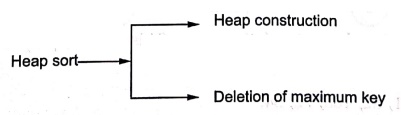
Heap
sort: Heap construction, Deletion of maximum key
1. Heap construction : First
construct a heap for given numbers.
2. Deletion of maximum
key : Delete root key always for (n ‒ 1) times to
remaining heap. Hence we will get the elements in decreasing order. For an
array implementation of heap, delete the element from heap and put the deleted
element in the last position in array. Thus after deleting all the elements one
by one, if we collect these deleted elements in an array starting from last
index of array.
•
We get a list of elements in a ascending order.
ADT for heap sort
{
Instances :
Heap is a tree data structure denoted by either a maxheap or minheap.
Operations :
1. Create_heap():
This is the first task to be performed for sorting the elements using heap
sort. The parent node must be either maximum of its children or minimum than
its children. That means a maxheap or minheap should be constructed.
2. Swap() :
The root node must be swapped with the node at the last position in tree.
3. Delete_node() :
The node at the last position in the heap tree must be deleted.
4. Insert_Q() :
The deleted element from the heap must be inserted in the priority queue.
5. Delete_Q() :
The element can be deleted from the priority queue by the front end, so that a
sorted list can be obtained.
}
Example : 1
State algorithm to sort
elements of a given array in ascending order using heap sort. Sort the
following numbers using heap sort : 48, 0, −1, 82, 108, 72, 54.
Solution : Algorithm :
Step 1 :
Construct the max heap from given set of elements.
Step 2 :
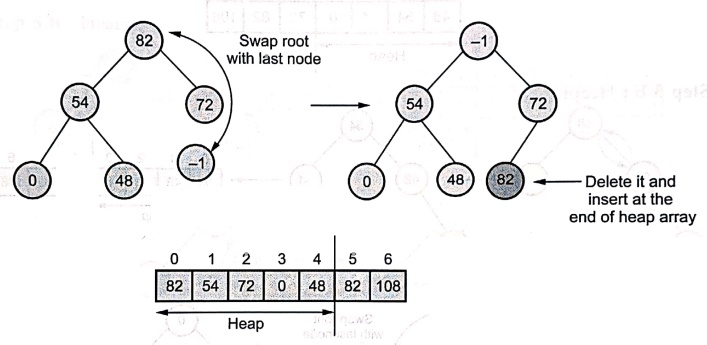
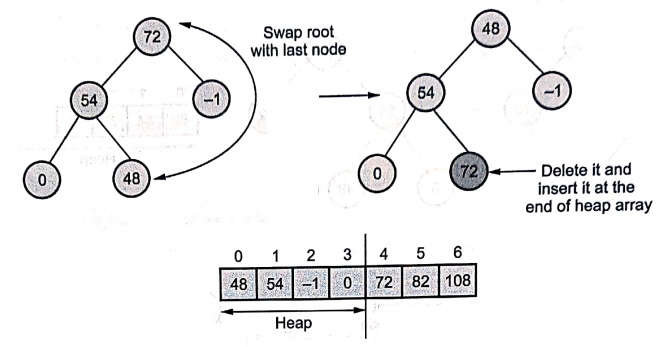
Swap the root key with the last node key of the heap.
Step 3 :
Delete the last node and store its key at the end of the array.
Step 4 : Heapify
the remaining heap structure.
Step 5 : Repeat
step 2 to 4 until the last remaining node.
Step 6 :
Delete the last node and store it at the end of the array.
Step 7 :
Print all the elements of the array. This will display the elements in sorted order.
Consider,
48, 0, ‒ 1, 82, 108, 72, 54.
Stage I : Construct heap
We
will construct max heap as follows ‒
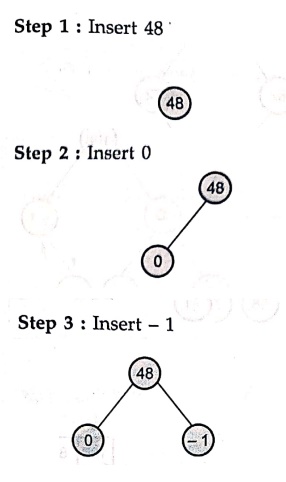
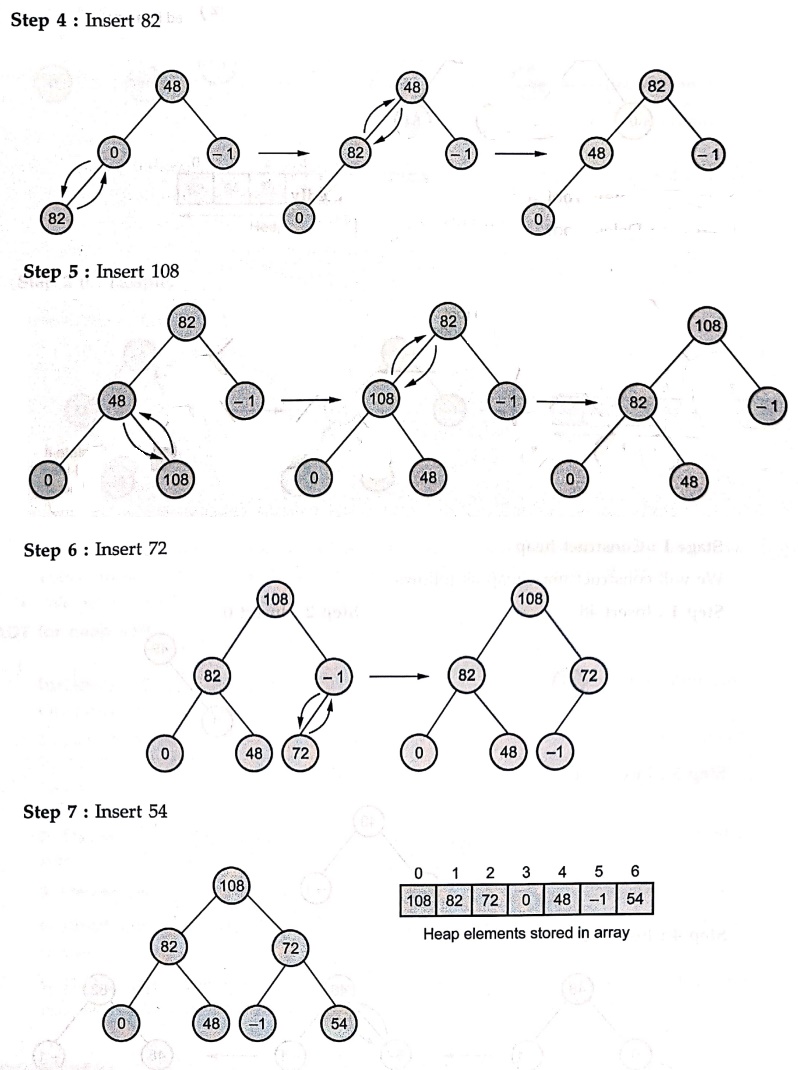
Stage II :
Delete root node and heapify repeatedly
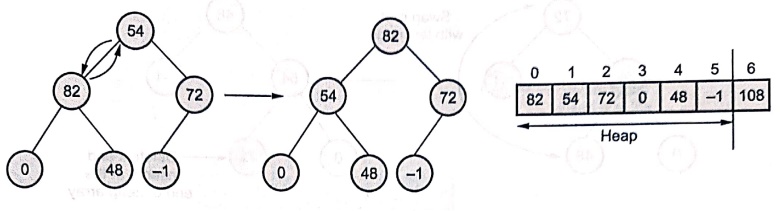
Step 1 a :
Delete root
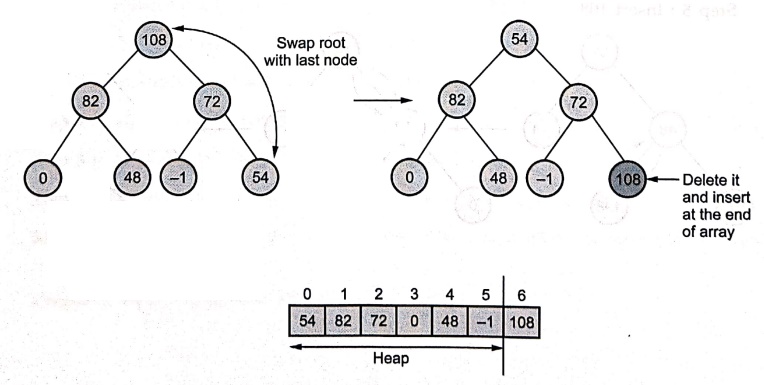
Step 1 b :
Heapify
Step 2 a :
Delete root
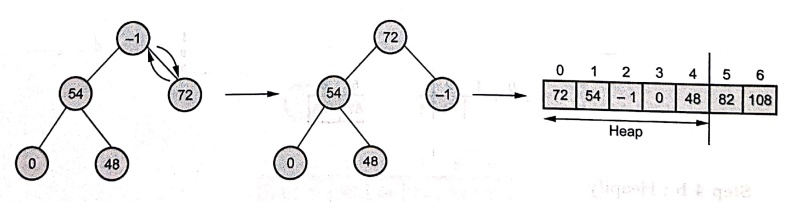
Step 2 b :
Heapify
Step 3 a :
Delete root
Step 3 b :
Heapify
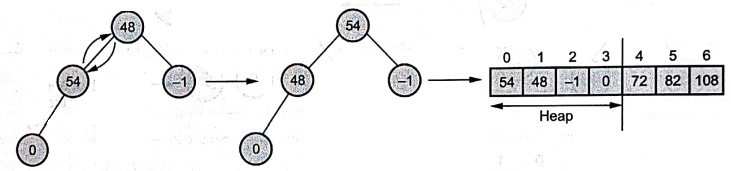
Step 4 a :
Delete root node
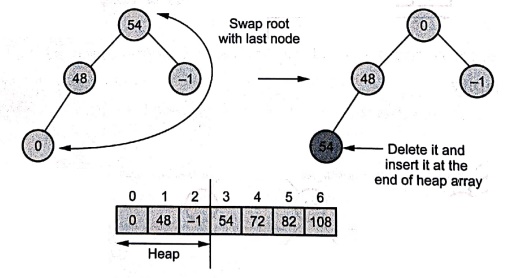
Step 4 b :
Heapify
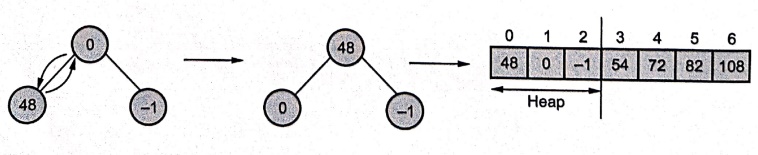
Step 5 a :
Delete root node
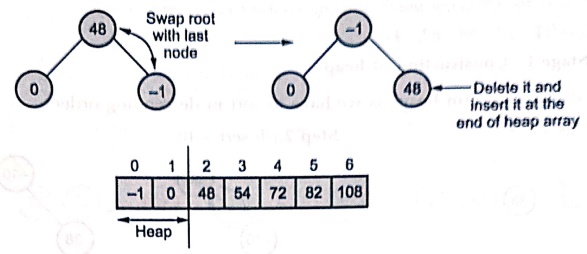
Step 5 b
: Heapify

Step 6 a :
Delete root node
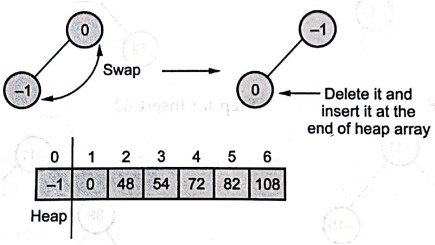
Delete
it and insert it at the end of heap array
Step 6 b :
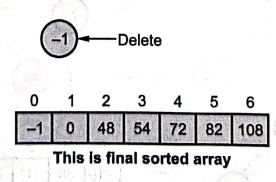
Example : 2
State algorithm to sort
elements of a given array in descending order using heapsort. Sort the
following numbers using heapsort in descending order:
38, ‒ 10, ‒ 11, 72, 98,
62, 44.
Solution :
Stage I: Construction of heap
We
will construct a min heap, as we have to sort in descending order.
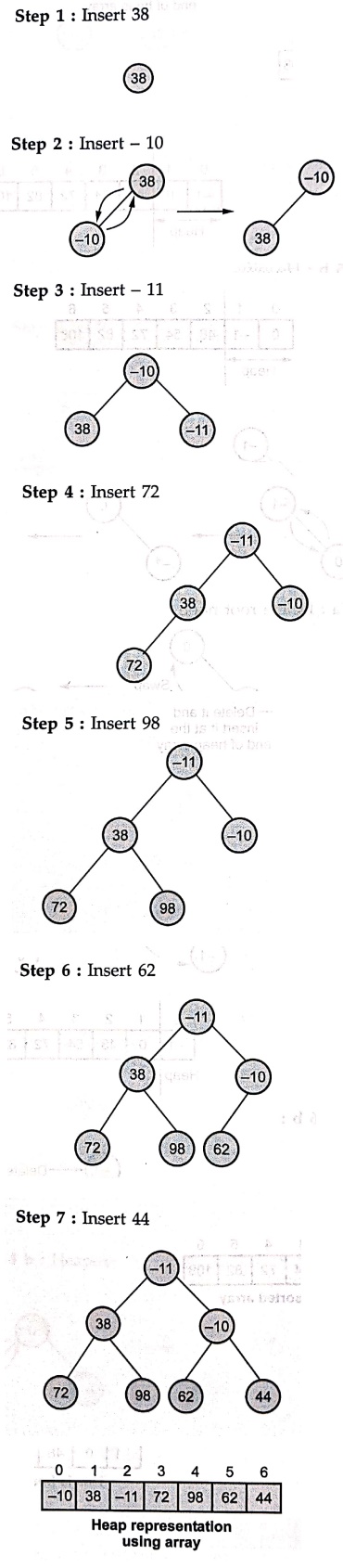
Stage II :
Deletion of root node and hepify repeatedly.
Step 1 a :
Delete root
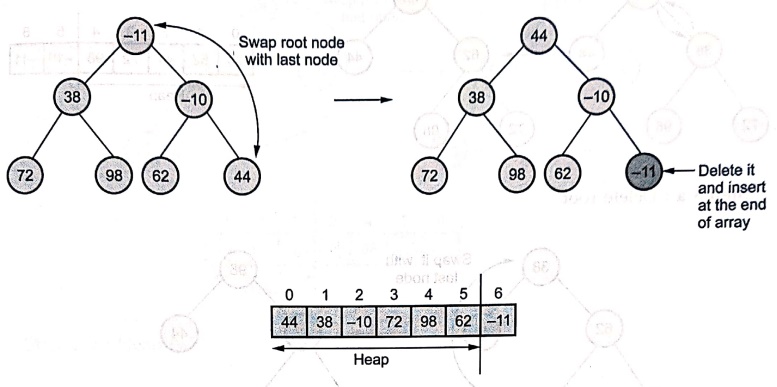
Step 1 b : Heapify
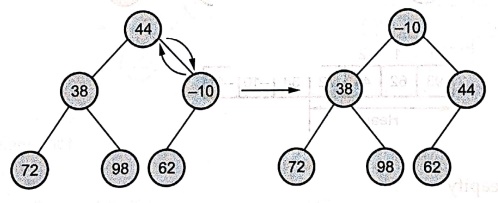
Step 2 a : Delete root
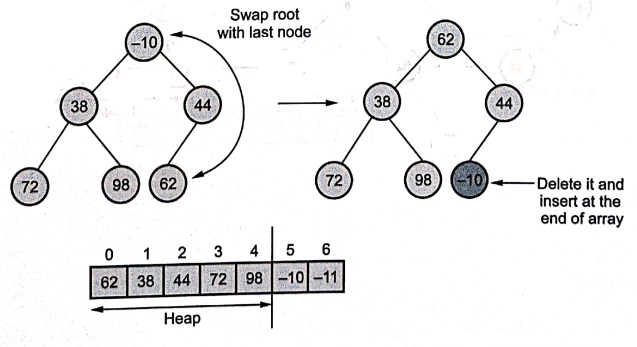
Step 2 b :
Heapify
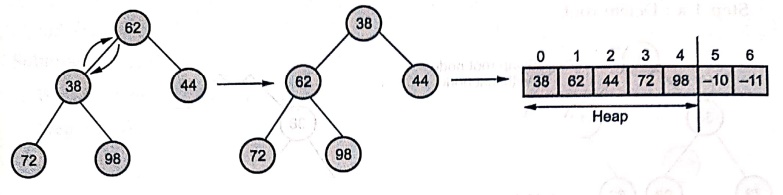
Step 3 a :
Delete root
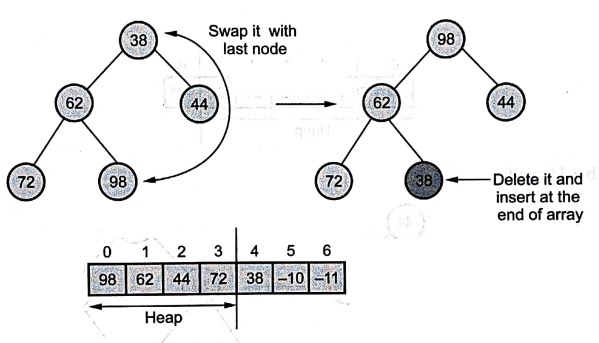
Step 3 b :
Heapify
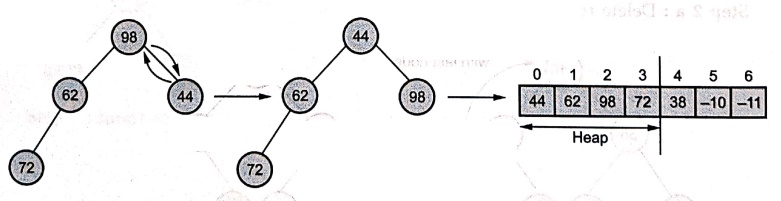
Step 4 a :
Delete root
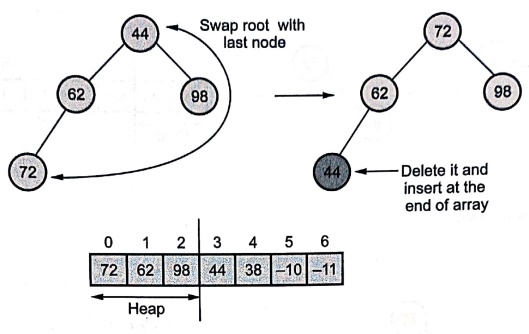
Step 4 b :
Heapify
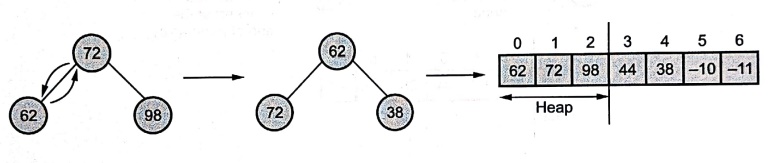
Step 5 a :
Delete root
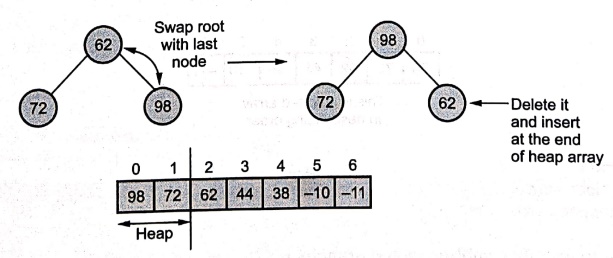
Step 5 b :
Heapify
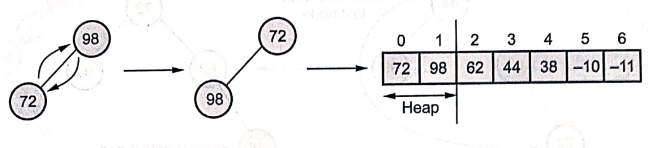
Step 6 :
Delete root
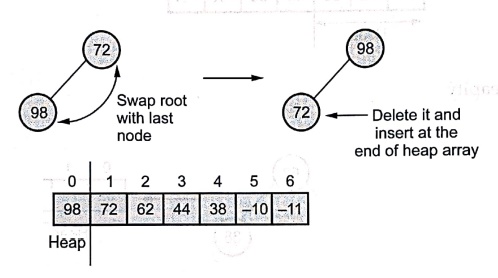
Step 7 :
Delete single node and insert at the end of heap array
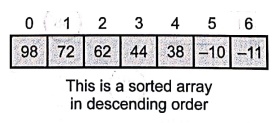
C++ Program
#include <iostream>
using namespace std;
// Function to heapify a subtree rooted at index i
void heapify(int arr[], int n, int i) {
int largest = i; //
Assume root is largest
int left = 2* i + 1; //
Left child index
int right = 2*i + 2; //
Right child index
// If left child is larger than root
if (left<n && arr[left] > arr[largest])
largest = left;
// If right child is larger than largest so far
if (right < n && arr[right]> arr[largest])
largest = right;
// If largest is not the root
if (largest != 1) {
swap(arr[i], arr[largest]);
heapify(arr, n, largest);
}
}
void heapSort(int arr[], int n) {
// Step 1: Build max
heap
for (int I = n/2 ‒ 1;
i >= 0; i‒‒)
heapify(arr, n, i);
// Step 2: One by one
extract elements from heap
for (int i = n ‒ 1; i
>= 0; i‒‒) {
// Move current root
to end
swap(arr[0],
arr[i]);
// Call heapify on
reduced heap
heapify(arr, i,
0);
}
}
int main() {
int arr[] = {38, ‒10, ‒11,
72, 98, 62, 44};
int n = sizeof(arr) /
sizeof(arr[0]);
heapSort(arr, n);
cout <<
"Sorted array: ";
for (int i = 0; i <
n; i++)
cout <<
arr[i] << " ";
cout << endl;
return 0;
}
Output
Sorted array: ‒11 ‒10
38 44 62 72 98
Analysis:
Time complexity :
The time complexity of heap sort is O(n log n).
Part I:
Recurrence relation for heapify()
If
height of the heap of h.
So
recurrence relation is ‒
T(h)
= T(h‒1) + O(1)
T(h)
= T(h− 2) + O(1) + O(1)
T(h)
= T(h‒3) + 3 . O(1)
…
T(h)
= T(0) + h. O(1)
Since
height h = log n
T(h) = O(log n)
Time
complexity of one heapify = O(log n)
Part II :
Heap building
Heap
buliding calls heapify on : n/2 nodes
Number
of nodes at height h = n/ 2h+1
Time
for each node at height h = O(h)
Total
timeT(n) = 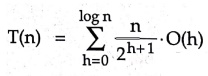
Data Structures using C PlusPlus: Chapter 9: Searching, Sorting and Complexity Analysis : Tag: Data Structure, C++ Programing : Example, Algorithm, Analysis, C++ Program - Sorting Algorithm: Heap Sort
Data Structures using C PlusPlus: Chapter 9: Searching, Sorting and Complexity Analysis
Under Subject
Data Structures using CPlusPlus
CS25C05 2nd Semester ECE Dept | 2025 Regulation | 2nd Semester 2025 Regulation
Related Subjects

English Essentials II
EN25C02 2nd Semester | 2025 Regulation | 2nd Semester 2025 Regulation

Tamils and Technology தமிழர்களும் தொழில்நுட்பமும்
UC25H02 2nd Semester | 2025 Regulation | 2nd Semester 2025 Regulation

Linear Algebra
MA25C02 2nd Semester | 2025 Regulation

Electron Devices
EC25C01 2nd Semester ECE Dept | 2025 Regulation | 2nd Semester 2025 Regulation
Data Structures using CPlusPlus
CS25C05 2nd Semester ECE Dept | 2025 Regulation | 2nd Semester 2025 Regulation

Circuits and Network Analysis
EC25C02 2nd Semester ECE Dept | 2025 Regulation | 2nd Semester 2025 Regulation

Re-Engineering for Innovation
ME25C05 2nd Semester | 2025 Regulation | 2nd Semester 2025 Regulation
Engineering Drawing - Laboratory
ME25C01 2nd Semester | 2025 Regulation | 2nd Semester 2025 Regulation
Data Structures using CPlusPlus - Laboratory
CS25C05 2nd Semester ECE Dept | 2025 Regulation | 2nd Semester 2025 Regulation
Devices and Circuits Laboratory
EC25C03 2nd Semester ECE Dept | 2025 Regulation | 2nd Semester 2025 Regulation