Data Structures using C PlusPlus: Chapter 1: Data Abstraction and Overloading
Class Scope and Accessing Class Members
Data Structures using C ++
Data Structures using C PlusPlus: Data Abstraction and Overloading: Class Scope and Accessing Class Members
Class
Scope and Accessing Class Members
•
Each class is a collection of data and functions that manipulate the data.
•
Placing the data and functions together into a single entity is the central
idea in object oriented programming.
•
The nouns in the system specification help the C++ programmer to determine the
set of classes. The objects for these classes are created. These objects work
together to implement the system.
•
Classes in C++ is the natural evolution of C notion of struct.
For example:
class rectangle
{
private:
int len,br;
public:
void get_data();
void area();
mioold0 genforeg
void print_data();
};
• Rules for declaring class name ‒
1.
The class name must begin with the letters, it may be followed by letters,
digits or underscore.
2.
The name of the class must not be same as keyword or reserved word.
3.
The class name must not contain any special character such_as_~,!,@,#,$,
%,^,&,*,(,),{,},[,],+,‒, |, /, \
Difference between Class and Object
Following
are some differences between the class and the object –
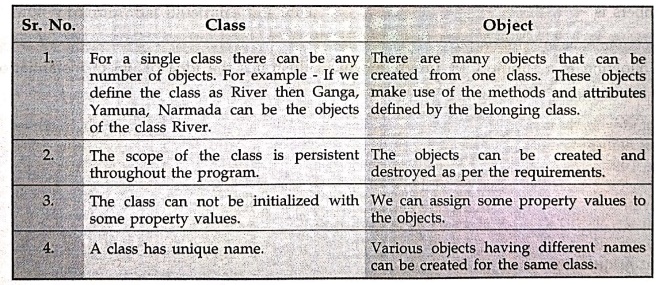
Class
1.
For a single class there can be any number of objects. For example ‒ If we
define the class as River then Ganga, Yamuna, Narmada can be the objects of the
class River.
2.
The scope of the class is persistent throughout the program.
3.
The class can not be initialized with some property values.
4.
A class has unique name.
Object
1.
There are many objects that can be created from one class. These objects make
use of the methods and attributes defined by the belonging class.
2.
The objects can be created and destroyed as per the requirements.
3.
We can assign some property values to the objects.
4. Various objects having different names can be created for the same class.
Difference between Structure and Class
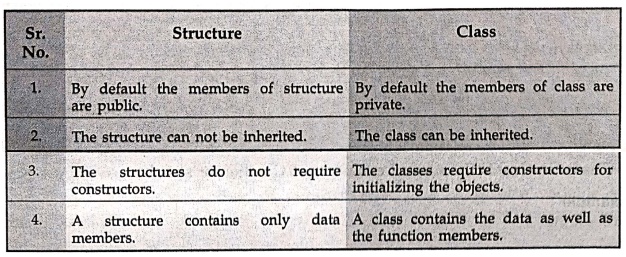
Structure
1.
By default the members of structure are are public.
2.
The structure can not be inherited.
3.
The structures do not require constructors.
4.
A structure contains only data members.
Class
1.
By default the members of class private.
2.
The class can be inherited.
3.
The classes require constructors for initializing the objects.
4.
A class contains the data as well as the function members.
1. Creating Class Objects
The
object is an instance of a class. Hence object can be created using the class
name. The object interacts with the help of procedures or the methods defined
within the class.
In
order to instantiate an object we need to declare an object along with the
class name.
For example ‒
int a; //an instance of type integer
double marks://an instance of type double
Student xyz://an instance of object xyz
2. Accessing Class Members
There
are two types of Class members –
i) Data members and
ii) Member functions
For
accessing them the object of that class is created. The syntax of accessing
class members is ‒
object_
name.class_member;
Following
is a simple C++ program which illustrates the idea of object instantiation and
interaction.
#include<iostream>
using namespace std;
class Test
{
private:
int a,b,c,
public:
int Addition(int a,
int b)
{
c=a+b;
return c;
}
void Display()
{ cout <<
"The sum is:" << c<< "\n";}
};
void main()
{
Test obj: // instantiation of object
obj.Addition(10,20);
obj.Display();
}
Output
The sum is: 30
Program Explanation
After
creating a class we can create the objects belonging to that class. This
process is called instantiation of the
object. The object can be created as a variable of type class. We can
create more than one objects belonging to the same class. In above code we have
created an object named obj. The
creation is as follows ‒
Test obj;
There
are two methods belonging to the class Test
‒ Addition and Display. Using
object obj we can pass the values 10
and 20 to the method Addition. These
values are then assigned to the variables
a and b. The addition of these
numbers is performed. The result is then stored in variable c and this variable is returned. The Display function makes use of this
variable to display the result of addition of two numbers.
Example: 1
Explain the concept of passing an array of objects as an argument
Solution:
We can pass an array of objects as an argument to the function. Following is a
simple program that illustrates this idea.
#include<iostream>
using namespace std;
class Test
{
int a;
public:
void setvalue(Test
arr[10]);
void display(Test
arr[10]);
};
void Test::setvalue(Test a[10])
{
for(int i=0; i<5;
i++)
{
a[i].a=i;
}
}
void Test::display(Test a[10])
{
for(int i=0;i<5;i++)
{
cout<<"
"<<a[i].a;
}
}
void main()
{
Test obj1[10];
Test obj2;
cout<<"\n
Setting the values";
obj2.setvalue(obj1);
cout<<"\n
The values are ";
obj2.display(obj1);
}
Output
Setting the values
The values are 0 1 2 3
4
Data Structures using C PlusPlus: Chapter 1: Data Abstraction and Overloading : Tag: Data Structure, C++, C Programing : Data Structures using C ++ - Class Scope and Accessing Class Members
Data Structures using C PlusPlus: Chapter 1: Data Abstraction and Overloading
Under Subject
Data Structures using CPlusPlus
CS25C05 2nd Semester ECE Dept | 2025 Regulation | 2nd Semester 2025 Regulation
Related Subjects

English Essentials II
EN25C02 2nd Semester | 2025 Regulation | 2nd Semester 2025 Regulation

Tamils and Technology தமிழர்களும் தொழில்நுட்பமும்
UC25H02 2nd Semester | 2025 Regulation | 2nd Semester 2025 Regulation
Linear Algebra
MA25C02 2nd Semester | 2025 Regulation

Electron Devices
EC25C01 2nd Semester ECE Dept | 2025 Regulation | 2nd Semester 2025 Regulation
Data Structures using CPlusPlus
CS25C05 2nd Semester ECE Dept | 2025 Regulation | 2nd Semester 2025 Regulation

Circuits and Network Analysis
EC25C02 2nd Semester ECE Dept | 2025 Regulation | 2nd Semester 2025 Regulation

Re-Engineering for Innovation
ME25C05 2nd Semester | 2025 Regulation | 2nd Semester 2025 Regulation
Engineering Drawing - Laboratory
ME25C01 2nd Semester | 2025 Regulation | 2nd Semester 2025 Regulation
Data Structures using CPlusPlus - Laboratory
CS25C05 2nd Semester ECE Dept | 2025 Regulation | 2nd Semester 2025 Regulation
Devices and Circuits Laboratory
EC25C03 2nd Semester ECE Dept | 2025 Regulation | 2nd Semester 2025 Regulation