Data Structures using C PlusPlus: Chapter 1: Data Abstraction and Overloading
Static Class Members
Data Structures using C ++ Program
Data Structures using C PlusPlus: Data Abstraction and Overloading: Static Class Members
Static
Class Members
A
class contains two types of static members ‒
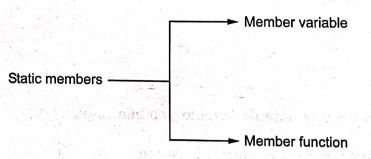
Static
members
* Member variable
* Member function
The
members of the class must be declared with the keyword static. The static data members have the same properties as that of
global variables. When we declare regular variables then multiple copies are
created for accessing them by each corresponding object but when the keyword
static is associated with any class variable then that means only single copy
of that variable must be created and all other objects must share that copy.
The static data members can be accessed without any instantiation of class as
an object. The static member functions
are not used very frequently in programs. All static variables are initialized
to zero before first object is created.
•
The syntax of static data declaration
and definition is as given below –
class
test {
private:
static int count; //declaration
…
};
int
test::count=100; //definition without instantiation of class as object
•
The static function can not refer to any non static member data in its class.
The static function can access only static and class‒specific data. The syntax
of static function is as given below ‒
class test()
{
private:
…
public:
static int
fun();//static function definition
{
}
};
void main()
{
…
test::fun(); //function
call
…
}
The
program having static class members is as given below ‒
C++ Program
#include<iostream>
using namespace std;
class count
{
private:
int
number;
static
int total; // declaration:static
data
public
count(); // initializer
int
get_number();// get a number
static
int get total(); // get total count
}:
count::count() //initialize
one count
{
number =
100 +total++;
}
int count::get_number()
// get number
{
return number;
}
int count::get_total() // get total counts
{
return
total;
}
int count::total = 0; //
definition of static data
void main()
{
clrscr();
//will
print initial count
cout
<< “Total count = " << count::get_total() << endl;
count a,
b, c,
//will
increment the count 3 times
cout
<< " a=" << a.get_number() << endl;
cout
<< " b=" << b.get_number() << endl;
cout
<< c="<< c.get number() << endl;
//will
print the final incremented count
cout
<< "Total count = " << count::get_total() << endl;
getch();
}
Output
Total count = 0
a=100
b=101
c=102
Total count = 3
Data Structures using C PlusPlus: Chapter 1: Data Abstraction and Overloading : Tag: Data Structure, C++, C Programing : Data Structures using C ++ Program - Static Class Members
Data Structures using C PlusPlus: Chapter 1: Data Abstraction and Overloading
Under Subject
Data Structures using CPlusPlus
CS25C05 2nd Semester ECE Dept | 2025 Regulation | 2nd Semester 2025 Regulation
Related Subjects

English Essentials II
EN25C02 2nd Semester | 2025 Regulation | 2nd Semester 2025 Regulation

Tamils and Technology தமிழர்களும் தொழில்நுட்பமும்
UC25H02 2nd Semester | 2025 Regulation | 2nd Semester 2025 Regulation
Linear Algebra
MA25C02 2nd Semester | 2025 Regulation

Electron Devices
EC25C01 2nd Semester ECE Dept | 2025 Regulation | 2nd Semester 2025 Regulation
Data Structures using CPlusPlus
CS25C05 2nd Semester ECE Dept | 2025 Regulation | 2nd Semester 2025 Regulation

Circuits and Network Analysis
EC25C02 2nd Semester ECE Dept | 2025 Regulation | 2nd Semester 2025 Regulation

Re-Engineering for Innovation
ME25C05 2nd Semester | 2025 Regulation | 2nd Semester 2025 Regulation
Engineering Drawing - Laboratory
ME25C01 2nd Semester | 2025 Regulation | 2nd Semester 2025 Regulation
Data Structures using CPlusPlus - Laboratory
CS25C05 2nd Semester ECE Dept | 2025 Regulation | 2nd Semester 2025 Regulation
Devices and Circuits Laboratory
EC25C03 2nd Semester ECE Dept | 2025 Regulation | 2nd Semester 2025 Regulation