Data Structures using C PlusPlus: Chapter 1: Data Abstraction and Overloading
Member Functions and Classes
Data Structures using C ++ Program
Question: Give the syntax and use of the reserved word inline with two examples.
Member
Functions and Classes
1. Defining Member Functions Inside the Class
The
class can contain the definition of the member functions. Usually these methods
are defined as the public. Following
program shows how to define the member functions inside the class.
#include<iostream>
using namespace std;
class Test
{
private:
int a,b;
public:
// Member
functions defined inside the class.
void
get_data()
{
cout<<"\n Enter the first number:
";
cin>>a;
cout<<"\n Enter the second
number: ";
cin>>b;
}
void
sum()
{
int c;
c=a+b;
cout<<"\n Sum of two numbers is:
"<<c;
}
};
void main()
{
Test obj;
obj.get_data();
obj.sum();
}
Output
Enter the first
number: 10
Enter the second
number: 20
Sum of two numbers is:
30
Note
that the above defined functions are belonging to the class Test. Hence the data members of this
class can be accessed by the methods defined within the Test class. That means the methods get_data and sum can
access the variables a and b. If we define another class say Test1 then this class methods can not
access variables a and b
Following
program will raise error!!
#include<iostream>
using namespace std;
class Test
{
private:
int a,b;
public:
void get_data()
{
cout<<"\n
Enter the first number: ";
cin>>a;
cout<<"\n
Enter the second number: ";
cin>>b;
}
void sum()
{
int c;
c=a+b;
cout<<"\n
Sum of two numbers is: "<<c;
}
};
class Test1
{
int x;
void mul() // This method
can not access the variables a and b of class Test
{
int c;
c=x*a;
}
};
void main()
{
Test obj;
Test1
obj1;
obj.get_data();
obj.sum();
obj1,mul();
}
Example: 1
Implement ATM
transaction in C++.
Solution
:
#include<iostream>
using namespace std;
class ATM
{
private:
double
balance,withdraw,deposit;
public:
void init()
{
balance =1000;
// Minimum required balance
}
void withdrawal()
{
cout
<< "\n Enter the amount to be withdrawn ";
cin>>
withdraw;
if
(withdraw >= 1000)
cout<<"\n
Insufficient balance!!!";
else
balance =
balance ‒ withdraw;
}
void deposition()
{
cout
<< "\n Enter the amount to be deposited: ";
cin
>> deposit;
balance =
balance + deposit;
}
void display()
{
cout<<"\n
Balance Amount: "<<balance;
}
};
void main()
{
char ans
= 'y';
int
choice;
ATM obj;
obj.init();
do
{
cout<<"\n
Main Menu":
cout
<< "\n 1. Withdraw \n 2. Deposit \n 3. Show Balance ";
cout
<< "\n Enter your choice: ";
cin >>
choice:
switch
(choice)
{
case
1:obj.withdrawal();
break;
case
2:obj.deposition();
break;
case
3:obj.display();
break;
}
cout<<"\n
Do you want to continue?";
cin
>> ans;
} while (ans == 'y');
}
Output
Main Menu
1. Withdraw
2. Deposit
3. Show Balance
Enter your choice: 1
Enter the amount to be
withdrawn 100
Do you want to
continue? y
Main Menu
1. Withdraw
2. Deposit
3. Show Balance
Enter your choice: 3
Balance Amount: 900
Do you want to
continue? y
Main Menu
1. Withdraw
2. Deposit
3. Show Balance
Enter your choice: 2
Enter the amount to be
deposited: 500
Do you want to
continue? y
Main Menu
1. Withdraw
2. Deposit
3. Show Balance
Enter your choice: 3
Balance Amount: 1400
Do you want to
continue?n
2. Defining Member Functions Outside the Class
The
members functions that needs to be defined outside the class are defined using
the scope resolution operator. Following program illustrates it
/*********************************************************************
Program that uses a class where the member functions are defined
outside a class
**********************************************************************/
#include<iostream>
using namespace std;
class Test
{
private:
int
a,b,c;
public:
int
Addition(int,int);
void
Display();
};
int Test::Addition(int a, int b)
{
c=a+b;
return c;
}
void Test::Display()
{ cout<"The sum is:" <c< "\n";}
void main()
{
Test obj;
obj.Addition(10,20);
obj.Display();
}
Output
The sum is:30
Example: 2
Write a menu‒driven
program to accept 2 integers and an operator (+,‒,*,%,/) and to perform the
operation and print the result.
Solution:
#include<iostream>
using namespace std;
class Test
{
int a,b,c
public:
void get
input();
void
addition();
void
multiplication();
void
division();
void
subtraction();
void mod();
};
void Test::get_input()
{
cout<<"\n
Enter first number";
cin>a;
cout<<"\n
Enter second number";
cin>b;
}
void Test::addition()
{
c=a+b;
cout<<"\n
The addition of two numbers is "<<c;
}
void Test::multiplication()
{
c=a*b;
cout<<"\n
The multiplication of two numbers is "<<c;
}
void Test::subtraction()
{
c=a‒b;
cout<<"\n
The subtraction of two numbers is "<<c;
}
void Test::division()
{
c=a/b;
cout<<"\n
The division of two numbers is "<<c;
}
void Test::mod()
{
c‒a%b;
cout<<"\n
The mod of two numbers is "<<c;
}
void main()
{
Test obj;
char opr
char
ans='y';
do
{
cout<<"\n
1. + \n 2. ‒ \n 3. * \n 4. / \n 5. %";
cout<<"\n
Enter your choice":
cin>>opr;
switch(opr)
{
case
'+':obj.get_input();
obj.addition();
break;
case '*':obj.get_input();
obj.multiplication();
break;
case '‒':obj.get_input();
obj.subtraction();
break;
case '/':obj.get_input();
obj.division();
break;
case
'%':obj.get_input();
obj.mod();
break;
}
cout<<"\n
Do you want to continue?";
cin>>ans;
}while(ans=='y');
}
3. Inline Functions
When
we define a function normally the compiler makes a copy of that definition in
the memory. And when a call to that function is made the compiler jumps to
those copied instructions and when the function returns, the execution resumes
from the next line in the calling function. Hence if we make a call to that
function for 5 times then each time the copied block of function in the memory
will be referred by the compiler. This also means that there is only one copy
of the function definition in the memory and on each call to that function the
same copy is referred.
Now
if there are many calls to that function and function contains very few lines
of code then such a jumping to memory becomes a performance overhead for the
compiler. It ultimately slows down the execution of the program. Hence the
solution is to make the function inline.
Definition :
The inline function is a function
whose code is copied in place of each function call. The inline specifies that
the compiler should insert the complete body of function in every context where
the function is used.
For
the inline function if the function is called for 5 times then for 5 times the
code of the function is copied to the calling function and hence no jump is
made to the memory. This improves the performance but increases the memory size
because of the made on each call.
The
fact is that if the function definition contains very few lines of code then
making the function inline is always preferred otherwise it is not at all
preferred to make the function inline because large code gets copied many times
and large amount of space will be wasted by storage of the same code.
C++
Program
#include<iostream>
using namespace std;
inline int sum(int x,int y)
{
return
(x+y);
}
void main()
{
int a,b;
a=10;
b=20;
cout<<"The
sum is "<<sum(a,b);
}
Output
The sum is 30
Difference between inline function and macro
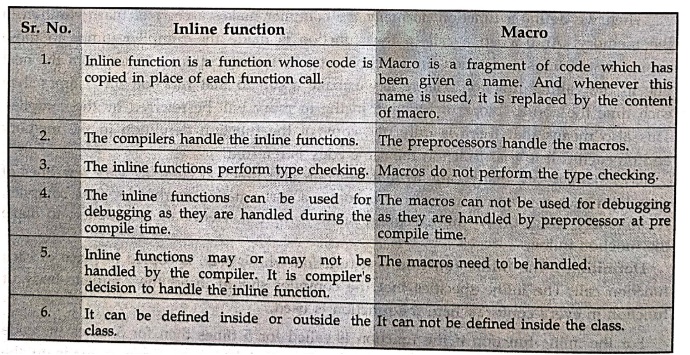
Inline function
1.
Inline function is a function whose code is copied in place of each function
call.
2.
The compilers handle the inline functions.
3.
The inline functions perform type checking.
4.
The inline functions can be used for debugging as they are handled during the compile
time.
5.
Inline functions may or may not be handled by the compiler. It is compiler's decision
to handle the inline function.
6.
It can be defined inside or outside the class.
Macro
1.
Macro is a fragment of code which has been given a name. And whenever this name
is used, it is replaced by the content of macro.
2.
The preprocessors handle the macros.
3.
Macros do not perform the type checking.
4.
The macros can not be used for debugging as they are handled by preprocessor at
pre compile time.
5.
The macros need to be handled.
6.
It can not be defined inside the class.
Review Question
1. Give the syntax and
use of the reserved word inline with two examples.
Data Structures using C PlusPlus: Chapter 1: Data Abstraction and Overloading : Tag: Data Structure, C++, C Programing : Data Structures using C ++ Program - Member Functions and Classes
Data Structures using C PlusPlus: Chapter 1: Data Abstraction and Overloading
Under Subject
Data Structures using CPlusPlus
CS25C05 2nd Semester ECE Dept | 2025 Regulation | 2nd Semester 2025 Regulation
Related Subjects

English Essentials II
EN25C02 2nd Semester | 2025 Regulation | 2nd Semester 2025 Regulation

Tamils and Technology தமிழர்களும் தொழில்நுட்பமும்
UC25H02 2nd Semester | 2025 Regulation | 2nd Semester 2025 Regulation
Linear Algebra
MA25C02 2nd Semester | 2025 Regulation

Electron Devices
EC25C01 2nd Semester ECE Dept | 2025 Regulation | 2nd Semester 2025 Regulation
Data Structures using CPlusPlus
CS25C05 2nd Semester ECE Dept | 2025 Regulation | 2nd Semester 2025 Regulation

Circuits and Network Analysis
EC25C02 2nd Semester ECE Dept | 2025 Regulation | 2nd Semester 2025 Regulation

Re-Engineering for Innovation
ME25C05 2nd Semester | 2025 Regulation | 2nd Semester 2025 Regulation
Engineering Drawing - Laboratory
ME25C01 2nd Semester | 2025 Regulation | 2nd Semester 2025 Regulation
Data Structures using CPlusPlus - Laboratory
CS25C05 2nd Semester ECE Dept | 2025 Regulation | 2nd Semester 2025 Regulation
Devices and Circuits Laboratory
EC25C03 2nd Semester ECE Dept | 2025 Regulation | 2nd Semester 2025 Regulation