Applied Chemistry I: UNIT 3: Electrochemistry
Electrode Potential of Some Metals with respect to SHE (or) Electrochemical Series (or) EMF Series
Significance of emf series (or) Applications of electrochemical series (or) Applications of Nernst equation (or) Importance of electrode potential
ELECTRODE POTENTIAL OF SOME METALS
WITH RESPECT TO SHE OR ELECTROCHEMICAL SERIES OR EMF SERIES
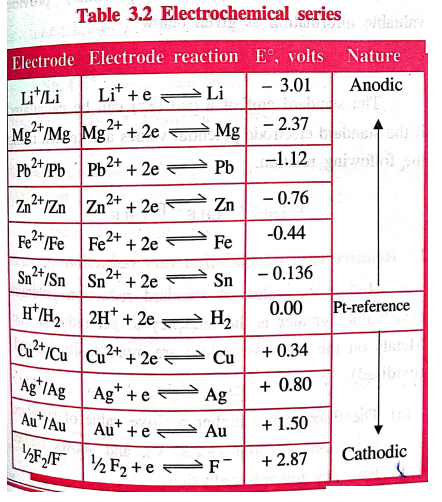
The standard electrode
potential (reduction) of a number of electrodes are given in table 3.2. This
values are determined potentiometrically by combining the electrode with the
another standard electrodes, whose electrode potential is zero.
Table 3.2
Electrochemical series
Definition
When various electrodes
(metals) are arranged the order of their increasing values of standard
reduction potential on the hydrogen scale, then the arrangement is called
electrochemical series.
Significance of emf
series (or) Applications of electrochemical series (or) Applications of Nernst
equation (or) Importance of electrode potential
The emf series
(electrode potential) provide valuable information as given below.
1. Calculation of standard emf of the cell
The standard emf of a
cell (E°) can be calculated if the standard electrode potential values are
known using the following relation.
E°cell = E°R.H.E
‒ E°L.H.E
2. Relative ease of oxidation (or) reduction
Higher the value of
standard reduction potential (+ve value) greater is the tendency to get
reduced. (i.e. Metals on the top (‒ve value) are more easily ionised) (oxidised).
(a) The fluorine has
higher positive value of standard reduction potential (+2.87 V), and shows
higher tendency towards reduction.
(b) The lithium has
highest negative value (‒3.01 V) and shows higher tendency towards oxidation.
3. Displacement of one element by the other
Metals which lie higher
in the emf series can displace those elements which lie below them in the series.
For example, we may
know whether Cu will displace Zn from the solution or vice‒versa. We know that
standard reduction potential of Cu & Zn.
i.e., E°Cu2+/Cu
= +0.34 V and E°zn2+/Zn = ‒0.76 V.
So, Cu2+ has
a great tendency to acquire Cu form, than Zn2+ has for acquiring Zn
form.
4. Determination of standard free energy change (ΔG) and equilibrium constant for the reaction
Standard electrode
potential can also be used to determine the standard free energy change (ΔG)
and equilibrium constant (K) for the reaction. We know that
‒ ΔG° = RT ln K = 2.303
RT log K
log K = [ ‒ ΔG° ]
/ [ 12.303 RT ]
= nFE° / 2.303RT
[∴
ΔG° = nFE° ]
From the value of E°,
the equilibrium constant for the cell reaction can be calculated.
5. Hydrogen displacement behaviour
Metals with negative
reduction potential (i.e., the metals placed above H2 in the emf
series) will displace the hydrogen from an acid solution.
Example
Zinc reacts with dil H2SO4
to give H2 but Ag does not why?
Zn + H2SO4
→ ZnSO4 + H2 ↑
E°Zn = ‒ 0.76
volt
The metal with positive
reduction potential (ie., the metals placed below H2 in the emf
series) will not displace the hydrogen from an acid solution.
Ag + H2SO4 → No reaction
E°Ag = +0.80
volt
6. Predicting Spontaneity (or) feasibility of Redox Reactions
Spontaneity of redox
reaction can be predicted from the emf (E°) value of the complete cell reaction
(ΔG = ‒nFE°).
(i) If E° of the cell
is positive, the reaction is spontaneous (or) feasible (ΔG = ‒ve).
(ii) If E° of the cell
is negative, the reaction is not spontaneous (or) not feasible
(AG = +ve).
In general, an element
having lower reduction potential can displace another metal having higher
reduction potential from its salt solution spontaneously.
Applied Chemistry I: UNIT 3: Electrochemistry : Tag: Applied Chemistry : - Electrode Potential of Some Metals with respect to SHE (or) Electrochemical Series (or) EMF Series
Applied Chemistry I: UNIT 3: Electrochemistry
Under Subject

Applied Chemistry I
CY25C01 1st Semester | 2025 Regulation | 1st Semester 2025 Regulation
Related Subjects

English Essentials I
EN25C01 1st Semester | 2025 Regulation | 1st Semester 2025 Regulation

தமிழர் மரபு - Heritage of Tamils
UC25H01 1st Semester | 2025 Regulation | 1st Semester 2025 Regulation

Applied Calculus
MA25C01 Maths 1 M1 - 1st Semester | 2025 Regulation | 1st Semester 2025 Regulation
Applied Physics I
PH25C01 1st Semester | 2025 Regulation | 1st Semester 2025 Regulation
Applied Chemistry I
CY25C01 1st Semester | 2025 Regulation | 1st Semester 2025 Regulation

Makerspace
ME25C04 1st Semester | 2025 Regulation | 1st Semester 2025 Regulation

Computer Programming C
CS25C01 1st Semester | 2025 Regulation | 1st Semester 2025 Regulation

Computer Programming Python
CS25C02 1st Semester | 2025 Regulation | 1st Semester 2025 Regulation
Fundamentals of Electrical and Electronics Engineering
EE25C03 1st Semester | 2025 Regulation | 1st Semester 2025 Regulation

Introduction to Mechanical Engineering
ME25C03 1st Semester | 2025 Regulation | 1st Semester 2025 Regulation

Introduction to Civil Engineering
CE25C01 1st Semester Civil Department | 2025 Regulation | 1st Semester 2025 Regulation

Essentials of Computing
CS25C03 1st Semester - AID CSE IT Department | 2025 Regulation | 1st Semester 2025 Regulation

Applied Physics I Laboratory
PH25C01 1st Semester practical Laboratory Manual | 2025 Regulation | 1st Semester Laboratory 2025 Regulation

Applied Chemistry I Laboratory
CY25C01 1st Semester practical Laboratory Manual | 2025 Regulation | 1st Semester Laboratory 2025 Regulation

Computer Programming C Laboratory
CS25C01 1st Semester practical Laboratory Manual | 2025 Regulation | 1st Semester Laboratory 2025 Regulation

Computer Programming Python Laboratory
CS25C02 1st Semester practical Laboratory Manual | 2025 Regulation | 1st Semester Laboratory 2025 Regulation

Engineering Drawing
ME25C01 EEE Mech Dept | 2025 Regulation | 2nd Semester 2025 Regulation

Basic Electronics and Electrical Engineering
EE25C04 1st Semester ECE Dept | 2025 Regulation | 2nd Semester 2025 Regulation