Applied Chemistry I: UNIT 3: Electrochemistry
EMF of a Cell
Electromotive force is defined as, "the difference of potential which causes flow of current from one electrode of higher potential to the other electrode of lower potential.
EMF OF A CELL
Definition
Electromotive force is
defined as, "the difference of potential which causes flow of current from
one electrode of higher potential to the other electrode of lower potential.
Thus, the emf of a
galvanic cell can be calculated using the following relationship.
EMF = { Standard
reduction potential of right hand side electrode } ‒ { Standard reduction
potential of left hand side electrode }
E°cell = E°right
‒ E°left
Example
Nernst equation for emf of a cell
The Daniel cell can be
represented as
Zn(s)/Zn2+
(1M) // Cu2+(1M) / Cu
The cell reaction is
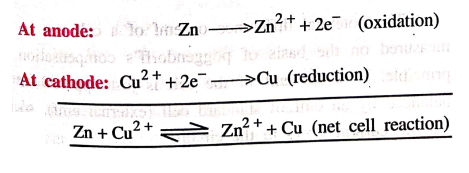
The Emf of the cell is
given as
Ecell = ECu
‒ EZn ………...
(1)
We know that,
the Nernst equation for
reduction potential of Cu
ECu = E°Cu
+ 0.0591/2 log [Cu2+] ………….(2)
Similarly, the Nernst
equation for reduction potential of Zn.
EZn = E°Zn
+ 0.0591/2 log [Zn2+] ………….(3)
Substituting equation 2
& 3 in 1, we get,
Ecell = ( E°Cu2+/Cu
‒ E°Zn2+/Zn ) + 0.0591/2 log ( [Cu2+]/[Zn2+] )

This is the Nernst
equation for emf of a daniel cell
1. Measurement of emf of a cell
The potential
difference or emf of a cell can be measured on the basis of poggendorff's
compensation principle. Here the emf of the cell is just opposed or balanced by
an emf of standard cell (external emf), so that no current flows in the
circuit.

Fig.
3.7 Potentiometer for the measurement of emf
The potentiometer
consists of a uniform wire AB (Fig. 3.7). A storage battery (K) is connected to
the ends A and B of the wire through a rheostat (R). The cell of unknown emf (x) is connected in the circuit by
connecting its positive pole to A and the negative pole is connected to a
sliding contact (D) through a galvanometer G. The sliding contact is freely
moved along the wire AB till no current flows through the galvanometer. Then
the distance AD is measured. The emf of unknown cell is directly proportional
to the distance AD.
Ex ∝ AD
Then the unknown cell (x) is replaced by a standard cell (s) in the circuit. The sliding contact
is again moved till there is null deflection in the galvanometer. Then the
distance AD' is measured.
The emf of standard
cell Es is directly proportional to the distance AD'.
Es ∝
AD'
Then, the emf of the
unknown cell can be calculated from the following equation.
Emf of the unknown cell
x / Emf of the standard cell s = Length
AD / Length AD'
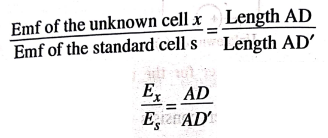
Ex/ Es = AD / AD'
Emf of the unknown cell = Ex = [ AD / AD' ]× Ex
2. Factors affecting emf of a cell
1. Nature of the
electrolytes and electrodes.
2. Concentration and
composition of the electrolytes.
3. pH and temperature of the solution.
3. Applications of emf measurements
1. Determination of standard free energy change and equilibrium constant.
(i) The standard free energy
change of a reaction can be calculated as follows
‒ΔG° = nFE°,
where,
n=Number of electrons
involved;
F = 96,500 coulombs ;
E°= Standard emf of the
cell.
(ii) The equilibrium
constant of a reaction can be calculated as follows:
E° = (0.0591/n) log K
E° = Standardemf of the
cell;
K = Equilibrium constant
2. Determination of pH by using a standard hydrogen electrode.
A hydrogen electrode is
introduced into the solution, pH of which is to be determined. It is then
coupled with a standard hydrogen electrode through the salt bridge and the emf
of the cell is measured. If E is the emf of the cell,
E = [ ‒2.303RT/nF ] log [H+]
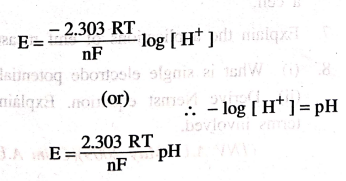
E = 2.303RT/nF
. pH
∴
‒ log [H+] = pH
From the above equation
the hydrogen ion concentration or the pH of the solution can be calculated.
3.
Solubility of a sparingly soluble salt can be determined.
4.
Valency of an ion can be determined.
5.
Potentiometric titrations can be carried out.
6.
Hydrolysis constant can also be determined,
Applied Chemistry I: UNIT 3: Electrochemistry : Tag: Applied Chemistry : - EMF of a Cell
Applied Chemistry I: UNIT 3: Electrochemistry
Under Subject

Applied Chemistry I
CY25C01 1st Semester | 2025 Regulation | 1st Semester 2025 Regulation
Related Subjects

English Essentials I
EN25C01 1st Semester | 2025 Regulation | 1st Semester 2025 Regulation

தமிழர் மரபு - Heritage of Tamils
UC25H01 1st Semester | 2025 Regulation | 1st Semester 2025 Regulation

Applied Calculus
MA25C01 Maths 1 M1 - 1st Semester | 2025 Regulation | 1st Semester 2025 Regulation

Applied Physics I
PH25C01 1st Semester | 2025 Regulation | 1st Semester 2025 Regulation
Applied Chemistry I
CY25C01 1st Semester | 2025 Regulation | 1st Semester 2025 Regulation

Makerspace
ME25C04 1st Semester | 2025 Regulation | 1st Semester 2025 Regulation

Computer Programming C
CS25C01 1st Semester | 2025 Regulation | 1st Semester 2025 Regulation

Computer Programming Python
CS25C02 1st Semester | 2025 Regulation | 1st Semester 2025 Regulation

Fundamentals of Electrical and Electronics Engineering
EE25C03 1st Semester | 2025 Regulation | 1st Semester 2025 Regulation

Introduction to Mechanical Engineering
ME25C03 1st Semester | 2025 Regulation | 1st Semester 2025 Regulation

Introduction to Civil Engineering
CE25C01 1st Semester Civil Department | 2025 Regulation | 1st Semester 2025 Regulation
Essentials of Computing
CS25C03 1st Semester - AID CSE IT Department | 2025 Regulation | 1st Semester 2025 Regulation

Applied Physics I Laboratory
PH25C01 1st Semester practical Laboratory Manual | 2025 Regulation | 1st Semester Laboratory 2025 Regulation

Applied Chemistry I Laboratory
CY25C01 1st Semester practical Laboratory Manual | 2025 Regulation | 1st Semester Laboratory 2025 Regulation

Computer Programming C Laboratory
CS25C01 1st Semester practical Laboratory Manual | 2025 Regulation | 1st Semester Laboratory 2025 Regulation

Computer Programming Python Laboratory
CS25C02 1st Semester practical Laboratory Manual | 2025 Regulation | 1st Semester Laboratory 2025 Regulation
Engineering Drawing
ME25C01 EEE Mech Dept | 2025 Regulation | 2nd Semester 2025 Regulation

Basic Electronics and Electrical Engineering
EE25C04 1st Semester ECE Dept | 2025 Regulation | 2nd Semester 2025 Regulation