Applied Physics I: Chapter 6: Oscillations and Waves - Electromagnetic Waves
Electromagnetic Waves: Basic Definitions and Fundamental Laws
Let us discuss some of the basic definitions which govern the electric field viz.
BASIC
DEFINITIONS AND FUNDAMENTAL LAWS
Definitions Governing Electric Field
Let
us discuss some of the basic definitions which govern the electric field viz.
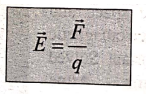
1. Electric field
intensity ( )
)
It
is defined as the ratio of electrostatic Force (field exerted) to the electric
charge.
Unit
for electric intensity: newton/coulomb
2. Electric
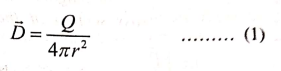
Displacement Vector ( )
)
It
is defined as the electric flux (Q) per unit area. It is also known as Electric
flux density.
Electric
displacement vector is a quantity which is used for analysing electrostatic
fields in the presence of dielectrics, which is given by
We
know that electric field intensity
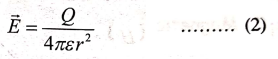
Comparing
equations (1) and (2), we get

3. Electrical permittivity (ε)
It
is defined as the ratio of displacement current () to the electric field
intensity ().
Electrical
permittivity 
Unit
for electrical permittivity: C2N‒1m‒2
4. Dielectric constant
(or) Relative permittivity (εr)
It is defined the ratio of permittivity of the medium (ε) to the permittivity of free space (or) vacuum (ε0).
Relative
permittivity εr = ε / ε0
(or)
ε
= ε0εr
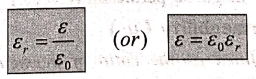
where
ε0 is the permittivity in free space or vacuum and its value ε0
= 8.854×10‒12 C2N‒1m‒2.
Definitions Governing Magnetic Field
Let
us discuss some of the basic definitions which govern the magnetic field viz.,
1. Magnetic flux
density ( )
)
It
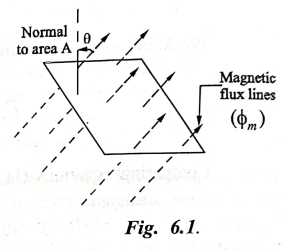
is defined as the number of magnetic flux lines of force (ϕm)
passing normally through unit area of cross section at that point as shown Fig.
6.1.

Unit
for magnetic flux density: weber/m2
2. Magnetic field
intensity ( )
)
It
is defined as the force experienced by a unit north pole placed at the given point
in a magnetic field.

Unit
for magnetic field intensity: ampere/m
3. Magnetic permeability (μ)
It
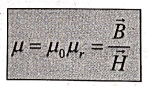
is defined as ratio of magnetic flux density ( ) to the magnetic field
intensity ().
) to the magnetic field
intensity ().
Magnetic
permeability = μ = μ0μr
It
is the measure of degrees at which the lines of force can penetrate through the
material.
Unit
for magnetic permeability: Ns2C‒2
4. Relative permeability (μr)
It
is defined as the ratio of permeability of the medium (μ) to the permeability
of free space (or) vacuum (μ0).
Relative
permeability μr = μ / μ0
μ
= μ0μr
Where
μ0 is the permeability in free space or vacuum and its value is μ0
= 4π×10‒7 Ns2C‒2.
Laws & Theorems Governing Electromagnetic Field
Let
us discuss some of the important laws and theorems that govern the
electromagnetic field viz.,
1. Gauss law for electric field
Gauss
law for electric field states that, the total flux through any closed surface
is equal to 1/ε0 times of the total charge (Q) enclosed in the
surface.
i.e., 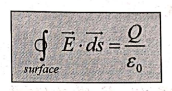
2. Faraday's law
Faraday's
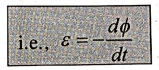
Law states that, the induced electromotive force (ɛ) in a coil is equal to the
rate of change of the magnetic flux (ϕ) linking the coil.
i.e.,
ε = ‒ dϕ/dt
The
negative sign implies the decrease in magnetic flux.
3. Ampere's circuit law
Ampere's
circuit law states that, the line integral of magnetic field ()
surrounding any closed path is equal to μ0 times of net current (I)
passing through that path.
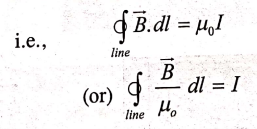
Since  , we can write the above equation as
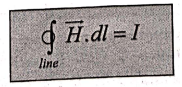
4. Gauss law for magnetic field
Gauss
law for magnetic field states that the magnetic flux () passing
through the closed surface is equal to zero.
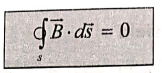
5. Divergence
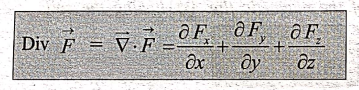
Divergence
is the amount of spreading out of a vector from the point (source) as shown in
Fig. 6.2.
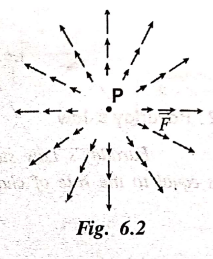
Definition
The
divergence of a vector  at a point 'P' is defined as the change of
vector (expansion) per unit volume as volume shrinks to zero about P
at a point 'P' is defined as the change of
vector (expansion) per unit volume as volume shrinks to zero about P
6. Curl
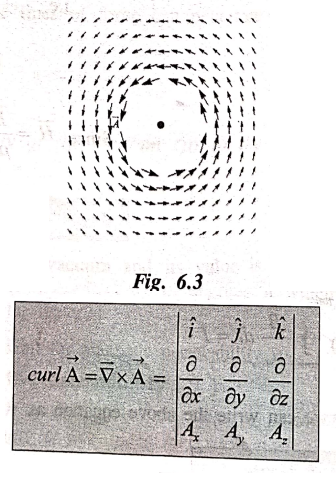
The
measure of twist of the vector with respect to a point is called curl.
Definition
The
curl of a vector  at a point is defined as the amount of twisting
(circulation) per unit area around that point as shown in Fig. 6.3.
at a point is defined as the amount of twisting
(circulation) per unit area around that point as shown in Fig. 6.3.
Note:
The Divergence and Curl together shall be represented by the vector identity  .
.
7. Gauss divergence theorem
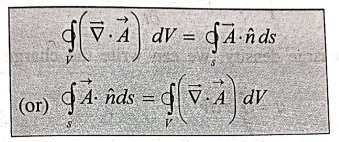
Theorem
It
states that, "the volume integral of divergence of a vector  is
equal to the vector that spreads out through the surface which
covers the volume (V).
is
equal to the vector that spreads out through the surface which
covers the volume (V).
Note:
Gauss
divergence theorem is used to convert surface integral to volume integral and
vice‒versa.
8. Stoke's Theorem
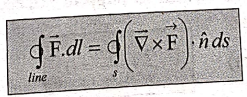
Theorem
It
states that, "the line integral of a vector around a closed
contour (line) is equal to the surface integral of curl over the region which
is bounded by the contour."
Note:
Stoke's theorem is used to convert line integral to surface integral and vice‒versa.
9. Equation of continuity
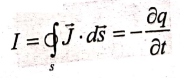
Let
us consider a closed surface enclosing a charge q. There exists an outward flow
of current given by
 ............(1)
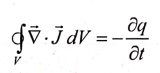
From
Gauss divergence theorem, surface integral is converted into volume integral
 ............(2)
Comparing
eqn (1) and (2) we get
 ............(3)
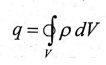
If
ρ is volume charge density, we can write the charge 'q' as
 ............(4)
Substituting
equation (4) in equation (3), we get
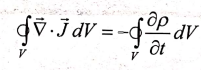
The
two volume integrals are equal only if their integrands are equal
Equation
(5) becomes
 ............(6)
Equation
(6) represents the equation of continuity.
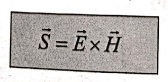
10. Poynting vector
Poynting
vector is defined as the amount of energy flow of electromagnetic wave per unit
area per unit time along the wave propagation direction. It is denoted by  and is given by
Applied Physics I: Chapter 6: Oscillations and Waves - Electromagnetic Waves : Tag: Applied Physics : - Electromagnetic Waves: Basic Definitions and Fundamental Laws
Applied Physics I: Chapter 6: Oscillations and Waves - Electromagnetic Waves
Under Subject

Applied Physics I
PH25C01 1st Semester | 2025 Regulation | 1st Semester 2025 Regulation
Related Subjects

English Essentials I
EN25C01 1st Semester | 2025 Regulation | 1st Semester 2025 Regulation

தமிழர் மரபு - Heritage of Tamils
UC25H01 1st Semester | 2025 Regulation | 1st Semester 2025 Regulation

Applied Calculus
MA25C01 Maths 1 M1 - 1st Semester | 2025 Regulation | 1st Semester 2025 Regulation
Applied Physics I
PH25C01 1st Semester | 2025 Regulation | 1st Semester 2025 Regulation

Applied Chemistry I
CY25C01 1st Semester | 2025 Regulation | 1st Semester 2025 Regulation

Makerspace
ME25C04 1st Semester | 2025 Regulation | 1st Semester 2025 Regulation

Computer Programming C
CS25C01 1st Semester | 2025 Regulation | 1st Semester 2025 Regulation

Computer Programming Python
CS25C02 1st Semester | 2025 Regulation | 1st Semester 2025 Regulation
Fundamentals of Electrical and Electronics Engineering
EE25C03 1st Semester | 2025 Regulation | 1st Semester 2025 Regulation

Introduction to Mechanical Engineering
ME25C03 1st Semester | 2025 Regulation | 1st Semester 2025 Regulation

Introduction to Civil Engineering
CE25C01 1st Semester Civil Department | 2025 Regulation | 1st Semester 2025 Regulation

Essentials of Computing
CS25C03 1st Semester - AID CSE IT Department | 2025 Regulation | 1st Semester 2025 Regulation

Applied Physics I Laboratory
PH25C01 1st Semester practical Laboratory Manual | 2025 Regulation | 1st Semester Laboratory 2025 Regulation

Applied Chemistry I Laboratory
CY25C01 1st Semester practical Laboratory Manual | 2025 Regulation | 1st Semester Laboratory 2025 Regulation

Computer Programming C Laboratory
CS25C01 1st Semester practical Laboratory Manual | 2025 Regulation | 1st Semester Laboratory 2025 Regulation

Computer Programming Python Laboratory
CS25C02 1st Semester practical Laboratory Manual | 2025 Regulation | 1st Semester Laboratory 2025 Regulation
Engineering Drawing
ME25C01 EEE Mech Dept | 2025 Regulation | 2nd Semester 2025 Regulation

Basic Electronics and Electrical Engineering
EE25C04 1st Semester ECE Dept | 2025 Regulation | 2nd Semester 2025 Regulation