Applied Physics I: Chapter 6: Oscillations and Waves - Electromagnetic Waves
Cell Phone Reception
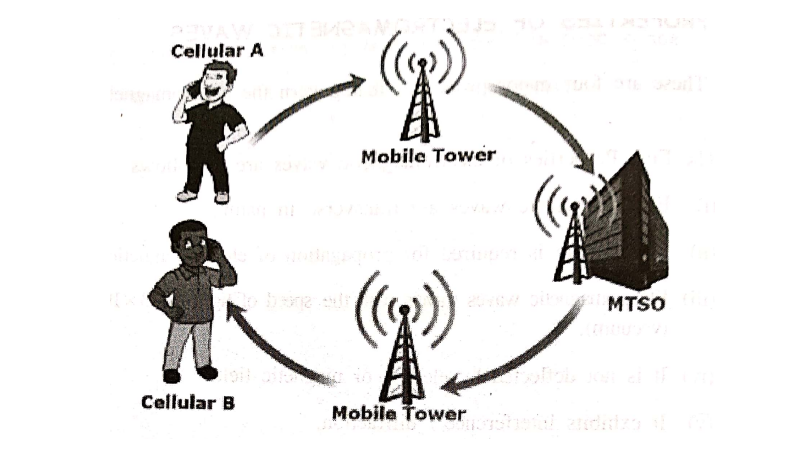
Every region of the electromagnetic spectrum has numerous applications in our regular life.
CELL
PHONE RECEPTION
Every
region of the electromagnetic spectrum has numerous applications in our regular
life. One of the important application is cell phone communication. The
communication from one cell phone to another cell phone is done through radio
waves.
Transmission & Reception unit
Cell
phone is a two‒way communicating radio, consisting of a radio wave transmitter
and a radio wave receiver. Cell phones contain at least one radio antenna in
order to transmit (or) receive radio signals.
Cell
phone antenna is a metallic element (such as copper) engineered to be an
effective size and shape for transmitting and receiving definite frequencies of
radio waves.
When
an antenna converts an electric signal into radio waves then it act as a
transmitter and when it converts the radio waves into an electric signal, then
it act as a receiver.
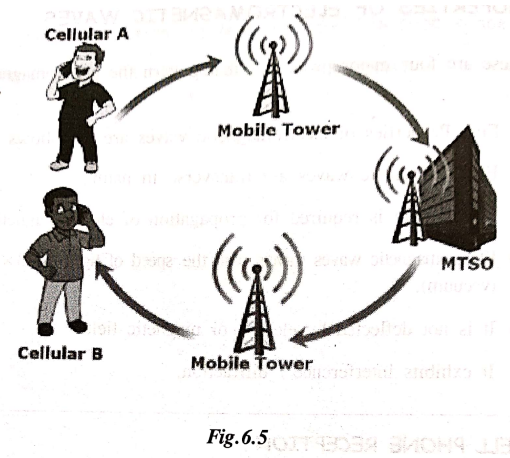
Reception mechanism
When
we make call on cell phone (Cellular A), it converts input voice into an
electrical signal, which is then transmitted via radio waves to the nearest
mobile tower as shown in Fig. 6.5.
Radio
waves transport digitized voice or data in the form of oscillating electric and
magnetic fields (Electromagnetic wave). Cell phones transmit radio waves in all
directions and it carries the information and travel with speed of light in
air.
The
network of mobile towers then relays the radio wave to destination tower via
Mobile Telephone Switching Office (MTSO) and inturn to the other cell phone
(cellular‒B), there in the electrical signal is converted back to sound again.
Modern
cell phones additionally consists of Wi‒Fi, Bluetooth and GPS antennas for different
purpose of usage.
Applied Physics I: Chapter 6: Oscillations and Waves - Electromagnetic Waves : Tag: Applied Physics : - Cell Phone Reception
Applied Physics I: Chapter 6: Oscillations and Waves - Electromagnetic Waves
Under Subject
Applied Physics I
PH25C01 1st Semester | 2025 Regulation | 1st Semester 2025 Regulation
Related Subjects

English Essentials I
EN25C01 1st Semester | 2025 Regulation | 1st Semester 2025 Regulation

தமிழர் மரபு - Heritage of Tamils
UC25H01 1st Semester | 2025 Regulation | 1st Semester 2025 Regulation
Applied Calculus
MA25C01 Maths 1 M1 - 1st Semester | 2025 Regulation | 1st Semester 2025 Regulation
Applied Physics I
PH25C01 1st Semester | 2025 Regulation | 1st Semester 2025 Regulation

Applied Chemistry I
CY25C01 1st Semester | 2025 Regulation | 1st Semester 2025 Regulation
Makerspace
ME25C04 1st Semester | 2025 Regulation | 1st Semester 2025 Regulation
Computer Programming C
CS25C01 1st Semester | 2025 Regulation | 1st Semester 2025 Regulation
Computer Programming Python
CS25C02 1st Semester | 2025 Regulation | 1st Semester 2025 Regulation
Fundamentals of Electrical and Electronics Engineering
EE25C03 1st Semester | 2025 Regulation | 1st Semester 2025 Regulation
Introduction to Mechanical Engineering
ME25C03 1st Semester | 2025 Regulation | 1st Semester 2025 Regulation

Introduction to Civil Engineering
CE25C01 1st Semester Civil Department | 2025 Regulation | 1st Semester 2025 Regulation
Essentials of Computing
CS25C03 1st Semester - AID CSE IT Department | 2025 Regulation | 1st Semester 2025 Regulation

Applied Physics I Laboratory
PH25C01 1st Semester practical Laboratory Manual | 2025 Regulation | 1st Semester Laboratory 2025 Regulation

Applied Chemistry I Laboratory
CY25C01 1st Semester practical Laboratory Manual | 2025 Regulation | 1st Semester Laboratory 2025 Regulation

Computer Programming C Laboratory
CS25C01 1st Semester practical Laboratory Manual | 2025 Regulation | 1st Semester Laboratory 2025 Regulation

Computer Programming Python Laboratory
CS25C02 1st Semester practical Laboratory Manual | 2025 Regulation | 1st Semester Laboratory 2025 Regulation
Engineering Drawing
ME25C01 EEE Mech Dept | 2025 Regulation | 2nd Semester 2025 Regulation

Basic Electronics and Electrical Engineering
EE25C04 1st Semester ECE Dept | 2025 Regulation | 2nd Semester 2025 Regulation