Data Structures using C PlusPlus: Chapter 5: Linked Lists
Other Linked List Operations
In this section we will discuss various operations that can be performed on the linked list.
Other
Linked List Operations
•
In this section we will discuss various operations that can be performed on the
linked list. For the sake of convenience we will discuss only functions
performing these operations assuming that the list is already created. The create() and display() functions will be common to all these operations.
Example : 1
Write a C++ code for
counting number of nodes in a singly linked list.
Solution :
void sll::count()
{
node *temp;
int c=0;
temp = head;
if(temp = = NULL)
{
cout<<"\n
The list is empty";
return;
}
while(templ=NULL)/*visiting each node*/
{
c = c+1;/*c is for
counting the node*/
temp = temp‒>next;
}
cout<<"\nThe Total number of nodes are:
"<<c;
getch();
}
Example : 2
Write a C++ code for
reversing the linked list (This is done using three pointers).
Solution :
void sll::reverse ()
{
node *temp1, *temp2, *temp3;
temp1= head;
if(temp1= =NULL)
{
cout<<"\n
The List is empty";
getch();
}
else
{
temp2=NULL;
while(temp1!= NULL)
{
temp3=temp2;
temp2=temp1;
temp1=temp1‒>next;
temp2‒>next=temp3;
}
head=temp2;
}
cout<<"\n The List is REVERSED";
}
For example
Consider
a linked list ‒

Step 1:
As
given in above algorithm initially
temp1
= head
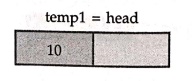
temp2
= temp3 = NULL;
Step 2:
temp3
= NULL
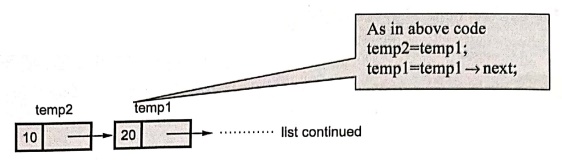
//As in above code
//temp2=temp1;
//temp1=templ→ next;
……….list
continued
Step 3:
For
the statements
temp3=temp2;
temp2=temp1;
temp1=temp1‒>next;
we
get the marking of nodes as ‒

Step 4:
As
temp2‒>next=temp3
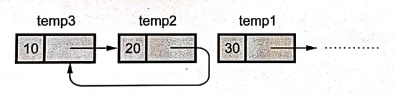
Step 5:
temp3= temp2;
temp2= temp1;
temp1= temp1‒>next;
temp2‒>next = temp3;
will
give us ‒
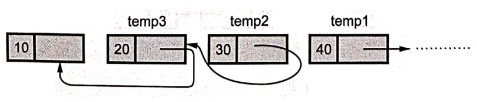
Step 6 :
Continuing
the steps
temp3=temp2;
temp2=temp1;
temp1=temp1‒>next;
temp2‒>next=temp3;
We
get ‒

Step 7 :
Finally
set temp2 as head node. Hence the list becomes

Thus
the linked list gets reverse using three pointers
Example : 3
Write a C++ code for
concatenation of two linked list.
Solution
:
void sll:concat(node *head1,node *head2)
{
node *temp1,*temp2;
temp1= head1;
temp2 = head2;
while(temp1‒>next!= NULL)
temp1=temp1‒>next;/*searching end of first list*/
temp1‒>next=temp2;/*attaching head of the second list*/
cout<<"\n The concatenated list is ...\n";
temp1=head1;
while(temp1!= NULL)
{/*printing the concatenated list*/
cout<<"
"<<temp1‒>Data;
temp1=templ‒>next;
}
}
Example : 4
Write a C++ code to
copy one singly list to another.
Solution :
void sll::copy(node *head1,node *head2)
{
node *temp1,*temp2;
temp1=head1;/*first non empty linked list*/
head2=(node *)malloc(sizeof(node));
temp2=head2;/*second empty linked list*/
while(temp11=NULL)/*while not end of first linked list*/
{
temp2‒>data=temp1‒>data;/*copy
the content to other node*/
temp2‒>next=(node
*)malloc(sizeof(node));
temp2 = temp2‒>next;/*
moving one node ahead */
temp1=temp1‒>next;
}
temp2=NULL;/*set the next pointer of last node of second list to
NULL*/
cout<<"\n The list is copied \n";
while(head2‒>next!= NULL)
{
/*printing the
second list i.e. copied list*/
cout<<"
"<<head2‒>data;
head2 = head2‒>next;
}
}
Example : 5
Write a C++ code to
recursive routine to erase a linked list (delete all node from the linked
list).
Solution :
node sll::*list_free(struct node *temp)
{
if(temp‒>next!= NULL)
{
temp1=temp‒>next;/*temp1
is declared globally*/
temp‒>next=NULL;
delete temp;
list_free(temp1);/*recursive
call*/
}
temp=NULL;
return temp;
}
Example : 6
Write a program in C++
to return the position of an element X in a list L.
Solution:
The
routine is as given below ‒
Return_position(node *head,int key)
{
/* head represents
the starting node of the List*/
/* key represents
the element X in the list*/
int count=0;
node *temp;
temp = head;
while(temp‒>data!
= key)&&(temp!= NULL)
{
temp=temp‒>next;
count = count+1;
}
if(temp‒>data= =key)
return count;
else if(temp= =
NULL)
return ‒1; /* ‒1
indicates that the element X is not present in the list*/
}
Example : 7
Write an algorithm to
perform each of the following operations
i) Reverse a list so
that the last element comes first and so on.
ii) Return the sum of
integers in a list.
iii) Delete every third
element from a list.
Solution:
i) Refer example 2.
ii)
void sum(node *head)
{
node *temp;
int sum=0;
temp = head;
while(temp!= NULL)
{
sum = sum+temp‒>data;
temp = temp‒>next;
}
cout<<"\n Sum of all the integers in a list is:
"<<sum;
}
iii)
void Delete _Third_ Node(node *head)
{
node *temp;
node *key;
int n=0;
while(temp!=NULL)
{
temp = temp‒>next;
n++://denotes total
number of nodes
}
int count=1;
temp=head;
while(count<=n)
{
key=temp‒>next‒>next;
temp‒>next‒>next=key‒>next;
temp=key‒>next;
key‒>next=NULL;
delete key;
count=count +3;
}
}
Example : 8
Write a C++ code to sum
up all odd numbers in a single linked list
Solution:
The
C++ code will be as follows ‒
void OddSum(node * head)
{
node *temp;
int sum;
temp = head;
sum=0;
while(temp!= NULL)
{
if((temp‒>data)%2=
=0)
temp=temp‒>next;
else
sum=sum+temp‒>data; // odd number in 'temp' node
}
cout<<"\n Sum of odd numbers: "<<sum;
}
Data Structures using C PlusPlus: Chapter 5: Linked Lists : Tag: Data Structure, C++ Programing : - Other Linked List Operations
Data Structures using C PlusPlus: Chapter 5: Linked Lists
Under Subject
Data Structures using CPlusPlus
CS25C05 2nd Semester ECE Dept | 2025 Regulation | 2nd Semester 2025 Regulation
Related Subjects

English Essentials II
EN25C02 2nd Semester | 2025 Regulation | 2nd Semester 2025 Regulation

Tamils and Technology தமிழர்களும் தொழில்நுட்பமும்
UC25H02 2nd Semester | 2025 Regulation | 2nd Semester 2025 Regulation
Linear Algebra
MA25C02 2nd Semester | 2025 Regulation

Electron Devices
EC25C01 2nd Semester ECE Dept | 2025 Regulation | 2nd Semester 2025 Regulation
Data Structures using CPlusPlus
CS25C05 2nd Semester ECE Dept | 2025 Regulation | 2nd Semester 2025 Regulation

Circuits and Network Analysis
EC25C02 2nd Semester ECE Dept | 2025 Regulation | 2nd Semester 2025 Regulation

Re-Engineering for Innovation
ME25C05 2nd Semester | 2025 Regulation | 2nd Semester 2025 Regulation
Engineering Drawing - Laboratory
ME25C01 2nd Semester | 2025 Regulation | 2nd Semester 2025 Regulation
Data Structures using CPlusPlus - Laboratory
CS25C05 2nd Semester ECE Dept | 2025 Regulation | 2nd Semester 2025 Regulation
Devices and Circuits Laboratory
EC25C03 2nd Semester ECE Dept | 2025 Regulation | 2nd Semester 2025 Regulation