Data Structures using C PlusPlus: Chapter 5: Linked Lists
Linked Lists: Two Marks Important Questions and Answers
Data Structures using C++ Program
Data Structures using C++ Program: Chapter 5: Linked Lists: Anna University Part A Two Marks Important Questions and Answers
Data Structures using C++ Program
Chapter 5: Linked Lists
Two Marks
Questions with Answers
1. Differentiate
between arrays and linked list.
Answer:
In arrays any element can be accessed randomly
with the help of index of array, whereas in lists any element can be accessed
by sequential access only.
Insertions
and deletions of data is difficult in arrays on the other hand insertion and
deletion of data is easy in lists.
2. State the advantages of circular list over
doubly linked list.
Answer:
In
circular list the next pointer of last node points to head node, whereas in
doubly linked list each node has two
pointers: One previous pointer
and another is next pointer. The
main advantage of circular list over
doubly linked list is that with the help of single pointer field we can access
head node quickly. Also some amount of memory get saved because in circular
list only one pointer field is reserved.
3. What
is a linked list ?
Ans :
A
linked list is a set of nodes where each node has two fields 'data' and 'link'.
The data field is used to store actual piece of information and link field is
used to store address of next node.
4. What
is the advantage of doubly linked list over a singly linked list ?
Answer:
The doubly linked list has two pointer fields.
One field is previous link field and another is next link field.
Because
of these two pointer fields we can access any node efficiently whereas in
singly linked list only one pointer field is there which stores forward
pointer, which makes accessing of any node difficult one.
5. Why is
linked list used for polynomial arithmetic ?
Answer:
Following
are the reasons for which linked list is used for polynomial arithmetic ‒
i)
We can have separate coefficient and exponent fields for representing each term
of polynomial. Hence there is no limit for exponent. We can have any number as
an exponent.
ii)
The arithmetic operation on any polynomial of arbitrary length is possible
using linked list.
6. Explain
the term dynamic memory.
Answer:
The
dynamic memory allocation means one can allocate the memory of required size,
as well as de allocate (free) it. So that freed memory can be utilized further.
Also the memory can be reallocated.
7. Represent
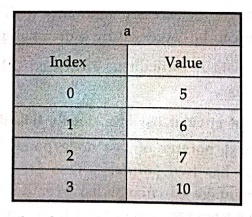
the polynomial 10x3 + 7x2 + 6x + 5 with the help of
array.
Answer:
For
single dimensional array the polynomial can be arranged like this.
The
index acts like a exponent and value acts as a coefficient of the term. Let us
take array a[5]
8. Define
sentinel nodes, header node and tail node.
Ans. :
• In some implementations an extra 'sentinel'
or 'dummy' node may be added before the first data record or after the last
one. This node is called as sentinel node. This type of node does not hold or
reference any data managed by the data structure.
•
The head node is the starting node of the linked list.
•
The tail node is the terminating or the last node of the linked list.
9. List
the applications of linked list.
Answer:
Various
applications of linked list are:
1.
Linked list can be used to implement linear data structures such as stacks and
qeues.
2.
Linked list is useful for implementing the non‒linear data structures.
3.
Linked list.
4.
Polynomial representation, and operations such as addition, multiplication and
evaluation can be performed using linked list.
10. Write
a procedure to insert an element in the beginning of a list ADT implemented using
a singly linked list.
•
There are three possible cases when we want to insert an element in the linked
list ‒
a)
Insertion of a node as a head node
b)
Insertion of a node as a last node
c)
Insertion of a node after some node.
We
will see the case
a)
first ‒
void sll:: insert head()
{
node *New,*temp;
New new node;
cout<<"\n
Enter The element which you want to insert";
cin>>New‒>data;
// There is
no node in the linked list. That means the linked list is empty
if(head= NULL)
head=New;
else
{
temp=head;
New‒>next = temp;
head=New;
}
}
If
there is no node in the linked list then value of head is NULL. At that time if
we want to insert 10 then
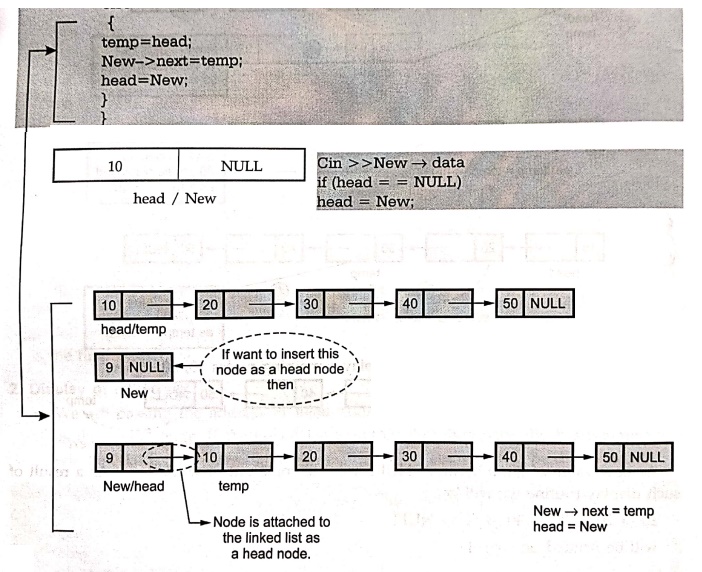
Data Structures using C PlusPlus: Chapter 5: Linked Lists : Tag: Data Structure, C++ Programing : Data Structures using C++ Program - Linked Lists: Two Marks Important Questions and Answers
Data Structures using C PlusPlus: Chapter 5: Linked Lists
Under Subject
Data Structures using CPlusPlus
CS25C05 2nd Semester ECE Dept | 2025 Regulation | 2nd Semester 2025 Regulation
Related Subjects

English Essentials II
EN25C02 2nd Semester | 2025 Regulation | 2nd Semester 2025 Regulation

Tamils and Technology தமிழர்களும் தொழில்நுட்பமும்
UC25H02 2nd Semester | 2025 Regulation | 2nd Semester 2025 Regulation
Linear Algebra
MA25C02 2nd Semester | 2025 Regulation

Electron Devices
EC25C01 2nd Semester ECE Dept | 2025 Regulation | 2nd Semester 2025 Regulation
Data Structures using CPlusPlus
CS25C05 2nd Semester ECE Dept | 2025 Regulation | 2nd Semester 2025 Regulation

Circuits and Network Analysis
EC25C02 2nd Semester ECE Dept | 2025 Regulation | 2nd Semester 2025 Regulation

Re-Engineering for Innovation
ME25C05 2nd Semester | 2025 Regulation | 2nd Semester 2025 Regulation
Engineering Drawing - Laboratory
ME25C01 2nd Semester | 2025 Regulation | 2nd Semester 2025 Regulation
Data Structures using CPlusPlus - Laboratory
CS25C05 2nd Semester ECE Dept | 2025 Regulation | 2nd Semester 2025 Regulation
Devices and Circuits Laboratory
EC25C03 2nd Semester ECE Dept | 2025 Regulation | 2nd Semester 2025 Regulation